 Jordan Pascale
Gov. Larry Hogan signed a bill today that should give Marylanders a break at the gas pump. Effective immediately, there will be a 30-day gas tax holiday.
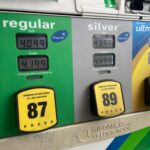
Maryland is now among the first states to help address rising gas costs, which are averaging about $4.20 a gallon in the state. Virginia is also exploring the idea of a three-month holiday, though Democrats there are less warm to the idea.
But the way the gas tax is levied is somewhat convoluted and the reduced price isn’t guaranteed to be passed on to the consumer.
So how does a gas tax holiday work? Here’s what you need to know.
Gas taxes are not sales taxes
Maryland has the eighth highest gas tax in the country — about 36-cents a gallon for regular fuel and 37 cents for diesel.
This tax is an excise tax, and it is paid by gas stations when they purchase fuel from wholesalers. So it’s not as easy or straightforward as a sales tax, which consumers pay at the pump.
Gas stations may have already paid the gas tax on shipments of fuel, so Maryland’s Comptroller office is telling gas station operators to note how full their tanks are when the holiday begins. They’ll get reimbursed for the tax already paid on the gas they purchased but haven’t yet sold. That tactic is called a “reverse price floor.”
Will prices immediately drop 36 cents?
Not necessarily. A lot of it depends on the honor system and market forces.
Officials expect and have told gas station owners to do the right thing and lower the price for consumers as the state has lowered the cost for gas station operators. The bill says the tax reduction “shall be reflected in sales to consumers.” But the state doesn’t have enough inspectors to make sure all 2,300 gas stations in the state are following the law.
That being said, officials expect gas stations to remain competitive, so you likely won’t see one gas station with $4.20 gas across the street from gas that’s $3.83. No one would go to the gas station that’s $4.20 a gallon.
And gas prices are constantly changing. Unlike some states, Maryland doesn’t have a law that restricts price changes to just once a day.
Market forces have driven gas prices about 75 cents per gallon higher over the past month, correlated with the soaring cost of crude oil. But crude prices have come down in recent days, so prices should come down accordingly. It’s hard to predict exactly what drivers will be paying at the pump.
What will prices look like on the D.C.-Maryland border?
This may be the most fascinating aspect of all. D.C. charges 29 cents a gallon for the gas tax, but often you see similar prices directly across the border despite the differing gas tax.
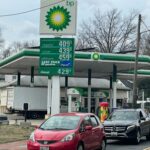
For instance, at the top of the diamond-shaped border of D.C., you can find prices for $4.28 and $4.23. Just across the border in Silver Spring, it’s $4.29 and $4.39. Gas pricing has a number of factors including crude oil prices, supply and demand, station location, scarcity of nearby stations, and more. So it’s unclear if we’ll see dramatically different pricing across the border.
The holiday is expected to last until April 16
Maryland’s gas tax holiday is in effect for a 30-day window, ending at 11:59 on April 16th. Some wanted the gas tax holiday to stretch longer or have a clause that would allow an extension, but that did not make it into the bill.
Why do a gas tax and not try other ideas?
Lawmakers see it as a direct way in their control to help consumers.
Todd Eberly, a political science professor at St. Mary’s College of Maryland, told the Baltimore Sun that the gesture is likely bigger than the savings.
“It’s not much, but it’s an indication that they’ve tried to do something,” he said, “That often scores more points than people may think.”
In reality, the gas tax isn’t saving that much money. Even if you fueled up a 15-gallon tank every week for the month, you’d only save $22.20, and that’s the best-case scenario.
Critics say a gas tax holiday could also hurt transportation funding. Maryland officials say the $100 million expected hit will be covered by the state’s $7 billion surplus. Other critics say public officials should encourage or even pay people to use public transit, biking, or other alternatives.
In California, the governor is proposing a $400 tax rebate that helps everyone with rising costs, instead of just offering breaks to drivers. The rebate would essentially cover the state’s 51 cents per gallon gas tax for a year’s worth of fuel for a vehicle with a 15-gallon tank. And that rebate goes to every taxpayer–including those who take public transit or have electric vehicles.
This story has been updated to reflect that Hogan signed the bill.