Héctor Alejandro Arzate
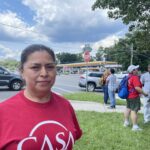
Nearly every day Auora Gámez, 48, walks from her home in Falls Church, Virginia, to the Culmore Shopping Center just off Leesburg Pike. She says it takes about 15 minutes on foot to get to her job at a laundromat inside the strip mall. Although the walk is relatively short, each trip Gámez worries about her safety.
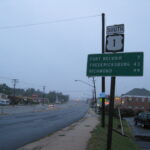
“It’s very dangerous in this area,” said Gámez, who’s lived in the neighborhood since immigrating from Honduras 20 years ago. The road can get up to six lanes wide and often drivers speed down the stretch. Meanwhile, the blocks are long with pedestrian crosswalks available only every quarter to a third of a mile or so.
In December, a driver struck and killed a 68-year-old woman, Nguyet Ly, while she was walking on the 5900 block of Leesburg Pike near a gas station. According to a report from the Fairfax County Police Department, Ly was walking near the shoulder of the road because there was no sidewalk available.
CASA, a local immigrant advocacy group (formerly known as the Central American Solidarity Association of Maryland), and the Coalition for Smarter Growth have launched a joint campaign to call on officials to improve the road’s safety. The two groups say that accidents are common due to the area’s limited sidewalks, lack of pedestrian crossing signage, and high driving speeds. They also say immigrant pedestrians are disproportionately affected by the road’s hazardous conditions.

Leesburg Pike – the road where Ly was hit – is not just a busy corridor. It’s bounded by many immigrant-owned and frequented restaurants, storefronts, and neighborhoods. And according to Gámez, it’s also common to see children and teens walking through, because of the proximity to Bailey’s Elementary School, Glen Forest Elementary School, and Justice High School.
“Many mothers who walk with their children endanger themselves just to cross the street,” said Gámez, who has a 17-year-old son.
The laundromat where Gámez works is right across the road from where Ly was killed. She says the trek that led to her death is all too familiar, and that people who live in the area have to traverse the busy road to get to businesses that they frequent as part of their day-to-day life.
“Every day is a worry,” said Gámez. “To catch the bus. To go to the laundromat. To go shopping. To go to church.”
According to data collected by the Virginia Department of Transportation, there were eight pedestrian-related crashes on both the east and westbound lanes of Leesburg Pike that resulted in visible, severe, or fatal injuries in 2021. Of those eight, two crashes were fatal, including Ly’s. Since 2015, there have been at least four fatal crashes that occurred within a half-mile section of the road.
Sonya Breehey, the Northern Virginia Advocacy Manager for CSG, says that the lengthy process of researching, funding, and building any long-term solutions – such as a road redesign – will take time. Still, she says simply reducing the speed limit, which is currently 40 mph, could lead to immediate improvements. She also says installing refuge medians and HAWK signals (which stand for High-Intensity Activated crossWalK beacon. It allows pedestrians to activate a flashing beacon alerting drivers to their crossing) would make it safer for pedestrians to cross the road.
“We really need to design this street to be safer for all users, not just the people driving,” said Breehey. “We hope to get some of these improvements, the near term ones, and then really start planning for the longer term.”
Marilyn Figueroa, a community organizer with CASA, says that the effort to make Leesburg Pike safer will require help from everyone, including people who drive on the road. As part of their campaign to raise awareness and improve the road, CASA and CSG launched a canvassing event last week to gather feedback from community members in the area.
“Bicyclists, pedestrians, and drivers,” said Figueroa. “We’re thinking about everyone because each runs a different risk. That’s why we went into the community. To listen to everyone’s concerns.”
https://twitter.com/CASAforall/status/1503804458161127429
For their part, VDOT says they have been working with Fairfax County and representatives from local advocacy groups to make the road safer. A spokesperson from the regional district for VDOT told DCist/WAMU that it’s developing plans that would help with the construction of missing sidewalks. They’re also evaluating the use of HAWK signals and collecting data for a study that could lead to reduced speed limits.
“We are currently on the first step, which is evaluating the feasibility of potential improvements,” said the representative. “Once VDOT and Fairfax County select which improvements to implement, the two agencies will coordinate to identify potential funding and possible phasing needs.”
According to Breehey, despite the steps being taken by advocates and VDOT, it’s ultimately up to elected officials to fund the changes that could prevent accidents and save lives.
“We can study it but at the end of the day, even when we determine the best improvements that’ll help, it’s our elected officials in Fairfax County that will provide the funding,” said Breehey. “We need to get Fairfax County leaders to really push to make those happen and to find the funding so we can get the improvements needed faster.”
For Gámez, change can’t come soon enough. She says the county needs to work quickly in order to prevent the next accident.
“Nothing has changed,” said Gámez. “We’re asking for help, and we need it fast because there have been too many deaths in this area.”