Amanda Michelle Gomez
 Margaret Barthel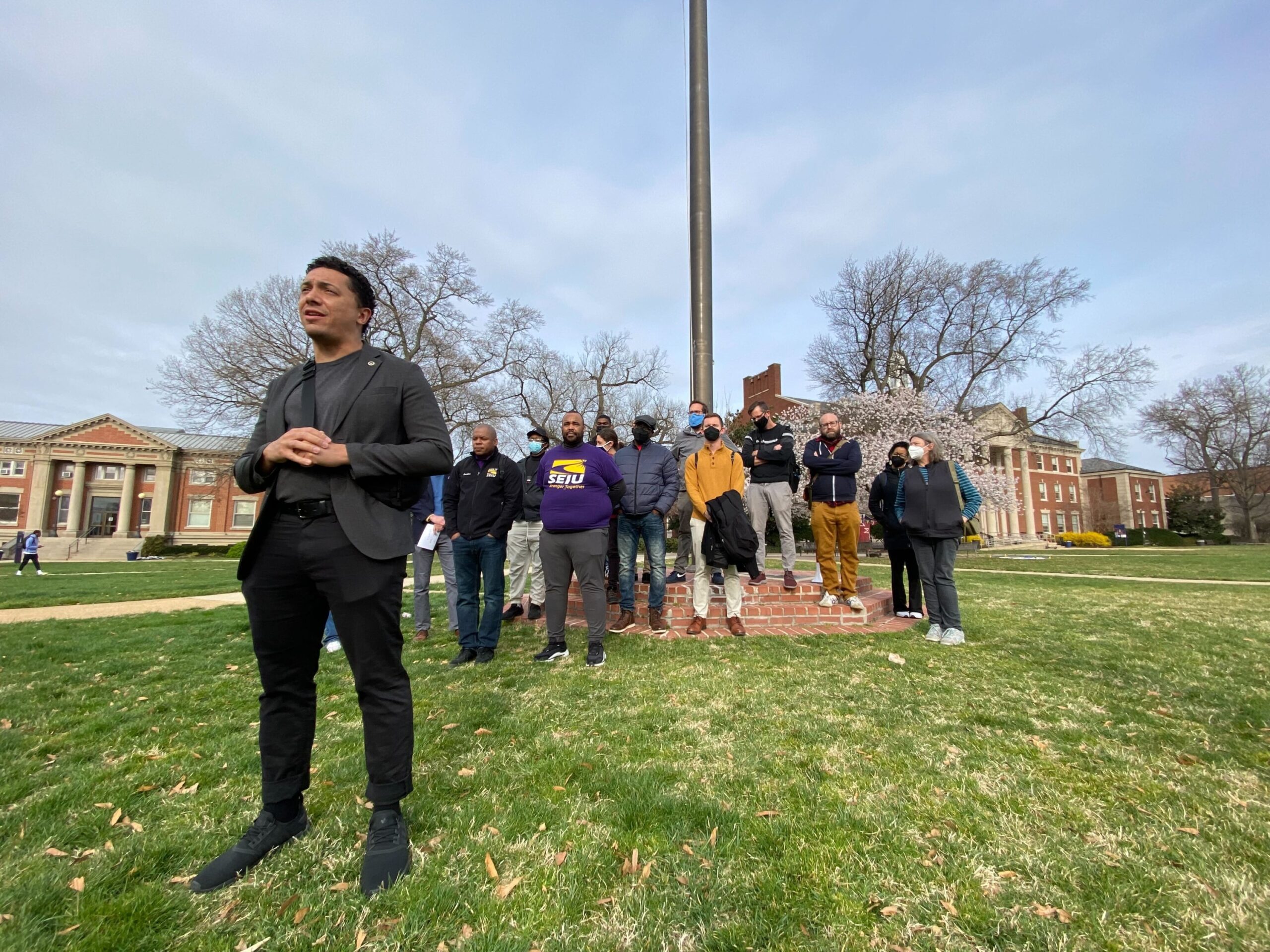
Non-tenured faculty at Howard University reached a tentative contract agreement with the school in the early hours of Wednesday morning, averting a strike planned for this week.
A small crowd of faculty, negotiators, and supportive students gathered at the flagpole near the center of campus to celebrate the news later in the morning. The mood was tired — negotiators had been at the table until 3:30 am — but upbeat.
“I really want to applaud my colleagues for what they were able to achieve by standing up for themselves, standing up to make this a better job site, to make this a better teaching place and make this a better site of education, and a better institution of higher learning,” said English senior lecturer Cyrus Hampton.
Details about what is actually two separate agreements — one for non-tenured full-time faculty and one for part-time adjuncts — were not immediately available, but union representatives said they believed both contracts would be fair. Union members first need to read the collective bargaining agreements, which are expected to be made public next week.
The two proposed three-year contracts will have to be ratified by a vote of the union membership and approved by Howard University President Wayne A.I. Frederick.
The faculty union twitter account called the agreement between the union and the university a “historic achievement for improving the lives of teaching faculty, and strengthening the Howard community as a whole.”
The agreement was a long time coming. The 350 unionized lecturers — 150 who teach full-time, and 200 who are part-time adjuncts — have been at the bargaining table with the university for almost four years, far longer than negotiations usually take, particularly in the case of full-time staff. Their union, SEIU Local 500, accused the university of bargaining in bad faith and refusing to provide information in filings with the National Labor Relations Board.
Howard University has consistently denied the allegations that it has stonewalled the collective bargaining process. In a statement on the tentative agreement with the union, the university said it was committed to negotiating in good faith.
“We have stood firm in our commitment to respect the bargaining process that our union-faculty are entitled to, and it is in the spirit of that commitment that our leaders remained in hours-long negotiations until an agreement was reached,” the university said in a statement. “Our contingent faculty are a respected part of our institution.”
Organizers say they believe the threat of a strike, as well as solidarity from the rest of the Howard community, prompted the two sides to finally find common ground.
“Just the mass swelling of support over the last two weeks has been instrumental,” said English instructor Kevin Modestino, a union member who was part of the negotiations. “I think we showed that we are essential parts of Howard University, that we aren’t just temporary faculty in the sub basement, but have been here for a long time and will be here for a long time.”
Securing a living wage has long been one of the central concerns of non-tenured faculty at Howard. Full-time lecturers at the school make less than $50,000 per year on average, according to 2018-2019 school year data from the Chronicle of Higher Education — in D.C., where the cost of living is steep. The union is also pushing to increase the pay for part-time adjuncts, which is currently just $4,000 per class, far lower than the rate their full-time counterparts make.
A union representative, who spoke to the press on background, said the new agreement “dramatically” closed that gap, but added there was still work to be done. The representative also said the contract represented “progress” in the faculty push to offer preference to adjunct faculty when full-time opportunities open up.
Job security was another major concern for the union. Currently, full-time non-tenure-track lecturers are forced to reapply every year for their jobs, and the university ends their full-time status after seven years, forcing some to become part-time. Modestino said the union made “significant progress at opening up career path status,” but didn’t elaborate on the specifics.
Howard students celebrated alongside their teachers on Wednesday.
“I think it’s exciting and really shocking to see the administration come so far in just these past few days,” said sophomore Tia-Andrea Scott. “With other student movements, we’ve seen a lot of pushback and a lot of gaslighting from the administration.”
Scott said many students had planned to not attend class if the faculty strike had moved forward, saying doing so would constitute crossing a picket line. Howard University had prepared other faculty to lead the classes of striking members.
Last year Howard students, including Scott, staged their own protest on a different issue. They occupied the Blackburn Student Center building and the surrounding area to demand the administration fix poor conditions in its dorms. Non-tenured faculty said the students’ stand, which lasted roughly 35 days, partly inspired their plans to strike.
“If there’s anything I know about Howard University students and faculty, it’s that there will always be a movement for something better,” Scott said.