 Jordan Pascale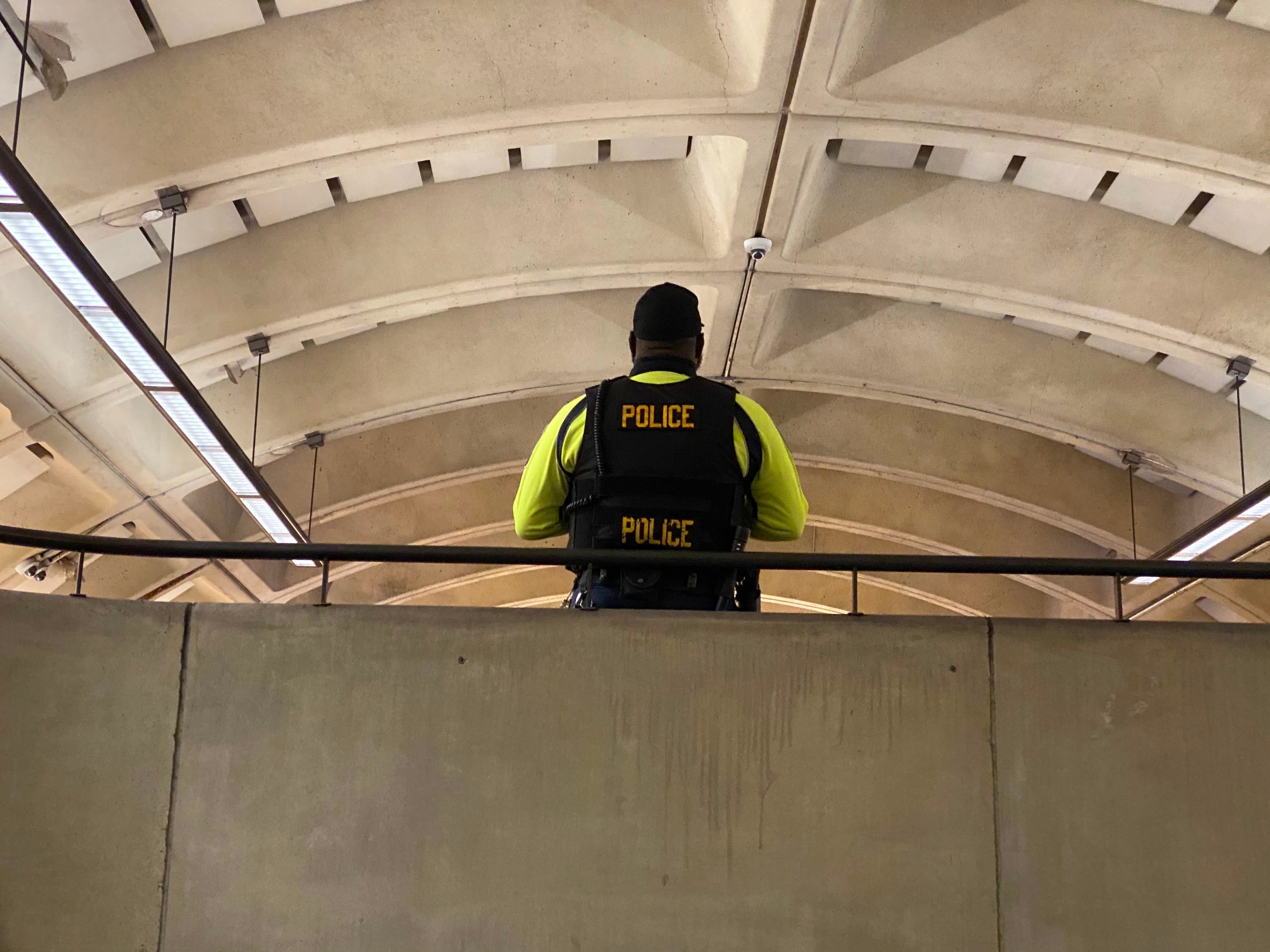
The Metro Transit Police Department (MTPD) says they are increasing their visibility on trains, buses, and in stations to help deter crime.
MTPD will hang its latest campaign on education, outreach, and enforcement and focus on the underlying issues that may lead to crime, according to new MTPD Chief Michael Anzallo.
Plainclothes and uniformed officers will increase patrols in a rotating list of high crime areas to “reassure riders and discourage criminal activity.” Meanwhile, the force has established a community service bureau that will work with schools, neighborhood groups, and mental health advocates to help address the root causes of crime. Police will also launch another anti-harassment campaign and put QR codes on station signs, trains, and buses to reach MTPD’s text tip number.
Crime has not spiked on Metro recently, but it certainly has not dropped at the same proportion that ridership has.
Aggravated assaults are one of the few crimes that increased during the pandemic, rising 40% compared to pre-pandemic times. There were 183 assaults in 2021 — a five-year high. Anzallo said 63% of those assaults are attributed to people that displayed a weapon or told victims they had a weapon, but didn’t actually carry out a physical attack.
Mental health calls are also up 67% compared to pre-pandemic.
WMATA, however, has not had a high-profile mass shooting or murder (a woman was pushed in front of a train) as they have had in New York. It also hasn’t had a noticeably higher crime rate like some other major cities.
Still, there is a general apprehension about returning to transit. Crime is one of the top concerns for riders, Metro says.
“While crime is a community and regional concern, customers should feel safe on Metro, and that means using every tool at our disposal including investing in the community and partnering with local resources for essential services,” General Manager Paul Wiedefeld said in a statement.
Transit workers have also felt the effects of crime: a bus operator was pistol-whipped near Southern Avenue in January, and a transit police officer shot a man who lunged at him with a knife after a preceding fight in Anacostia earlier this month.
Anzallo, who was appointed in February, said he thinks the community-based approach works.
“The police can’t do it alone, as far as crime-fighting goes,” he said. “We need the community’s help, and we need their buy-in because you’ll never arrest your way out of the crime problem.
“You have to get to the root causes of crime and get other individuals involved so you can try to mitigate that.”
Some riders expressed concerns about riding on emptier trains. Ridership is still only about 40% of pre-pandemic levels, but riders are also stuffed on fewer trains as 60% of Metro’s fleet is sidelined because of wheel issues. (Train frequency is another top concern of riders — some are waiting 20 minutes for a train).
Anzallo said people’s perception of crime has traditionally been a problem for law enforcement.
“(Riders) encounter different things, and they see different things and sometimes it may not necessarily be a dangerous situation, but they see some sort of disorder that causes them to fear that maybe a crime may occur,” he said. “And that’s something that, you know, we tried to battle against and make people feel safe, you know, while riding the system.”
Transit police have 490 sworn officers, 101 special security officers, and 50 contract officers. There are 91 Metro stations, dozens of bus lines, and hundreds of bus stops throughout the region.
MTPD would not provide a list of specific lines or stations. It did say it would also focus on major bus hubs.
WMATA is not heavily investing in new technology to deter crime. Recently, the MTA in New York announced it was exploring safety equipment like train platform doors to prevent people from getting pushed or jumping in front of trains, and special large event type metal detectors that scan people as they go through to catch handguns and weapons. Riders would not need to empty their pockets like at an airport, but simply would walk through the checkpoint on their way into the station.
Last year, Metro’s board stopped an effort to temporarily ban repeat sex and gun offenders on the system after community pushback.
Earlier this month, a man harassed, physically intimidated, and yelled transphobic slurs at a transgender woman while she was taking a train. An MTPD boards the train and assists. The woman, Saoirse Gowan, said she was grateful for the intervention, but said there need to be alternatives to policing and incarceration. Gowan declined to press charges against her harasser because she does not believe that imprisoning transphobic people stops the violence. She hopes there can be education campaigns about how people can help de-escalate a situation like hers.
Metro says its new anti-harassment public awareness campaign that will launch next month is an extension of an ongoing effort that began in 2012 to raise awareness and combat harassment in the Metro system.