Colleen Grablick
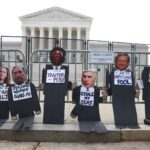
A non-scalable fence and concrete barriers have been added around the Supreme Court building this week, amid ongoing demonstrations over the future of abortion access.
Shortly after Politico published a leaked draft on Monday night of a Supreme Court opinion signaling that a majority of justices intended to overturn the landmark Roe v. Wade decision, police erected metal barricades in front of the Supreme Court steps. On Tuesday morning, U.S. Capitol Police said the force was working with other agencies to prepare for potential demonstration, and the Metropolitan Police Department activated its civil disturbance unit through Sunday.
By Wednesday evening, after two days of demonstrations, workers had begun constructing a “non-scalable,” eight-foot-tall fence around the Supreme Court building, according to NBC, similar to the fencing that surrounded the Capitol for six months following the Jan. 6 insurrection. An Associated Press image of a sign attached to the fencing reads it was ordered by the Supreme Court Marshal, but a spokesperson for SCOTUS did not return DCist/WAMU’s request for comment on the fencing, why it was installed, or how long it will last. (A spokesperson for the USCP said the agency “beefed up security” out of an abundance of caution earlier this week, but that USCP is not responsible for erecting the fence and directed DCist/WAMU to the Supreme Court Police.)
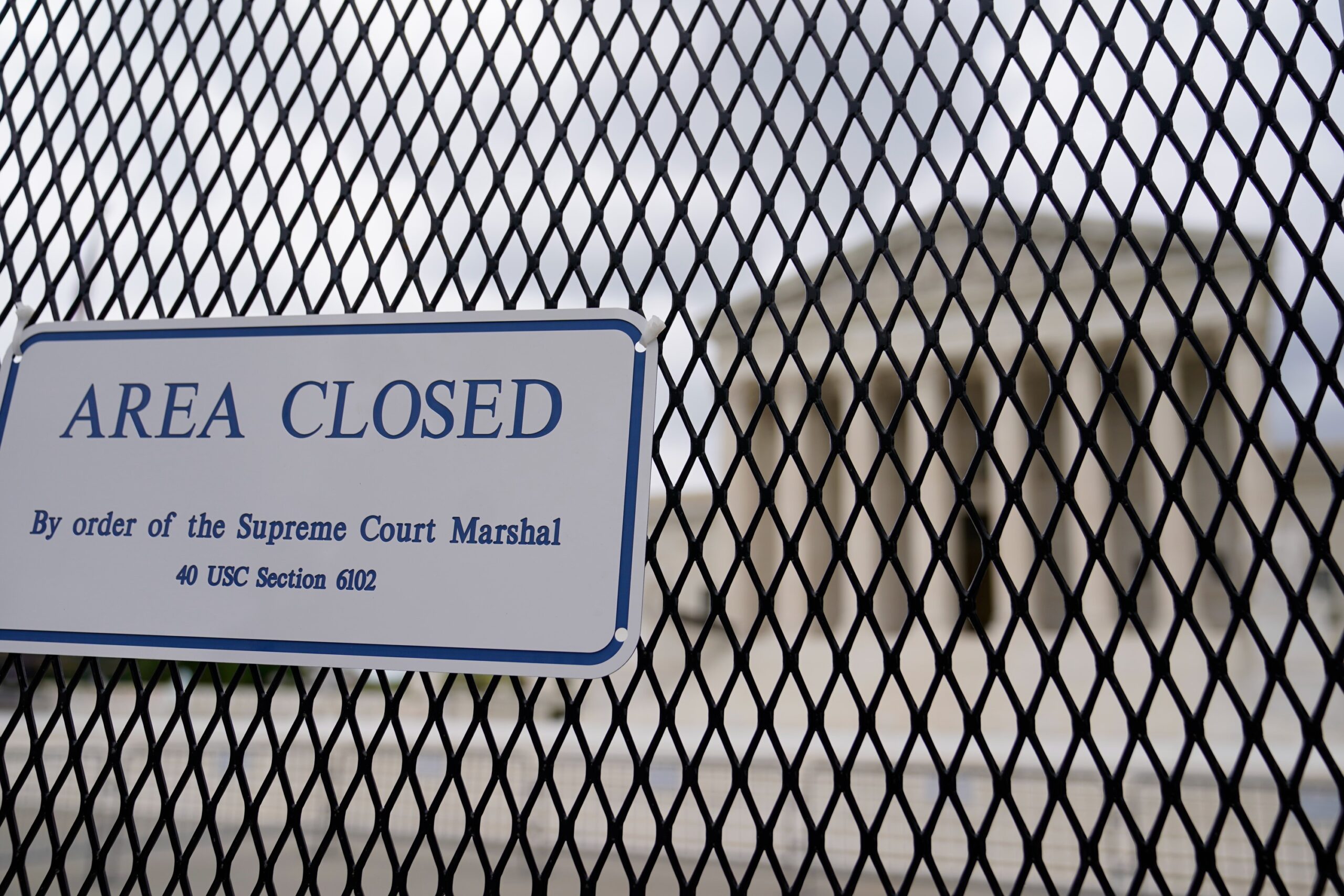
In addition to the fence, crews were also seen installing concrete barricades around the Supreme Court on Thursday afternoon, closing portions of First Street, Second Street, and East Capitol Street, according to the USCP spokesperson. The spokesperson did not confirm which agency installed in the barricades.
Despite the ominous optics of the black metal fence and concrete slabs, the demonstrations at the Supreme Court this week have been largely peaceful — prompting criticism of the fencing as perhaps more symbolic than practical. (Some pointed out an apparent hypocrisy in the Court’s protection; in 2014, the Court struck down a law that would have added a buffer zone around clinics that provide abortion services, ruling it impeded on protesters’ First Amendment rights.) And while it’s the first time in recent years this level of security has been installed around the Supreme Court, Washingtonians are now no strangers to barricades and troops in their home city.
The fence that encompassed the Capitol for six months in 2021 interrupted nearby residents’ daily lives, sparked a number of protests, and even spurred legislation from D.C. Del. Eleanor Holmes Norton, who proposed banning any permanent fencing around the Hill. A similar fence surrounded Lafayette Square Park in the months after former president Donald Trump ordered the forcible removal of protesters from the park by police in the wake of George Floyd’s murder in 2020. We’ve also seen iterations of Fence Lite in 2022 — in March, USCP briefly reinstalled a fence around the Capitol ahead of Biden’s first joint address to Congress, although it was deconstructed shortly after.
It’s unclear how long the fencing and additional security measures will last, given the little information offered from the Supreme Court’s police. Activists announced plans on Thursday to host a day of action on Saturday, May 14, of which the details are still being nailed down. It’s likely that the SCOTUS steps will see demonstrations throughout the weekend and into next week. On Friday night, Fridays for Future DC will be staging a protest in front of the Supreme Court, drawing attention to the intersections of climate justice and reproductive justice.
Previously:
If Roe Goes, What’s Next For Local Abortion Access?
How Local Abortion Funds Have Been Getting Ready For The End Of Roe