Martin Austermuhle
This will eventually make more sense, but this elections roundup was written by Martin Andres Austermuhle. With that being said, let’s get into it.
About those middle names…
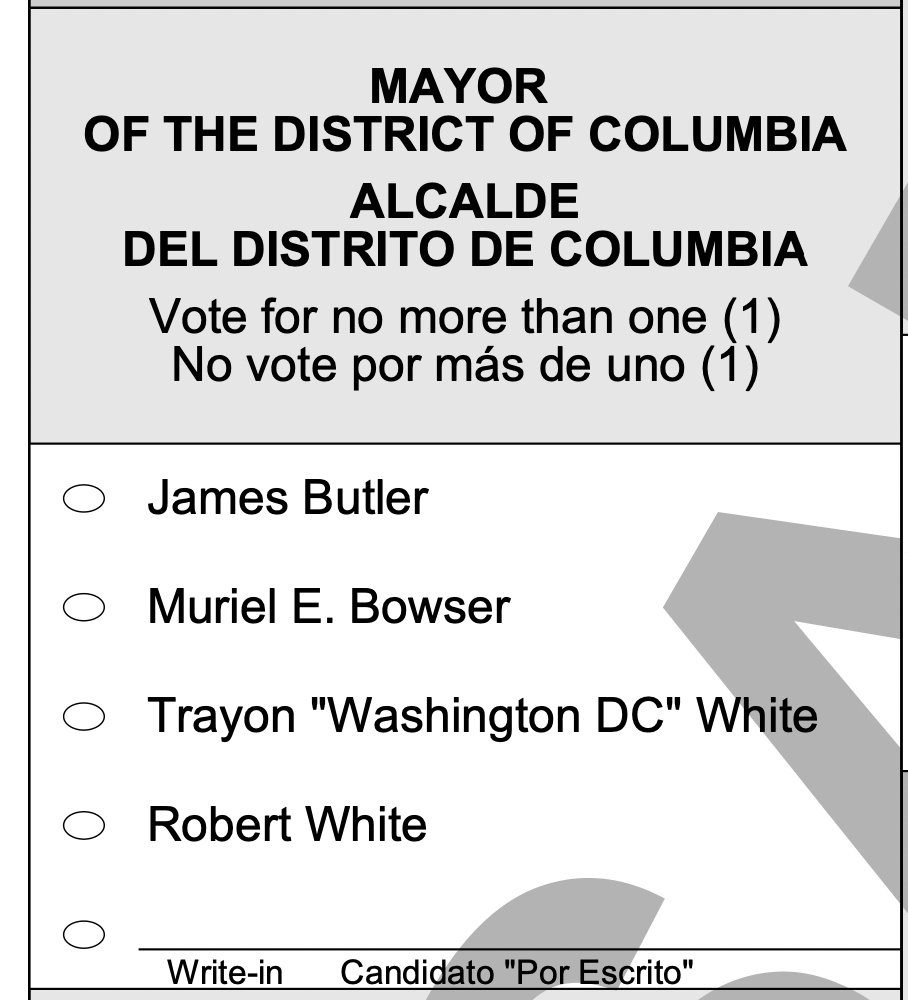
Many D.C. voters will start getting their ballots in the mail this week, and if they’re like Twitter user Josh Kramer, they’ll quickly notice something quirky with some of the candidates — unconventional middle names.
That’s especially the case with a certain D.C. Councilmember from Ward 8 whose name appears on the ballot as “Trayon ‘Washington DC’ White.” But there’s also Wendy “Hope Dealer” Hamilton running for D.C. delegate to Congress, and Gordon “The People’s Champion” Fletcher, who is running for the Ward 5 seat on the council.
No, these aren’t legal last names, and yes, the D.C. Board of Elections allows candidates to decide how their name will appear on the ballot. But why do it? As with so much in politics, it comes down to branding.
“It’s a statement of purpose first and foremost,” says Fletcher, whose legally given middle name is Lee, which comes from his father. “I just champion supporting the people of Ward 5.”
He also says it’s in easy way to stand out — especially in his race, which has seven candidates.
“You have your progressive pick, you have the establishment pick, you have somebody that’s been around for a long time, and then you have Gordon Fletcher, who is just trying to serve the people of Ward 5,” he says. “It’s catchy, people will remember it, and it will distinguish me.”
To give credit where credit is due, Trayon White may have trailblazed the practice. Back in a 2015 special election he narrowly lost, he appeared on the ballot as Trayon “WardEight” White. In a race he won a year later for the Ward 8 seat, he went with Trayon “Ward Eight” White, which he kept for his 2020 re-election bid. And in that year’s general election, White squared off against — you guessed it — Nate “Ward 8” Derenge, a Republican. (Clearly White’s chosen middle name has since evolved to match his citywide candidacy.)
Also in 2020, voters had the chance to vote for Michangelo “DoctorMic” Scruggs for an At-Large seat on the council and John “Recovery” Cheeks for D.C. delegate to Congress. Neither of them won their respective races. And we certainly can’t forget Oye “TAXFREEDC” Owolewa, who did end up winning his race for shadow representative. (He’s running for re-election this year, as the mere Oye Owolewa.)
Interestingly, D.C. isn’t much of an outlier in allowing middle names on the ballot, but it may stand apart in letting candidates basically make up those middle names. According to the National Conference of State Legislatures, Alaska allows “any nickname or familiar form of a proper name of the candidate,” while North Carolina permits “legitimate nicknames in ways that do not mislead the voter or unduly advertise the candidacy.” D.C. is clearly much more permissive, though it does not allow honorifics like “Dr.” or “Rev.” (Hamilton, for her part, is actually a reverend.)
But will the practice of made-up middle names now catch on more widely in D.C.? Who knows. But at least one current candidate is rueing a missed opportunity. “Totally should’ve done Henry ‘YIMBY’ Cohen,” tweeted the Ward 3 candidate, using the acronym for “Yes In My Backyard,” a term commonly associated with advocates of letting more housing be built in more places.
10,000 jobs and 10,000 questions
For anyone who runs for elected office, there’s probably no fear bigger than a verbal slip-up or misstatement being weaponized against them. (See McAuliffe, Terry.) And that’s somewhat been the case for mayoral candidate Robert White in recent weeks.
When White stepped to the lectern at a community garden in Ward 7 in late April, he unveiled a sweeping plan that amounted to a job guarantee for pretty much anyone who would want one. And in response to questions from reporters, White said the jobs — 10,000 in all — would largely be with the government.
It was a huge pledge, and has also become a huge headache since.
Despite protestations that he was misunderstood, White’s promise of the massive jobs program has been seized upon by Mayor Muriel Bowser, who took her first swipe during WAMU 88.5’s mayoral debate earlier this month.
“D.C. government just can’t hire 10,000 people. It’s unsustainable,” she said, adding that “all of us heard that a guarantee would mean 10,000 government jobs.” White, though, fired back. “You heard it, but I didn’t say it,” he said.
Well, that’s not totally true.
White did say at the press conference that the jobs would be from a “combination” of sources, but also clearly added that “we have to envision over 10,000 government jobs.” To put this in context, the D.C. government currently employs 33,000 people, so White’s plan could in theory amount to a 30% increase in the city’s workforce.
To get better clarity on that exact point, I asked White how D.C. residents might react to such an increase in the city’s workforce. “This would be a significant expansion, but people see the needs in their communities,” he said, seemingly not contesting the idea that these would be government positions.
And at a mayoral debate hosted by the D.C. Office of Campaign Finance earlier this week, it came up again, when Bowser said that White’s plan would require the city to increase residential property taxes to cover the cost of hiring that many new employees. White responded by saying she was “fear-mongering” and mischaracterizing his plan.
“What the mayor could do is actually read my plan and not read the headlines and see it’s not a proposal for 10,000 government jobs. I think we can put that to bed,” he said, adding what is now the clearest indication of what he is proposing. “10,000 residents, not 10,000 government jobs. At the press conference I said some of these would be union jobs, some with non-profits.”
In a statement on Friday, White’s campaign restated that point, and said that the candidate had misspoken during the initial press conference. “His job guarantee will be based on a mix of government and non-government jobs,” it said.
Endorsement watch
As we reported last week, D.C. Councilmember Janeese Lewis George (D-Ward 4) made the already competitive race for the Ward 5 seat on the council even more interesting when she endorsed Zachary Parker. Well, this week her colleague Councilmember Kenyan McDuffie (D-Ward 5) gave his nod to Faith Gibson Hubbard, following the lead of Councilmember Christina Henderson, who endorsed her in March.
Mailer watch
D.C. mailboxes are getting more and more packed these days, with many candidates starting to send out mailers touting their candidacies. Bowser, for one, has been sending out mailers recounting when she went toe to toe with former president Donald Trump during the racial justice protests of summer 2020. Her challenger Robert White has sent out his own mailer, this one saying Bowser has been too closely linked to developers — to the detriment of the construction of affordable housing.
Eagle-eyed residents have also reported getting mailers from D.C. Democrats for Education Reform (DFER), a well-funded national organization that generally supports education reform efforts and charter schools. DFER got into some hot water in 2020 when it sent out mailers in 2020 attacking Lewis George, who at the time was challenging incumbent former councilmember Brandon Todd. One of those mailers focused on police instead of education, accusing Lewis George of wanting to divest from police. An outcry from critics forced the group to apologize for the messaging.
This time around, DFER seems to be moderating its message on behalf of Bowser (who the group endorsed), D.C. Council Chairman Phil Mendelson, and Ward 3 candidate Eric Goulet. But some of the claims on its mailers aren’t playing well with everyone; Councilmember Elissa Silverman (I-At Large), for one, tweeted this week that some of DFER’s claims aren’t totally accurate.
“Wow, [DFER’s] political mail continues to be, um, creative in its statements as well as its ‘Check the Facts’ footnotes. I guess they are so cynical they don’t think voters will check em. DC voters, look for ‘Paid for’ label & look up facts yourselves. The truth is out there,” she said.
One claim that drew some criticism was on the mailer for Mendelson, where the group said that he had “brought $54 million in pay raises for early childhood teachers.” While it is true that Mendelson created the mechanism to deliver those raises, he also did vote against the tax increase approved last year that actually created the funding stream that allows the raises to take place. (This is a point that Erin Palmer, who is challenging him, made in an interview with DCist/WAMU this week.)
DFER did not respond to a request for comment, either on which candidates it is backing other than Bowser and also how much money it is spending on the mailers.
Some required reading
While we think you should read DCist first and foremost, but we by no means hold a monopoly on interesting reporting on D.C. politics and elections. To wit:
- Read a profile of James Butler, the fourth Democrat running for D.C. mayor. (Washington Post)
- Ward 1 challenger Salah Czapary had to dump his campaign chairperson after links to the Trump world surfaced. (Washington City Paper)
- Bowser has yet to say whether she’ll attend the only televised mayoral debate. (Fox 5)
- In an unusual move, almost all the Ward 3 candidates joined together to denounce comments made by another candidate in the race about people who get housing vouchers. (Washington City Paper)
- D.C. Council Chairman Phil Mendelson says he will vote for Bowser. (Axios)
- Crime is a key issue in the mayoral race. (Washington Times)
- The At-Large council candidates debated this week. (Washington Post)
This post has been updated with a statement from Robert White’s campaign.