 Ilana Washington
This article is part of a collection of work produced by young journalists. DCist/WAMU partnered with The Creative School, a nonprofit focused on empowering youth-led storytelling in Southeast D.C., to teach a foundations of journalism workshop during spring break. You can see all of the stories here.
Hundreds of thousands of people travel to D.C. each year to see the thousands of cherry blossom trees that blanket parts of the city in pink and white flowers for a short period in March and April. Many also participate in what has become a four-week-long festival that includes art exhibits, live performances, and more.
Despite the international fame of these trees, the deep history that came before the festival is not as well known.
It took 24 years and several passionate people to bring Japanese cherry trees to the nation’s capital. What the governments of both Japan and the United States describe as “an international gift of friendship” has stood the test of time and conflict. Japan sent additional cherry trees and other more permanent gifts, including a stone pagoda and a 300-year-old stone lantern that is now used to kickoff the festival in D.C. each year – its counterpart stands in Tokyo’s Ueno Park. The U.S. sent gifts of flowering dogwood trees as recently as 3,000 sent by the Obama administration in 2012.
World War II strained this connection. Demonstrators cut down four cherry trees after the attack on Pearl Harbor and the U.S. festival was put on hold for 8 years, according to Smithsonian Magazine. The initial grove in Japan where the U.S. trees came from was all but wiped out by industrialization and the costs of the war: pollution and burning wood for fuel. But cuttings from the trees in the U.S. were sent to Japan to help revive them, and more were sent to horticulturalists there to preserve the genetic line of the trees.
To learn more, we talked to Mike Litterst, a communications specialist with the National Park Service. Litterst grew up in the D.C. region and always enjoyed attending the cherry blossom festivals and parades. The first one he remembers distinctly was in 1984. In his 30-year career with the National Park Service (NPS), this year’s festival marked the seventh one he’s been involved with professionally.

Why were the trees given? Was there a reason?
About 3,000 trees were given in 1912. The people of Tokyo expressed that it was an international gift of friendship.
When and how did the cherry festival start?
About 15 years after the initial gift. 1927 is the first of what we would call a festival, where there are events that take place around the blossoming cherry trees. In the 1950s, it becomes a formal organization, a formal event. And there is a group today, the National Cherry Blossom Festival Incorporated, charged with putting on the parade and the kite festival and all the community events that take place around the city during what now spans four weekends.
What led to the events being planned around or sort of inspired by the cherry trees?
With each passing year, there were more and more people that came to see the cherry blossoms. And there is an opportunity there for tourism. They’re in town, they’re looking for things to do. So let’s plan a parade, let’s plan other events. And of course, it’s a huge economic driver for the city. The estimates are that as many as a million and a half people come to D.C. over those four weekends to see the cherry blossoms. They’re spending money in restaurants, they’re spending money in hotels, they’re buying souvenirs. And all of that becomes, again, a huge economic opportunity. So a lot of the events sprang out of that.
How is the festival tied to the trees?
Everything from the color scheme, which is pink and sort of matches the trees, to a lot of the events reflecting Japanese culture.

There was a problem with the first shipment of trees, right?
You don’t want to introduce a tree disease from Japan into the United States where it can spread to our trees. Those sorts of arrangements take place behind the scenes that most people don’t think of or aren’t aware of, but [they] are very important when you get something like 3,000 trees coming in from a foreign country.
They actually had to destroy the first shipment (1910) of trees. Here we have this great international gift of friendship, and we wound up literally just burning it because it was diseased. So there was a lot of diplomacy back and forth between the Japanese and the Americans.
Who had the idea to bring all of the trees?
There was a woman by the name of Eliza Scidmore. She had traveled to Japan and she had seen the Japanese cherry blossoms come out. So she had the idea that maybe we could plant cherry trees here in Washington, D.C. And she spent years trying to get people’s attention. It wasn’t until she got the interest of First Lady Helen Taft, who was married to President William Howard Taft. She thought it was a great idea. And when you get somebody that important behind your cause, that’s ultimately what allows Eliza Scidmore’s vision to become reality.
How did they know that the cherry trees could even survive since they weren’t an indigenous plant?
Nobody knew for sure. They’re not exactly the same climate as the Japanese trees. They’re not on the same latitude. But Eliza Scidmore had somebody that she knew [who] had brought back a few cherry trees from Japan. (David Fairchild, a U.S. Department of Agriculture employee tasked with seeking out non-native plants to bring to the U.S., predominantly to improve our food, according to a 1977 pamphlet published by the National Arboretum.) He actually planted them up in Chevy Chase. And when those trees survived, that convinced her all the more that it was something that they should pursue here. But you’re absolutely right, they are a non-native species and there’s always some questions about whether or not they’ll survive.

Were there multiple types of cherry trees in the second shipment?
There are over 400 different varieties of cherry trees around the world. There are a dozen different varieties found here on the National Mall. The vast majority of what was sent are what are referred to as the Yoshino cherry trees. They make up about 70% of that shipment. The second most abundant variety are the Kwanzan trees. They come out a couple weeks after the Yoshinos.
So were all of the different types of cherry trees dispersed around one area, or were they separated?
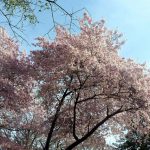
Part of it was planned and part of it was just sort of a random dispersal. If you look around the Tidal Basin today during peak bloom, what you see mostly are the Yoshino trees. And the Yoshino petals, they’re really not pink, they’re more of a white. And so they decided to plant the Yoshinos around the Tidal Basin. But because it’s so white, they mixed in another variety called the Akebono. They bloom at the same time as the Yoshinos, and they’re a much deeper pink than the Yoshinos. So the effect you got was some splashes of pink from the Akebonos, in amongst the Yoshinos.
The others tend to be planted in groups. The Kwanzans for the most part are in East Potomac Park down by Hains Point. There are some of what are referred to as the Autumn Flowering Cherry Trees, they’re on the Washington Monument grounds. [If] you get a warm spell in late fall or early winter, they’ll come out. So every couple of years they come out in December and everybody gets all excited that the cherry trees are coming out, but just those select few.

Do you know of any similarities or differences between the cherry blossom festival in America versus in Japan?
There are a number of similarities. The Japanese bloom period is known as sakura. And as [excited] as everybody gets in Washington, D.C., apparently it’s nothing compared to what happens in Japan. We’ve got 3,000 trees here, they’ve got exponentially more trees there – and it almost becomes a national holiday of sorts. There’s a Japanese word, hanami, which is the art of cherry blossom seeing. So, the Japanese, during the time that their trees are out, entire families and villages will go out and engage in this hanami, spreading blankets and having picnics and wandering amongst the trees and just sort of taking it all in. So we have those similarities. You know, the Americans obviously like to come down and see the cherry trees here as well. But it’s on a much smaller scale.
Are the events that we plan for the cherry blossom festival now, like the kite flying and the art exhibits, similar to how it was in some of the first cherry blossom festivals?
It’s evolved over the years. The kite festival, for example, originated in Washington, D.C., in the 1970s, if not before that. It was not originally part of the National Cherry Blossom Festival. And everybody said, “Oh, you know, there’s a kite festival going on at the same time the Cherry Blossom Festival is going on.” And they sort of merged the two events from that. The parade, as well, has evolved over the years. It didn’t start out in those early years. But since then, has become sort of one of those beloved Cherry Blossom Festival events.
This interview has been lightly edited for clarity and length.