Martin Austermuhle
Renee Thomas didn’t know where she was going to end up Wednesday afternoon, but she said she wouldn’t be going far.
“Once they close this [encampment] down we’re just going to move to these benches,” the 53-year-old told DCist/WAMU on Tuesday, pointing to the public benches lining the perimeter of the triangle-shaped park downtown she’s called home since the start of the pandemic. “Everybody is picking a bench. Coco got that bench right there, and I’m going to get that one right beside it.”
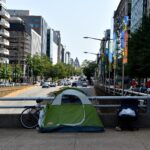
Thomas is one of the people who got pushed out of two longstanding homeless encampments — one at Columbus Circle outside Union Station, the other at 11th Street and New York Avenue NW — on Wednesday. Both sites were cleared by the National Park Service, which controls both plots of land and announced in late March that they would be closed down “to address threats to public health and safety” from the growing presence of tents.
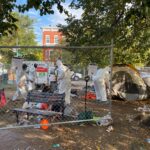
NPS crews arrived at Columbus Circle at 7 a.m. and started working shortly thereafter, emptying and dismantling tents — most of which were disposed of in an accompanying dump truck. Some of the tents were empty, but outreach workers for D.C. agencies and non-profit groups spoke with remaining residents to let them know how to apply for housing opportunities. The crews later moved to the smaller encampment at 11th Street and New York Avenue.
Camping is not allowed on federal land in D.C., but NPS says it largely stepped back enforcement during the pandemic unless specific hazards demanded immediate action. The federal agency cleared the encampments at Burke Park and Gompers Park in downtown last summer, and another encampment just east of Union Station in the fall, citing such hazards both times.
In signs posted at Columbus Circle and at 11th Street and New York Avenue announcing the planned closures on Wednesday, NPS said that “renewed enforcement… will also allow for rehabilitation of the turf, cleaning and maintenance of the park area, and mitigation of rodent infestation.”
The move to clear the two encampments comes amid a months-long push by D.C. and federal officials to address what was for a time a growing number of people moving into tents in public areas (the city’s annual point-in-time count showed that D.C. is now experiencing its lowest level of homelessness in 17 years).
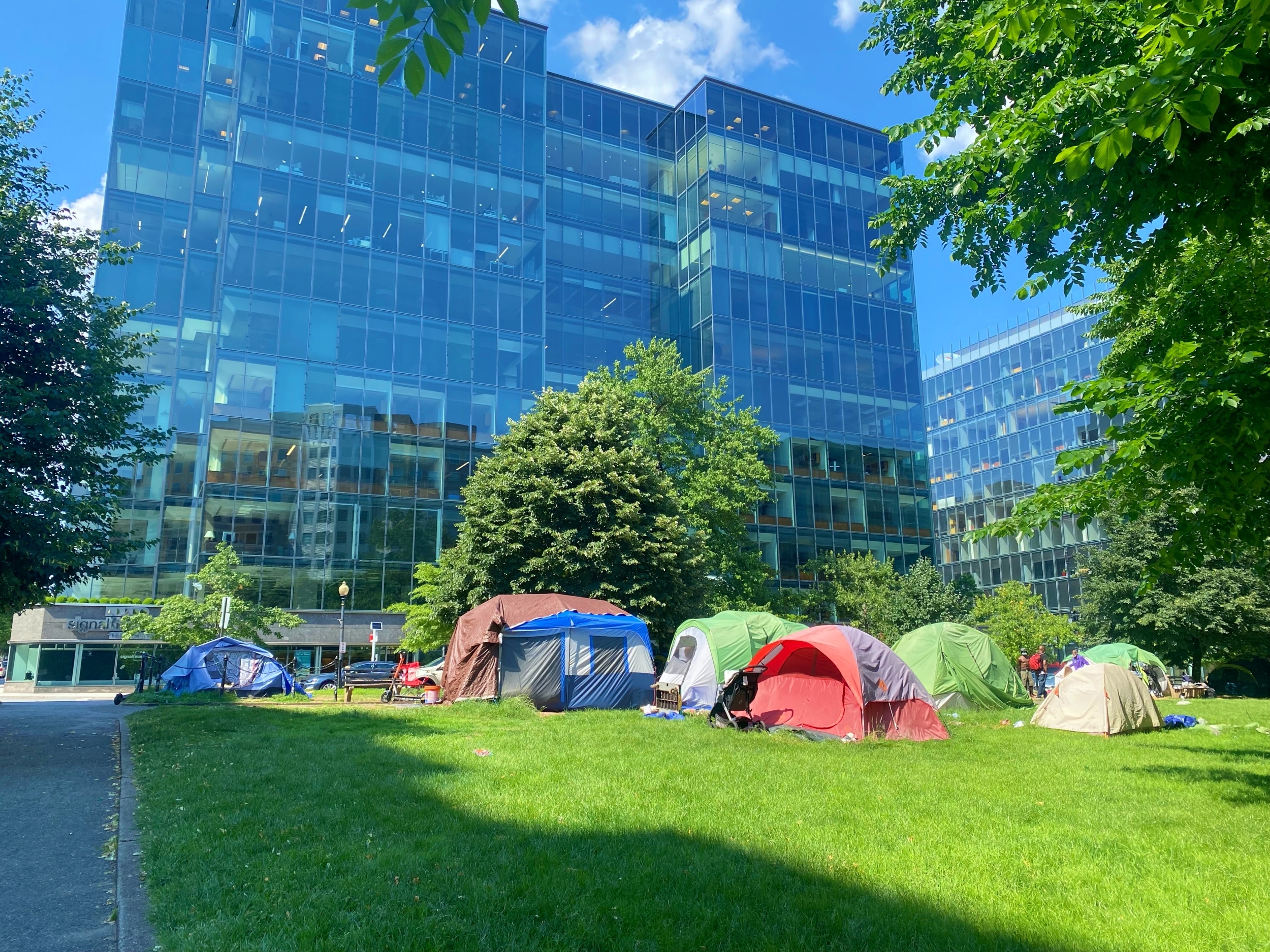
Last fall D.C. launched a pilot program to clear five designated encampments — in NoMa, Truxton Circle, and Foggy Bottom — by first working with residents there to find them housing. City officials told the D.C. Council in late February that the pilot was a success, with 65% of the 139 people listed as living at the designated encampments having been placed in apartments or hotels pending an apartment lease being completed. A poll conducted by the Washington Post that month also found that the city’s program was widely supported by residents.
But advocates for the homeless and some lawmakers said the pilot program still had its faults, specifically in setting deadlines for encampment closures and the use of heavy equipment to clear away tents. At one clearing in NoMa last fall, a man in a tent was lifted up by a small bulldozer. They also said that some people experiencing homelessness who did not get housing would simply move to other encampments.
Those concerns grew louder when NPS announced its plans to close the encampments outside Union Station and at 11th Street and New York Avenue. While the agency asked the city to help find housing for the residents at those encampments, city officials said they did not have the resources to apply the same expedited-housing approach they used in their pilot program for encampments on federal land.
And while NPS did give two months notice of the closures that took place Wednesday, some advocates say that wasn’t enough time to work with unhoused residents to get them necessary documentation, identify the types of services they would need, find temporary housing options, and move their belongings.
“It could take days, months, or literally years because we have never had enough permanent housing solutions to meet the need. It’s a math problem. We don’t have enough affordable and really deeply affordable [housing], which means either federally or locally funded vouchers to meet the need,” says Christy Respress, director of Pathways to Housing, a social services organization that worked with the city to find housing for residents at the NoMa and Truxton Circle encampments that were closed and has been engaging with residents in Columbus Circle and downtown.
Still, D.C. officials say their partnership and communication with NPS about encampments on federal land has improved over the last year, and that they got straight to work once NPS announced the planned closures in late March.
“We began some intensive and coordinated efforts for outreach engagement to the residents of both locations. Those outreach engagements consisted of day and evening outreach; service connection to mental health stability resources; housing navigation assessment; as well as supply and resource distribution on a weekly basis. We also assisted NPS in providing weekly cleanup and biohazard removal services for any abandoned or dilapidated tents,” says Jamal Weldon, who leads the encampment-clearing efforts in the office of D.C.’s Deputy Mayor for Health and Human Services Wayne Turnage.
Turnage’s office said D.C. had also offered to store people’s personal belongings for up to 60 days, and that encampment residents who had been cleared for permanent supportive housing were being offered temporary placements in hotels until their leases are signed. Respress estimates that just under half of the residents at both encampments fell in this category.
Still, Respress worries that the closures of the encampments at Columbus Circle and 11th Street and New York Avenue will merely scatter residents to other locations on the street. “Encampment closures are traumatic,” she says. “It moves people from place to place, which makes it harder to help people in housing plans. It just makes it more difficult in general to work with people to move out of homelessness.”
Kevin, 44, expressed frustration that he would be forced to leave the encampment at 11th Street and had no other housing option that was available to him.
“What are we going to do? We’re going to go down to another park and then they’re going to close that park and we’re going to circle right back around, and then you end up locked up because you have no place to go,” he said.