Colleen Grablick
Update: The D.C. Council unanimously approved a bill earlier this month to dedicate Swann Street NW after William Dorsey Swann, a formerly enslaved D.C. resident and the world’s first known drag queen.
The city is expected to install a commemorative sign near the Dupont street, marking Swann’s historic contributions.
Original: For some D.C. residents, Dupont’s Swann Street might be associated with the iconic gingko trees, who simultaneously shed their leaves in one dramatic drop each year, blanketing the sidewalk and road.
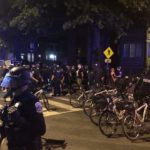
Others might think of the 2020 protests following George Floyd’s murder, when police kettled dozens of protesters with flashbangs and pepper spray, and resident Rahul Dubey made national headlines for sheltering the demonstrators in his Swann Street home.
But now, a group of Dupont neighbors is pushing to have the street, which stretches about five city blocks, dedicated in honor of William Dorsey Swann, a formerly enslaved Washingtonian, and the world’s first self-identified drag queen, whose contributions to drag, ball culture, and queer resistance span states and centuries.
“We thought it would be exciting to dedicate Swann Street after William Dorsey Swann, a Black Washingtonian who was a pioneer in a lot of different ways,” says Advisory Neighborhood Commissioner Matthew Holden, who introduced an ANC2B resolution to rename the street, which passed unanimously on Wednesday. “He was such a cool historical figure that, probably, a lot of people didn’t know a lot about.”
Dorsey Swann was born into slavery in Hancock, Maryland, and later moved to D.C. after emancipation, where he led groups of formerly enslaved Black men in the first documented drag balls. Much of what’s known about Dorsey Swann comes from historian and journalist Channing Joseph, who came across Dorsey Swann’s history while researching his own family tree. Until learning about Dorsey Swann’s life, Joseph hadn’t known that the term “drag balls” dated so far back in history.
“[I] became sort of obsessed with trying to find as much as I could about particularly Black queer people who lived long ago, particularly during the era[s] of slavery and reconstruction and segregation,” Joseph tells DCist/WAMU. “I’ve come to realize it means a lot to other people to be able to connect to the past in that way because we, for the most part, are not taught about our queer Black historical figures in the U.S.”
According to Joseph’s research, Dorsey Swann is the first known person in history to have self-identified as a drag queen — hosting balls in often secret, private formats, decades before they’d gain more visibility in the Harlem drag ball scene of the 1920s and 1930s. Joseph says the term “drags,” used in reference to cross-dressing balls, existed before it was associated with “queen,” a word which, during Dorsey Swann’s era, was a term of honor and respect used for the leader of the ball. (Today, he says the word is used more loosely, to refer to anyone participating in drag.)
During Swann’s balls, Joseph says they likely competed in dances like a cakewalk, a dance performed by enslaved people in pre-Civil war America, mimicking the mannerisms of plantation owners. The cakewalk’s improvisational movements and subtle expressions of communication resemble voguing, the style popularized in Harlem’s ball scene. Given the era, there’s no videotape of Swann’s balls — but even if there were, Joseph says, the organizers needed to operate the events in secret.
“Swann and his accomplices had to keep [the balls] secret, and oftentimes weren’t able to keep them secret from the authorities,” Joseph says. “[That’s] to our benefit — often the reason we know about these balls is because they were raided by the police, and the police reported the names of the participants. If they had achieved their goal of keeping all of them secret we would not know about them to this day.”
Swann was frequently arrested and jailed for throwing balls, without ever being charged with specific crimes. Police would arrest Swann and participants as “suspicious characters,” according to Joseph, or charge them without evidence for associated crimes like vagrancy or “keeping a disorderly house,” a law often associated with sex work. At one point, after being arrested and jailed, Swann sought a presidential pardon from then-president Grover Cleveland. He gathered lawyers and even collected signatures from community members to support his innocence. While he did not receive the pardon, he’s recognized as the first person to take legal steps to defend the right to assemble for a queer party.
“Swann repeatedly had to face the D.C. police and other sort of forces that were trying to stop the groups from meeting and to stop the balls from happening,” Joseph says. “There was not an organization, there was not the ACLU or GLAAD or anyone coming to their defense to say ‘these people didn’t violate this particular law.'”

The idea to dedicate the street first started with resident Yonah Freemark, a Dupont neighbor who moved to the area two years ago. While researching the history of ball culture out of personal interest, he stumbled across Joseph’s work and recognized Swann’s name — it was the name of the street a block over from his home. As an urban planner, Freemark had also been digging into the history of the Dupont neighborhood, which includes the Striver’s Historic District, an area that as early as the 1870s served as a locus for Black business, education, and religion.
“I connected the dots, and it just struck me as something that we really needed to try to push for, to try to acknowledge this person who has such a fascinating history and such remarkable history, both in terms of gay rights, but also in terms of Black rights,” Freemark says. “I think we need to do more to acknowledge first of all, our history as a predominantly Black neighborhood, but second of all, make our neighborhood a welcoming space for people of all identities.”
Freemark then went on to contact Joseph, who helped Holden craft the resolution. Now, Joseph is working on a book about Swann and his contributions, hopefully coming out in 2023, titled House of Swann: Where Slaves Became Queens.
“This period of time in the 1880s and 90s, particularly what’s happening with African American queer people, what’s happening on the local level for people who are living in D.C., as community, as residents of D.C.?” Joseph says. “I think it’s a fascinating, sort of understudied period of time.”
The ANC resolution itself cannot change the name — it’d need to be done via a bill introduced in the D.C. Council — but both Freemark and Holden say the mayor’s office has been supportive of their effort. Holden says he hopes to see the council pass legislation dedicating the street in Swann’s honor and adding a nameplate or plaque that could tell a bit of his history to visitors and neighbors. Ward 2 Councilmember Brooke Pinto, who represents Dupont, wrote in an email to DCist/WAMU that her office is supportive of the effort, and looks foward to “working with the Commissioners on moving this street renaming forward.”
The re-dedication follows a trend over the past two years of states and cities taking down statues and removing the names of Confederate leaders and slaveowners from schools, buildings, and streets. (In 2020, a D.C. committee recommended changing the names of more than 50 spaces across the city, although the effort has largely flopped.) The current namesake of Swann Street is believed to be Thomas Swann, a former Maryland governor and Baltimore mayor, a slaveowner, and staunch defender of slavery — which for Freemark, Holden, and Joseph, makes the re-dedication all the more important.
“I think it’s a wonderful story of celebrating the joy and self-expression and celebrating queerness at a time when we don’t learn about the existence of queerness. Particularly when we talk about Black history, we learn about a lot of really depressing things, like segregation, and the KKK, and the inequality that was enforced legally and socially upon African Americans,” Joseph says. “It’s quite meaningful to me, to take a street that’s named after a slave-holder in our nation’s capitol, and to re-dedicate to somebody with the same name who was a figure of resistance and activism.”
This post has been updated to reflect that a Council bill has passed, commemorating the street.