 Sarah Y. Kim
A D.C. man is suing the U.S. Park Police for upwards of $1 million, saying officers used excessive force while arresting him for unknown reasons during the summer.
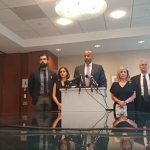
The man, Jonathan McKinney, a professional dog walker, filed the civil suit Thursday in the D.C. District Court. At a press conference announcing the suit, McKinney said he was playing Pokemon Go and walking through Battery Kemble Park to his home in Palisades when he was chased and tased by officers.
McKinney’s attorney, Donald Temple, told DCist/WAMU that the arrest was “bizarre,” and suggested his client was racially profiled as a Black man.
“He’s not doing anything other than walking in the park, returning from walking the dog,” Temple said.
Sergeant Thomas Twiname, public information officer for U.S. Park Police, told DCist/WAMU that the department takes any allegation of misconduct seriously. “We cannot comment on litigation, but we will make incident information available as soon as we are able,” he said. The Park Police have jurisdiction over wide swaths of parkland across the D.C. area. Park Police Officers have come under scrutiny for arrest tactics and use of force in the past, including in the killing of Bijan Ghaisar, who was shot and killed by Park Police during a traffic stop in 2017.
According to McKinney’s account, he was walking through the park when he was approached by a white man in shorts and a T-shirt, Temple said. The man “grimaced” at McKinney and said “how you doing?,” according to Temple.
The suit reads that McKinney “apprehensively” told the man not to talk to him. The man reportedly replied: “I can talk to you; this is a public park. All I asked was how are you?” The suit reads that the man was “increasingly invasive,” and that, feeling threatened, McKinney walked away.
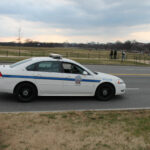
As McKinney left the park, a car pulled up and officers emerged. They chased McKinney and tased him three times, Temple said. He was arrested and taken to the emergency room where the metallic tasers were removed from his spine, right inner thigh, and his right shin, per the lawsuit.
Afterward, he was fingerprinted and spent more than a full day in jail before being released with no explanation and no charges filed, according to the lawsuit. Following his release, he was also diagnosed with COVID-19.
“I’m just hoping for accountability and for professional behavior,” McKinney said at the Thursday press conference, according to WTOP. “And for people to be able to move freely in their communities without threat of being profiled…So I’m just looking for justice.”
The lawsuit reads that McKinney continues to suffer physically and emotionally from the tasing, that he had to pay medical costs for the injuries, and that incident has caused him “mental anxiety, loss of self-esteem, and continued flashbacks of the incident as he has attempted to sustain himself and continue his business.”
While the charges against McKinney were dismissed, Temple said “stigma” often still lingers.
“These young people are criminalized because now they’re booked. They have fingerprints, they have photographs,” he said. “This happens too much.”