Margaret Barthel
Here’s a link to our profiles of the six candidates running for school board.
It’s a Friday night in October, which means that Lauren Shernoff and her husband Alex are knocking on doors in a Leesburg neighborhood.
People who aren’t home or don’t come to the door get a campaign door hanger. People who are home get a version of Shernoff’s spiel, which sounds something like this:
“Are you following what’s going on in Loudoun? It’s hard to miss,” she says to one resident. “I’m a teacher in Loudoun and a mom, and I really just want to bring the polarization to a place where we can start to really impact outcomes for kids.”
“What’s going on in Loudoun” is shorthand for more than a year of intense partisan bickering at school board meetings and online. Conservative parents are angry about pandemic restrictions, so-called “critical race theory” and “transgender ideology,” explicit books, and the public schools’ mishandling of a pair of sexual assaults in two high schools. Meanwhile, liberal parents have loudly defended school equity policies, library catalogs, and inclusive policies for LGBTQ students.
Shernoff, an LCPS parent and a literacy specialist, says she got into the race because she didn’t see her perspective as an educator represented on the current school board. She also says she didn’t see any nuance in the debates.
“Is that what we teach our children — take a side and stick to it and never listen to the other side?” Shernoff asks. “It’s not. It’s not what we teach our kids, but it is what we’re starting to teach our kids in this culture.”
School board seats are technically nonpartisan, but — no surprise given the political climate — the campaign has been anything but. There are a total of six candidates for Loudoun’s school board, spread across two seats representing the Leesburg and Broad Run Districts. Each race has a Republican-endorsed candidate, a Democratic-endorsed candidate, and an independent.
In Leesburg, Shernoff is facing Erika Ogedegbe, who has the Democratic endorsement, and Michael Rivera, who has Republican backing. In Broad Run, incumbent Andrew Hoyler is an independent, challenged by Democrat Nick Gothard and Republican Tiffany Polifko.
All of them acknowledge that, in choosing to run, they’re putting themselves squarely in the middle of a heated, often ugly community split. Several candidates say the first question voters ask them is some variation on “why would you do this to yourself?”
That includes the Broad Run incumbent.
“Some people would say I’m pretty crazy for wanting to continue on the school board after everything that’s happened over the past 12 months,” says Hoyler, who was appointed to the Broad Run seat after the former representative died last year.
The school board races are a window into a community grappling with the local fallout from a now-national political movement to make public schools the latest front in the culture wars. Their results will be an imperfect but useful data point in understanding how the different ideological positions energize Loudoun voters — and whether an independent can coax people out of their corners.
Out knocking on doors, one resident put that very question to Shernoff.
“If we don’t start talking to each other, I’m really worried about outcomes for kids, because it’s like we’re in a stalemate on everything and that just doesn’t have to be that way,” Shernoff said.
“I just feel like unfortunately it is that way it is,” the voter replied. “There’s so many black and white issues that — they’re not, but they’re being forced to be black and white by interpretation and misrepresentation of so many issues.”
Loudoun County is the wealthiest county in the nation, with an average household income of nearly $150,000. It’s also a part of the vote-rich Northern Virginia suburbs, a major determining factor in statewide elections in Virginia. It’s also one of the fastest-growing counties in Virginia, but much of the western end of it is quite remote, country roads dotted with horse farms.
While the previously Republican county has trended blue in recent years — Jennifer Wexton, its Democratic congresswoman, flipped the seat in 2018, and voters supported President Joe Biden by a wide margin in 2020 — it still has a purple tinge. Virginia Gov. Glenn Youngkin, a Republican, didn’t win the county, but he did significantly close the gap, losing by just 9 points.
Youngkin himself is a central player in the development of the current wave of cultural conflict over public schools. In his gubernatorial race last year, he successfully capitalized on existing parent frustrations over pandemic school closures and simmering conservative anger over “critical race theory,” a catchall term for racial equity policies and an acknowledgement of systemic racism.
Loudoun had seen public outbursts at school board meetings over the school board’s vote on a policy designed to support transgender students and the mishandling of two sexual assaults in Loudoun County high schools, a case picked up by conservative news outlets who pushed the narrative that the teenage perpetrator was transgender. Parents had also begun speaking up against racial equity policy work the school division began in response to a state investigation into frequent racial slurs and other racist incidents. All that became the backdrop for Youngkin’s campaign argument about schools. Youngkin’s narrow win — the first statewide success for Republicans in more than a decade — caught the attention of Republicans across the country as a possible template for the party in 2022 and 2024.
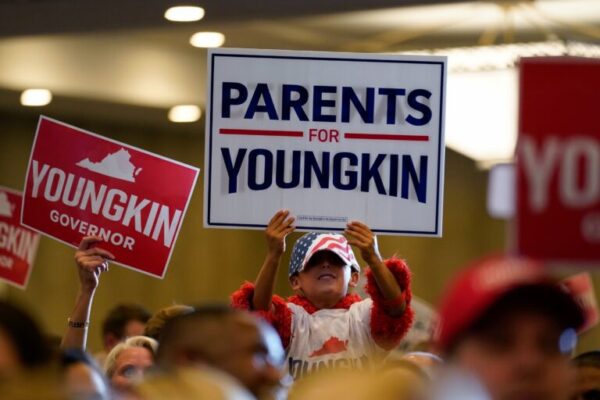
But even with the governor’s race in the rearview mirror, the political divisions in the county continued to deepen. A group of conservative parents mounted several recall campaigns against board members — prompting one to resign, citing threats to her family’s safety. (This year’s Leesburg candidates are now vying to replace her.) Public anger at school board meetings over critical race theory and mask mandates became a regular spectacle — and spilled over into viral posts and videos online. The Youngkin administration launched an investigation into the sexual assault case, and the administration joined in a lawsuit against LCPS’ mask mandate. Dueling parent groups formed, some to create and amplify parent anger at the schools, others to refute it.
These days, the meetings themselves are less rowdy — though attendees still have to go through a metal detector to enter the administration building. But they continue to feature emotional, often accusatory testimony from parents on both sides of the political aisle. One recent evening, a parent compared the school board’s equity policy to the “playbook” of Adolf Hitler and Karl Marx. School board members sit, listen, and as is the practice after public comments, they don’t respond. After the outpouring, they move on to their business items for the evening.
All of it is impossible to ignore, and the candidates aren’t trying to. Some speak with concern about conversations in their community being reduced to buzzwords. Republicans and Democrats talk about outreach to the other side — long conversations they don’t believe will necessarily yield a vote in their favor, but which they feel are important to being prepared to govern well if elected. All six say they want to create better opportunities for community engagement, beyond the two-minute public comments offered at school board meetings.
And everyone is positioning themselves as the way back to some version of sane political discourse.
The conservatives in the race say they’re LCPS parents running to take “identity politics” — another catchall buzzword that tends to mean an awareness of systemic racism and other types of bias — out of the schools. In fact, that’s the origin story of both candidates’ decision to run.
For Leesburg candidate Michael Rivera, a sheriff’s deputy, the breaking point came when his son was asked to watch a video from a Seattle television station about systemic racism for class. Another major early concern was sexually-explicit books, including This Book Is Gay, which has information and depictions of how men have sex with men.
Rivera says it’s not about wholesale book-banning for him, but he objects to the book being available to kids. “I’m not saying those books don’t need to exist because I’m a believer that you can celebrate the accomplishments of people in the LGBT community without knowing how they have sex,” he says. On Twitter, he has named and called the LCPS employee who purchased the collection of books reflecting the experiences of LGBTQ people and people of color an “activist administrator.”
Getting rid of “identity politics” is also first on the agenda for Tiffany Polifko, the Republican-endorsed Broad Run candidate, who has appeared on Steve Bannon’s show The War Room several times on the subject. Like Rivera, she links her decision to run for the position back to discovering her child reading content that, in her opinion, overemphasized the role of race in society — in this case, a discussion of a New York Times lesson about a spate of shootings of mostly Asian women in Atlanta-area massage parlors as a hate crime.
“I found that along with this assignment, he was asked to watch a TED Talk video in which a woman was standing on the stage and told the audience that they should acknowledge their privilege, that she was a victim of racism her entire life, that she felt she was a victim of racism, and that we could really only begin to solve these problems when we could fully dismantled what once was,” Polifko recalls. “At that moment in time, I knew that this county in particular was taking a shift away from the fundamentals in education and broadening the scope into bringing in politics, bringing in ideology.”
The two candidates with Democratic endorsements, meanwhile, are running because they believe the angry debate does not represent their community. Erika Ogedegbe, whose background is in higher education data, talks about how “dangerous and scary” the “divisiveness” in the county is at present.
“So oddly, that’s sort of what made me want to stand up, because I think it’s really important that we show that that’s not who we are as a community, that we are supportive of our schools,” she says. (Ogedegbe’s day job is at American University, which holds the license to and owns WAMU/DCist.)
She says she wants to stand up for equity — “understanding that students have different needs. And as a public school system, we need to meet those needs. And that might mean different resources to be able to meet the needs that students have,” she says.
Ogedegbe and Gothard, who grew up in Loudoun County and attended the schools himself, connect the partisan anger to fears that arise from a rapidly growing, diversifying region. Gothard, who wants the schools to continue to provide the supports he relied on as a low-income kid who came out in high school, sees an opportunity on the school board to help the county chart a course forward through those changes.
“The role of the school board is to work in these areas that can take the Metro to D.C. and make sure that these kids are getting as good an education as the ones who’ve got cows in their yard,” he says. “And that’s a difficult balancing act.”
Despite the rhetoric about working together, plenty of division has popped up in the campaigns. Several conservative groups have sharply criticized the Democrat in the race, Nick Gothard, creating compilations of his TikTok videos, suggesting he’s being fed debate lines by endorsers, and calling into question his claims about growing up economically disadvantaged. They’ve also posted and re-posted a photo of Gothard with a protest sign supporting defunding the county sheriff’s office (Gothard told WJLA that he doesn’t want to defund the sheriff or move away from school resource officers in LCPS).
Those groups include Parents Against Critical Theory (PACT), which has been harshly critical of equity policies in LCPS and counts Broad Run candidate Tiffany Polifko on its leadership team as executive vice president of education and outreach (Polifko says that role involves advocating for parents on schools-based concerns and engaging with news media. “I am not now, nor have I ever been in charge of social media output or engagement for PACT,” she explains.)
Meanwhile, Gothard, who has also served as the executive director of the county’s Democratic Party, refused to participate in a candidate forum hosted by the local chapter of the conservative group Moms For Liberty. Gothard said he wouldn’t join an event hosted by an organization that “[perpetuates] hate,” according to local news site LoudounNow. Ogedegbe and Shernoff, who cited a conflict, also did not join in the forum.
Hoyler and Shernoff, the independents, are banking heavily on the idea that people will be eager to support a candidate outside of the partisan political fray. But without a party label — or party support in the form of volunteers or a spot on a sample ballot — they’re left to try to explain who they are to residents who have become wary after more than a year of political infighting.
“By saying I’m independent, I still get all the time, ‘well, what are you really, you know, are you a Democrat or a Republican really?’” Hoyler says.
“I would say the biggest thing is people wanting to box us in, you know, like they really want to know, like, ‘Are you trying to hide secrets so that you get on the board and then you’re going to reveal which side you’re on?’” Shernoff adds. “And it’s like, I don’t know how else to say it except that we are genuinely out here…We believe that this is how we come back together for our kids.”
Beyond wondering why she would ever get involved in the school board in the first place, Shernoff says the most frequently-asked question she gets on the campaign trail is ‘Are you a book banner?’ which “sets it into that polarized climate right off the bat,” she says.
But Shernoff’s answer takes in both sides. It’s got something for people who are angry about explicit books, and something for people who want to defend them as opportunities for children to come into contact with a wide variety of identities and perspectives.
“We have beautiful, culturally diverse books in our classrooms. And children learn so much from that and they see themselves in those books,” she begins, noting that she’s a literacy specialist and works with children on reading in classrooms all day long.
But she adds, “You have to have developmentally appropriate content. You don’t necessarily want sexually explicit content in the hands of certain age levels. So we have to work through those kinds of rubrics and thinking,” she continues. “We do it with movies. I think we can do it with books.”
There aren’t polls or other easy measures of how each message — right, left or center — is landing. Shernoff has raised a whopping $53,940 for her campaign, about $40,000 more than anyone else in the race, much of it from family members. Asked by a voter about whether they’d find people mostly on one side or the other on the list, Shernoff said people with all political affiliations have donated.
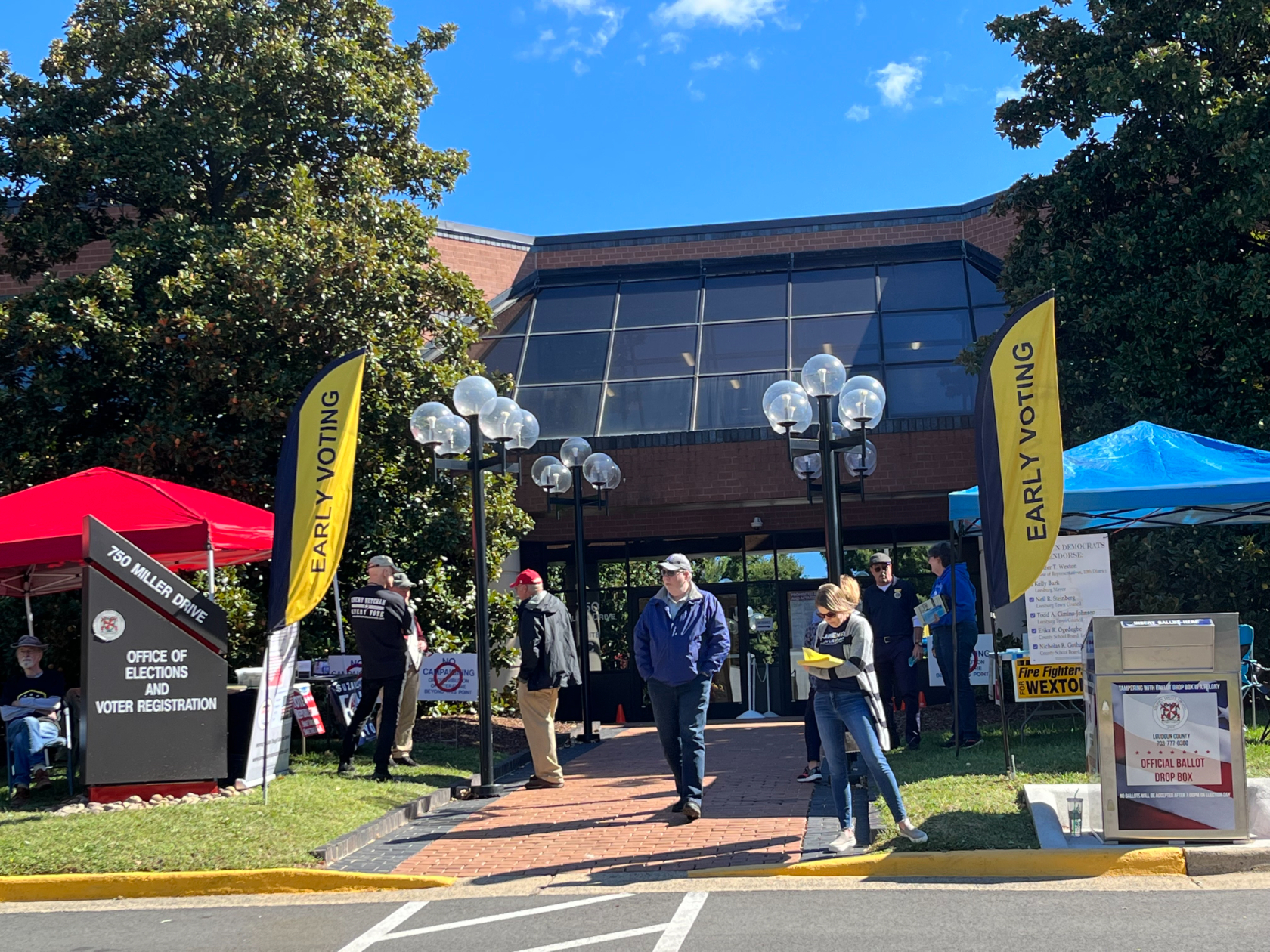
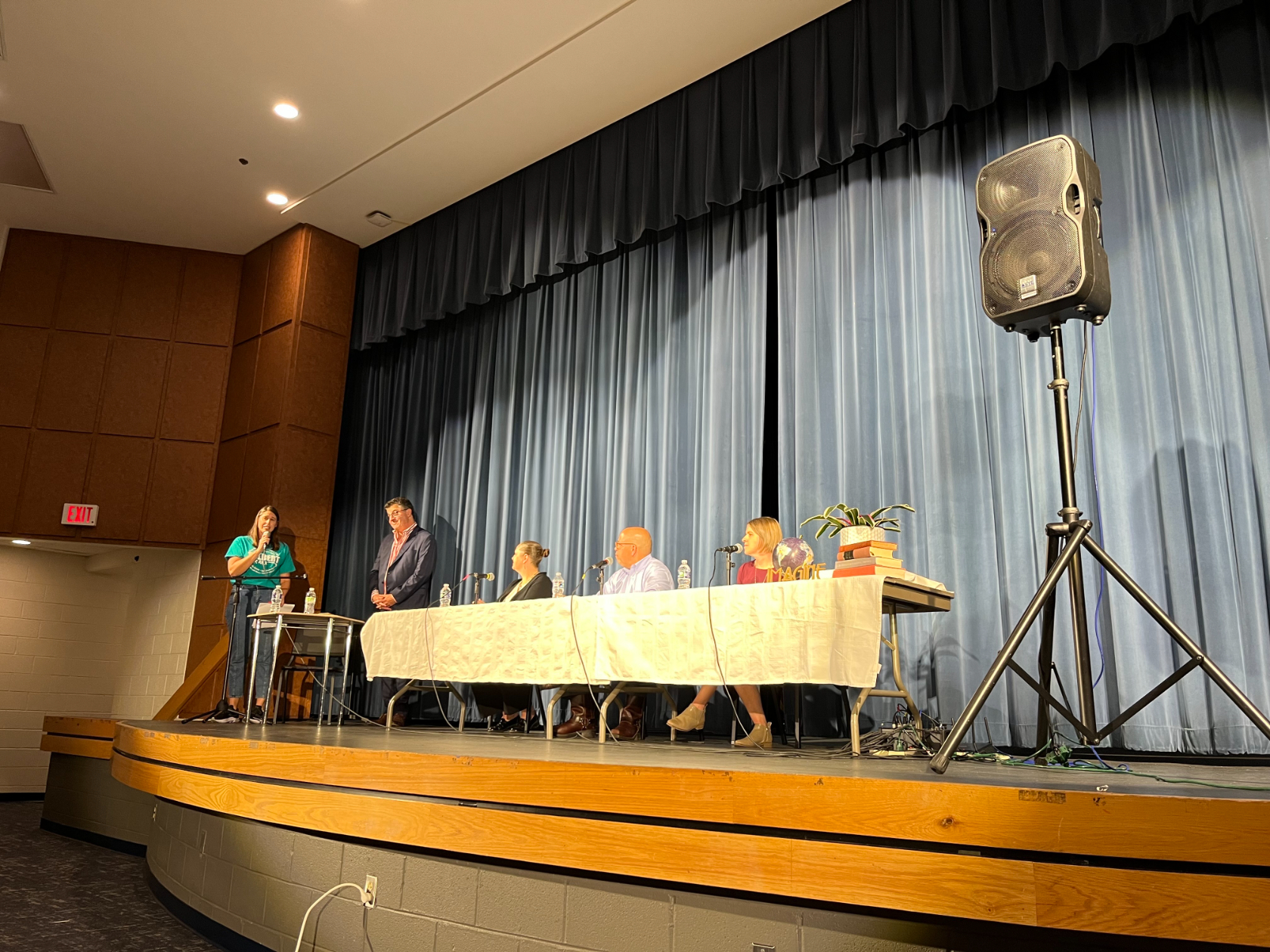
About a hundred people came out to a candidate forum for the Leesburg seat put on by a group of district PTAs on Oct. 13. Some sported buttons or t-shirts of their preferred candidates, and some genuinely undecided.
Wanelle Trost was there to support Michael Rivera. She says she’s concerned about the divisions between teachers and parents in the schools, but she’s also bothered by the idea of “critical race theory,” which she feels overemphasizes racial differences.
“I don’t think that’s something that should be forced on teachers to teach,” she says. “Maybe it should be an option, like if there’s an extra class and someone wants to say, ‘hey, my child wants to take that,’ sure.”
Parent Courtney Smith cited her concerns about reporting on rates of racist incidents in LCPS as her reason for voting for Ogedegbe. Asked about the partisan climate in Loudoun County, she said she was an “involved” parent but stays off social media over safety concerns. But overall, she says the partisanship keeps people engaged, at least.
“Everyone should be voting. Everyone should be participating. Everyone should be aware of what’s going on in their communities,” she said. “Honestly, we need partisans to protect kids who are marginalized.”
Others were exhausted with the way the national debates are preventing candidates from addressing a wider range of issues. Jessie McCraken sees Shernoff as a way to move on from them.
“I am very dismayed with how many of our conversations are not productive for our students and aren’t rooted in what students and teachers and families need,” said McCraken, a parent who also works in the schools. “Lauren has really been a breath of fresh air.”
Nancy Hunter, a parent and mental health professional, came away from the debate supporting Shernoff, too — in large part because her personal political leanings weren’t on display.
“Listening tonight to all three, I feel like Lauren was the only one where I still sat back and went, ‘Hmm, I really don’t know how she votes [on national issues],” she said. “And that’s good because that doesn’t matter.”
At the end of the forum, one of the PTA leaders got up to thank the audience.
“My worst fears tonight were not realized. I did not call the police department,” she said, to laughter from the crowd. “So thank you so much for the respect you gave the candidates, for cheering appropriately … And thank you so much for coming out.”