Amanda Michelle Gomez
Stephen Grivnow filed a union grievance with DC Public Schools in May 2019, alleging his principal at Dunbar High School in Truxton Circle fabricated his teacher evaluation. Grivnow, who taught math and special education at the high school for five years, was fired later that summer as a result of his poor performance evaluation.
More than three years later, a hearing officer with the DCPS Labor Management and Employee Relations (LMER) office ruled in favor of Grivnow’s case against his former principal. DC Public Schools has been ordered to reinstate Grivnow and provide back pay for the 2020-2021 academic year, according to the June 2022 decision shared with DCist/WAMU.
Grivnow says the decision does not come close to remedying his wrongful termination. The principal who allegedly falsified his evaluation, Nadine Smith, is still employed at Dunbar High School and local schools still use the controversial evaluation system called IMPACT. Meanwhile, Grivnow says he is teetering toward bankruptcy after being fired. He says he couldn’t get another teaching job and struggled to keep any job during the COVID-19 pandemic, forcing him to take on debt to sustain himself.
“I was targeted for retaliation of whistleblowing and being a union activist,” Grivnow tells DCist/WAMU, adding that he doesn’t regret his participation but is surprised things escalated. “I thought maybe cooler heads would prevail and things would smooth over. But, no. They just got worse, increasingly worse.”
Nadine Smith did not immediately respond to requests for comment. A spokesperson for DC Public Schools says the education agency cannot comment on pending litigation.
Resolving Grivnow’s case took longer than he and his union desired. A DCPS spokesperson says the union chose not to conduct grievance hearings, even virtually, for the first year-and-a-half of the pandemic even though the education agency was ready to proceed. But the union says Grivnow’s case reached DCPS LMER in September 2019 — roughly six months before COVID-19 was declared a pandemic — and a minor investigation ahead of that stage would have resolved the grievance sooner. The union also faults the backlog of grievances related to IMPACT and minimal number of hearing officers.
A year into the grievance process, Grivnow filed a lawsuit in federal district court against Mayor Muriel Bowser and several DCPS officials, including Smith. A federal judge recently decided to move forward with one of Grivnow’s claims, retaliation under the D.C. Whistleblower Protection Act, while dismissing the other charges.
Grivnow alleges in the complaint that Smith sought to fire him through a poor performance evaluation — and went as far as to partially base it off an observation that never occurred — because he was an active member of the Washington Teachers’ Union and he contributed to an damning investigation of his school. The independent investigation found attendance records of Dunbar graduates were changed at extreme rates, calling into question whether policies were violated simply to pass students and leading the previous principal to be placed on administrative leave.
Smith, through her lawyer, has denied the allegations, arguing the retaliation claim is dubious because the evaluation came over a year after the investigation, according to court documents. A hearing over the whistleblower complaint is scheduled for next year. Smith has asserted in court documents and through the grievance process that her review of Grivnow is based on three observations, including one where she described his classroom as “chaotic”.
Grivnow and his union ultimately see his dismissal as a further evidence that IMPACT is a broken tool that can be weaponized against educators. A D.C. teacher’s classroom performance is tied to their job security and paychecks. Teachers are subject to dismissal if they are ranked “developing” three consecutive years, “minimally effective” two consecutive years, or “ineffective” one year.
Critics of IMPACT cite a city-commissioned study released last year that says white educators received higher evaluation scores on average than their Black and Latinx counterparts. IMPACT is not only prone to racial bias, various educators and their supporters argue, but does not accomplish the stated goal of supporting teacher growth and instead creates a culture of fear at school. A survey from the D.C. State Board of Education found IMPACT to be a driver of teacher departures, with 24% of respondents citing the evaluation as the primary reason for leaving the classroom.
WTU President Jacqueline Pogue Lyons says most union grievances are related to IMPACT. For academic year 2021-2022, she says there were 72 such grievances, which is lower than previous years when the pandemic didn’t disrupt in-person instruction.
“It’s a verb. ‘I’ve been to impacted out,’ and everybody knows what you’re talking about,” Lyons tells DCist/WAMU. “It has taken on a culture and a life of its own.”
The WTU field representative who handles grievances, Juan Gonzalez, estimates roughly a fifth of teachers he’s supported since 2018 have been let go because of their evaluations. Many are fired after receiving repeated “developing” ratings, he says. Grivnow’s case is rarer, he adds. “It was one of the most shocking cases that we’ve had in front of us.”
Grivnow says most years he received “effective” scores but he got his first “ineffective” ever during the 2018-2019 academic year. He received it based on three observations from the principal, one of which he and other school staff and students contend never occurred, according to the hearing officer’s decision and supporting documents. The other observations occurred during stressful times, the day the school returned from Thanksgiving break and another day amid PARC testing.
After being hit with “ineffective”, Grivnow followed the standard grievance process, which included taking it up with the principal and then the superintendent. Then DCPS Superintendent David Pinder denied the request for relief, writing the evidence submitted “did not substantiate that the observation did not take place,” according to the May 2019 decision shared with DCist/WAMU. Grivnow then appealed his case to the liaison between DCPS and the union, Labor Management and Employee Relations manager Jade Fuller, who also denied his grievance.
Grivnow believes that the DCPS officials never seriously considered the evidence he had, which included several students confirming Smith had never visited their classroom. Grivnow submitted cell video of the students, along with other testimony from his assistant principal, who was the floor manager that day and confirmed he did not see Smith. That former assistant principal, who declined to be named for fear of workplace retaliation, says he and other educators have received poor evaluations that did not reflect their work but rather Smith’s opinion of them.
“He’s not the only teacher she has done that to. He’s the one who spoke up,” they tell DCist/WAMU. “There has been times during admin meetings where she said ‘Grivnow has to go,” they added, but Smith didn’t explain why. They suspect it is because Grivnow had filed grievances against her and a past principal for allegedly violating the union’s labor contract. Grivnow had been the union’s building representative for Dunbar.
Student and staff testimonies, along with the lack of proof from Smith, helped to convince the hearing officer that he should be reinstated and given back pay. Hearing Officer Cherylen Hardrick said in her opinion that the principal’s notes from the observation were inaccurate. Smith said Grivnow was teaching Probability/Statistics when he was scheduled to teach Algebra during the time of the alleged observation. “The fact that she would sit in the classroom for 30 minutes of observation and not know what class is being taught is difficult to overcome,” said Hardrick in the opinion.
Hardrick also noted that Smith did not produce her notes during the Pinder meeting and misspoke about what time the observation occurred during that meeting, too. Hardrick did uphold the validity of the other two observations, saying “All instructional time can be observed.” Gonzalez says the most compelling piece of evidence was the computer records that showed Smith revised his score multiple times, suggesting she tried to get his evaluation to be “ineffective.”
“It is difficult to imagine that a HS Principal would ever fabricate an IMPACT evaluation or manipulate the IMPACT system to eliminate or punish teachers with whom administration does not always see eye to eye,” concluded Hardrick in her opinion. “In this case, at a minimum Smith was not thorough in documenting her actions. Worst case, she intentionally weaponized the IMPACT process against Grievant.”
Grivnow’s case is now before an arbiter due to an appeal of the the compensation amount. He and his union are fighting for more than one school year’s worth of back pay. Grivnow is unsure if he’ll return to DC Public Schools.
“I have a more cynical view of the world,” Grivnow says. “When I first came to DCPS I was like, ‘Okay, well, we’re in this. We’re going to help the kids.’ And it didn’t take me very long to realize that this is a scheme, not a school.”
It took over a year to get a hearing because DCPS only had one hearing officer in 2019, according to Gonzalez, who partially handled Grivnow’s case. Grivnow also blamed the union’s initial handling of his case, believing leadership at the time was disorganized. Gonzalez says DCPS has since hired a few more officers. But it’s unclear if that’s enough — Gonzalez says he still has dozens of grievances related to IMPACT in the backlog.
“We are telling DCPS to hire more hearing officers,” Gonzalez says. “Or get rid of fucking IMPACT, that would solve it. If you have a teacher who needs more coaching, coach the teacher. Don’t fucking fire the teacher.”
The grievance process appears to be slow-moving regardless of the pandemic. Another individual, Jeff Canady, says DCPS fired him in 2009 over his union participation. He waited several years before LMER ordered reinstatement and $800,000 in back pay and legal fees. The former teacher, told the press in 2019 that he hadn’t gotten back pay nearly a decade after being fired. Even now, he tells DCist/WAMU he still hasn’t received his back pay in full, although his union representative Charles Moore disputes that and says the case has been settled. DCPS did not immediately respond to request for comment.
The slow-moving grievance process meant Grivnow had to leave teaching temporarily. He became a tour guide. But then lost his job again once the pandemic hit, forcing him to file for unemployment benefits. He is currently a teacher at Fairfax County Public Schools, but says the impact of being fired still reverberates — he’s in debt because he charged everything to credit cards when he had no income.
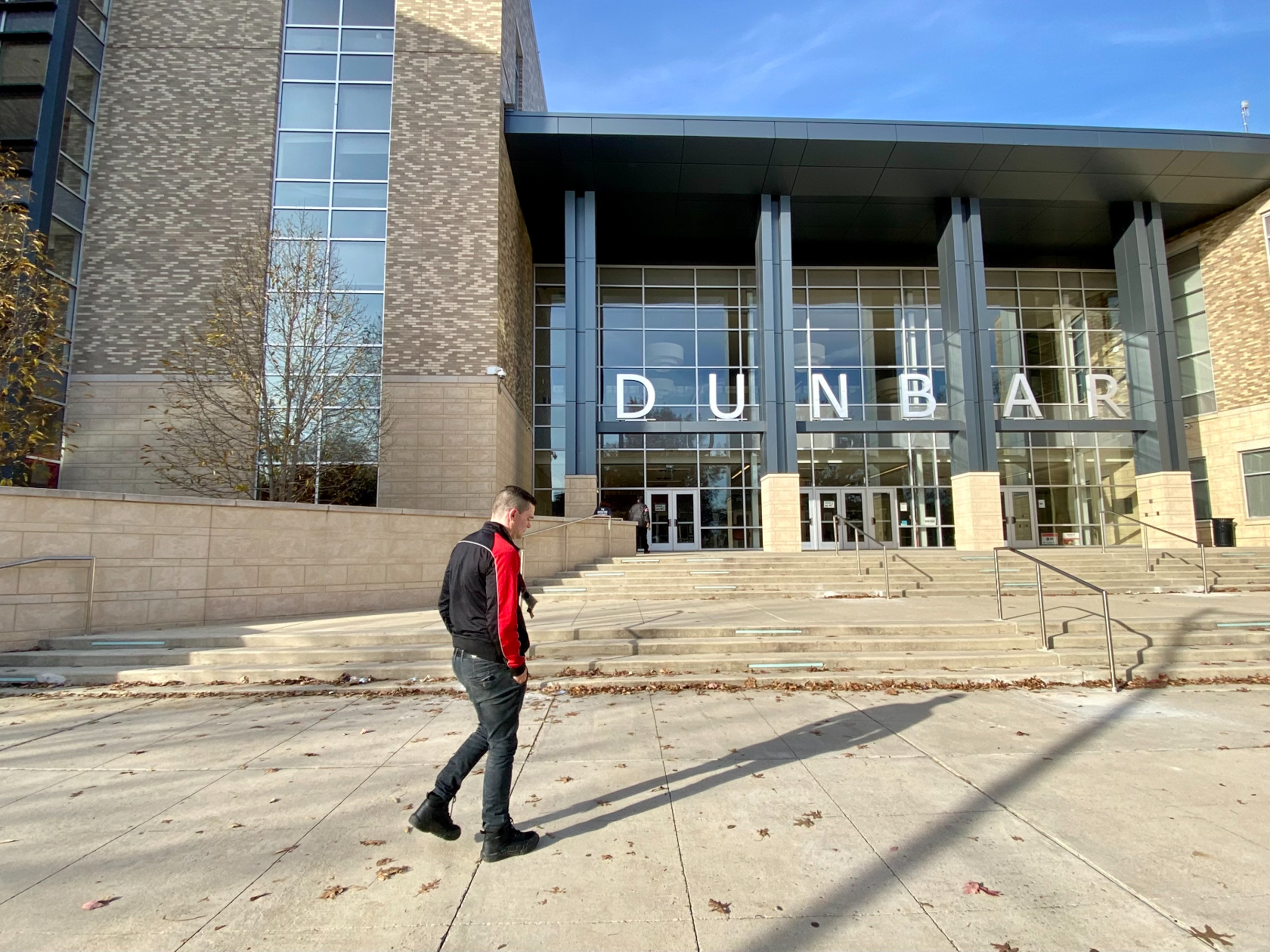
“It was obviously a low point,” he says outside of Dunbar High School. “Just coming here, I feel like I have a little bit of PTSD and I feel like someone’s out to get me.”
This post has been updated to include comment from union representative Charles Moore.