Jacob Fenston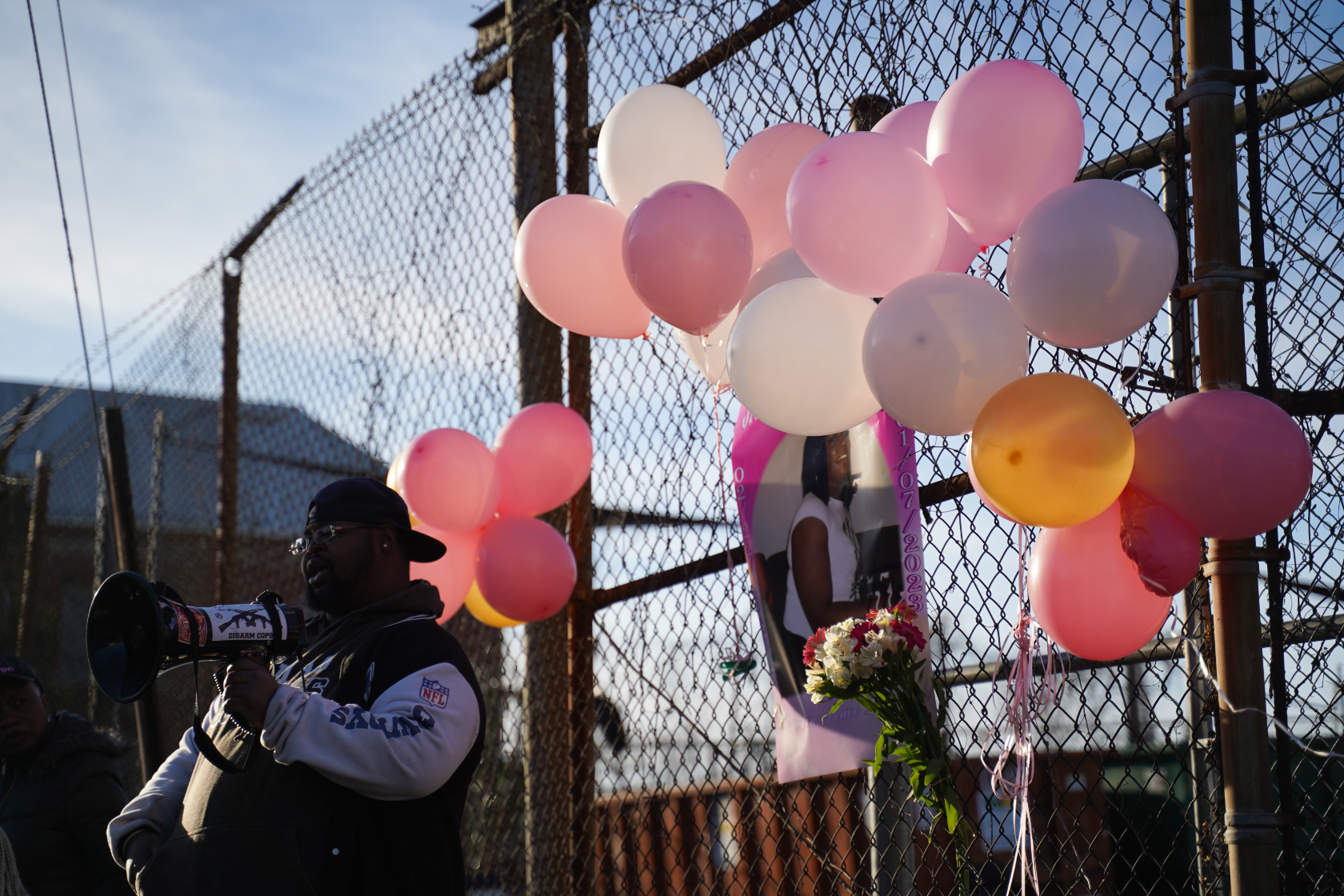
Pink and white balloons were tied to the chain-link fence outside a bus parking lot in Ivy City as several dozen people bowed their heads in prayer.
“All of us who are made in the image and likeness of God, we look to you right now. We’re crying out and we’re asking that the blood stop,” said Rev. Dr. D. Amina Butts.
The vigil was held on the corner where Jasmine “Starr” Parker, a 36-year-old Black transgender woman was killed earlier this month. A poster with her photo read, “Rest in Peace Queen.”
The vigil was organized by Earline Budd, a longtime trans rights activist, and a case management specialist at the nonprofit HIPS. Budd says she knew Parker for some 20 years, both as a friend and as her caseworker.
“I loved her dearly,” said Budd in an interview after the vigil. “She was someone who deserved so much more than what she got.”

Budd remembers Parker for her love of food, singing, and fashion. “She loved clothes. She loved to dress up when she could,” Budd said.
According to police, Parker was found with “apparent stab wounds” early in the morning of Jan. 7. Officers were flagged down in the 2000 block of Gallaudet St., NE, and found Parker had “no signs consistent with life.” The homicide branch of the Metropolitan Police Department is investigating, and offering a $25,000 reward. Parker also went by Jasmine “Star” Mack, according to police.
Many members of the local LGBTQ+ community spoke at the vigil, and decried the recent national spike in violence against trans people, especially trans people of color.
“Walking the streets should not mean risking your life. Going to the store should not mean that you could be taken down,” said Kenya Hutton, with the Center for Black Equity. “It’s not being called a hate crime. Well, we know what it was. Starr should be here today.”
Members of Parker’s family also spoke. “I appreciate everybody for coming out,” said her brother, Andre Tinsley, in an interview. “The violence have to stop, you know what I’m saying? Whether it’s gay or straight, violence is violence. I don’t believe we have to murder each other.”
Japer Bowles, director of the Mayor’s Office of LGBTQ Affairs, told family members he was sorry for Parker’s death. “Circumstances should not have put Starr and many members of the community that we see in the danger that they are in, and that is a failure from where I’m at in my job. We have to do more,” Bowles said. “I promise we will do more.”
Still, despite Bowles’s presence, Budd said she’s disappointed Mayor Muriel Bowser and Police Chief Robert Contee have not spoken publicly about Parker’s killing, or released much information.
“It’s almost as if she didn’t exist,” Budd said.
Parker was the first transgender person to be killed in the U.S. this year, after several years of rising numbers of such violence, according to The Washington Post. In 2021, there were the most documented killings of trans people on record. More than 75% of victims nationwide were Black trans women, according to the Post.
Advocates say there has been an uptick in violence and harassment against trans and LGBTQ+ people in the District. Police data show there were 22 hate crimes based on gender identity or expression last year, up from 16 the year before, and 45 hate crimes based on sexual orientation, up from 38. However, the numbers have gone up and down over the past decade. Police say it is difficult to establish hate as a motivation for a crime.
Police have not indicated Parker’s death is being investigated as a hate crime, and a spokesperson did not respond to a request for comment.