Martin Austermuhle
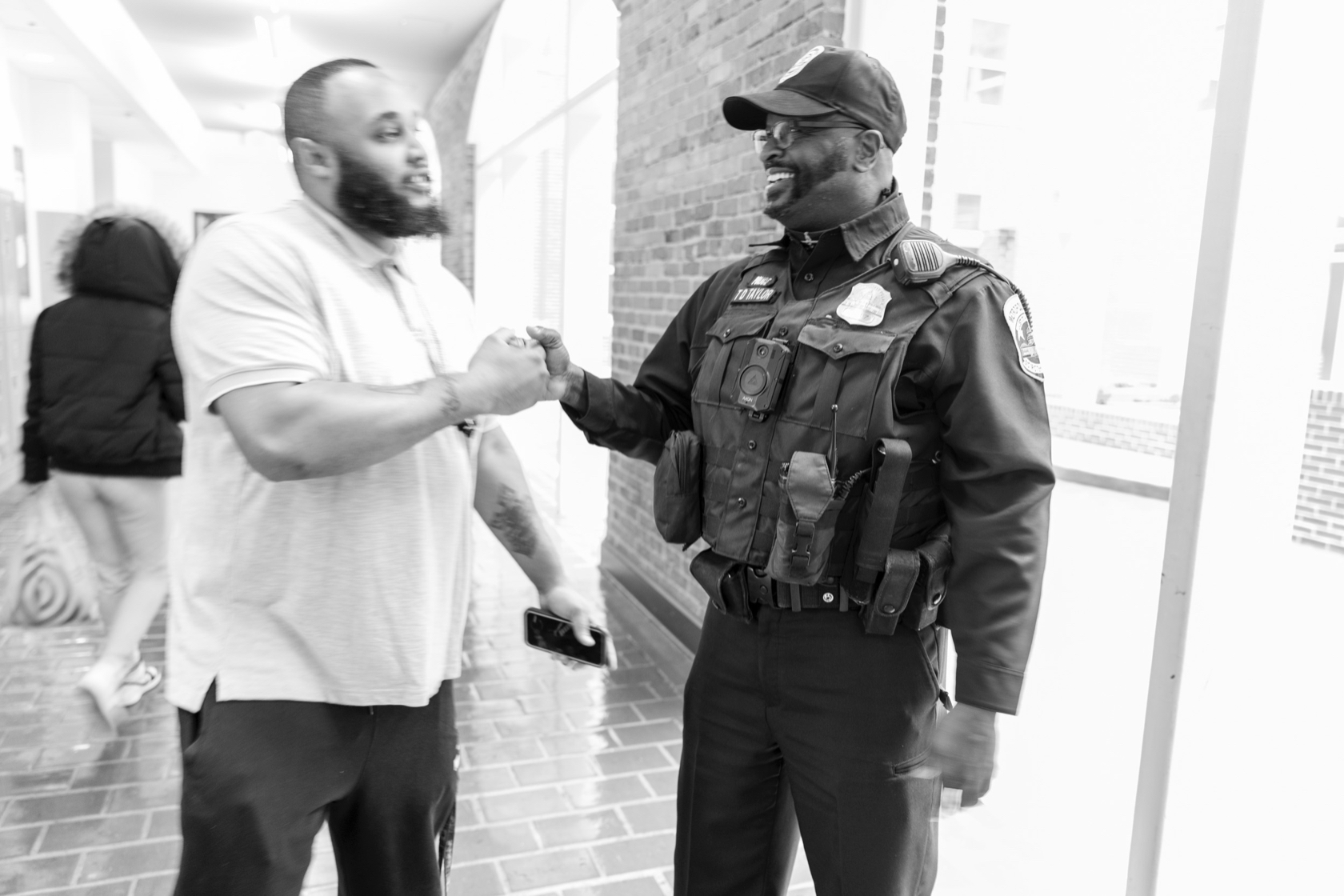
At least twice a day, D.C. Police Officer Tracy Taylor knows exactly where he’ll be: standing sentry at Eastern High School, greeting the more than 700 students as they come and go from the 100-year-old building on East Capitol Street NE.
As one of the city’s designated school resource officers, it’s Taylor’s job to be a presence at the school, ensuring the students get in and out of the building safely, working to de-escalate any conflicts that may brew in surrounding neighborhoods and make their way into the building, and responding should a principal need him to intervene during the school day.
But lately Taylor says his job has gotten a little harder: there are simply fewer school resource officers for the same number of D.C. schools that need them on a daily basis, meaning that he finds himself splitting his time between more places.
“We’re really stretched thin,” he says.

And that’s largely by design: Two years ago the D.C. Council voted to gradually pull police officers out of the city’s schools, citing concerns over the climate it created in schools, as well as about policing more broadly in the wake of the racial justice protests that erupted across the country after George Floyd’s murder in 2020. The Metropolitan Police Department’s School Safety Division was once staffed by 100 school resource officers; it’s now down to 40, with the division set to disappear altogether by July 2025.
But even amidst the broad rethinking of policing that has happened in recent years, the issue of school resource officers has prompted some of the most vigorous debate — and flip-flops in local policies. School resource officers were fully pulled out of schools in nearby Alexandria and Montgomery County, only to be later returned, albeit under new names and with slightly modified responsibilities. In Boston, some local lawmakers are pushing to return police to schools after a spate of violent incidents.
Now D.C. Mayor Muriel Bowser says she’s redoubling her efforts to reverse the council’s move to pull officers out of schools. And she’s likely to have at least some support on the council, where lawmakers are more closely divided on the issue than they are with almost any other element of police reform.
“I really think the council doesn’t realize how valuable we are,” says Taylor. “So they’re just throwing us away like trash.”
‘They say Uncle Tracy’
Taylor has been with MPD for 31 years, 10 of which he has spent as a school resource officer. The Maryland native says he never expected to work with kids, but a stint in the Boys and Girls Club — which provide recreation and educational activities for kids, and which were managed by MPD until 2003 — changed that. Taylor got trained as an SRO, and for a while served as Officer Friendly, which connects police officers to elementary schools.
He says his job is easily misunderstood; Taylor insists that SROs aren’t on hand to enforce school policies or write up kids wandering in the hallways. (The city contracts with private security guards to work at the entrances of schools.) Rather, Taylor says his first job is establishing relationships with kids. “I know most of the kids out there,” he says. “They don’t even call me Officer Taylor anymore. They say Uncle Tracy.”

That personal relationship with kids and families is critical, says Taylor, whether it’s to break up fights between families at pick-up or drop-off (they happen, he says) or to quickly jump in to de-escalate a conflict between students. Were schools to rely on traditional patrol officers, says Taylor, the responses could be much different.
“They don’t know what’s going on with that child in the building,” he says. “And I show up, I know exactly who the child is. I’m able to de-escalate, talk to him, and allow him to have a normal day, so to speak. Because a lot of times, they just left trauma maybe from home and they’re elevated when they get in the building. And if you don’t understand that as an officer, all you see is someone who is elevated, and you respond to that.”
Katreena Shelby, the principal at Kramer Middle School in Anacostia, says she’s seen how the responses can differ between a known school resource officer and a patrol officer called at moment’s notice.
“Because they don’t know who these students are and they’re responding to an incident where I’m saying there’s a huge brawl outside, they’re going to come to dismantle the brawl and it’s going to be handled not like these are children, but this is a street brawl,” she says. “When I call a resource officer, he’s coming with the context that these are kids that he works with every single day.”
Shelby says the school resource officers also help school leaders like herself understand what neighborhood issues and conflicts kids might be bringing with them everyday, as well as working to safely get kids to and from school everyday — a critical role in some parts of D.C., where students cross through neighborhoods where violence and local beefs may be endemic.
Ari’yell Carter came to Eastern last year after having moved to D.C. from South Carolina. The 16-year-old sophomore has grown to know Taylor, who she refers to as “family” and an officer who “gives people chances.” She thinks his presence can give students a positive view of police, one they may not otherwise get on a daily basis. And Carter says Taylor helped her manage her own transition into the school.
“I was actually having trouble at Eastern and he gave me some good, positive vibes and gave me motivation,” she says. “I feel that if he wasn’t around, I wouldn’t be safe.”
‘One day they might be nice, but then the next they might flip out’
Samaria Short is a few grades ahead of Carter at Eastern, and has had a different experience with school resource officers. Short, 17, says one of the officers once singled her out, ordering her to change because the officer claimed she was violating the school’s dress code. That uncertainty over how a student might be treated can be unsettling, she says, especially for kids who may have had unpleasant run-ins with police outside the school building.
“A lot of the kids who go to my school, me included, have dealt with harassment from police officers just from walking on the streets. So having them being allowed in a place where they’re supposed to feel safe and comfortable to learn is very triggering,” she says. “You don’t know what you’re going to expect. One day they might be nice, but then the next day they might flip out on you. You never know.”
That sentiment echoes the findings of the D.C. Police Reform Commission, the 20-member body created by the D.C. Council in the summer of 2020 in the wake of racial justice protests across the country, in its final report outlining dozens of proposed changes for policing in the city.
“The regular presence of police in schools creates more possibilities for young people to have negative contact with law enforcement, including physically and psychologically harmful episodes in which police use inappropriate force. Their presence also increases possibilities for young people to have contacts with the criminal legal system for disciplinary issues that are more appropriate for school personnel to address directly,” said the commission in the report, issued in April 2021.
Later that year the council took up the cause, inserting a provision into the budget that would gradually shrink the size of MPD’s School Safety Division through 2025, after which it would no longer exist. It was a year later that Bowser tried to repeal that measure, but was rejected by the council. Five lawmakers dissented, though, showing some unease with the move to remove police from D.C. schools. Earlier this year, Bowser indicated that she’d wage the fight again.
Late last month, EmpowerEd and the Black Swan Academy, progressive advocacy groups that work with teachers and students, respectively, urged lawmakers to stay the course. “We do need security and safety in our schools,” they wrote. “But a focus primarily on armed officers as the only way to make schools safe misses the point, ignores the research, and leaves us more vulnerable to escalating conflict and violence in situations that could be de-escalated by non-armed adults with proper training.”
That’s what Short says she’d like to see.
“I believe that a lot of the schools don’t have enough mental health resources that will reach everybody. So they’ll have one school counselor for hundreds of students in different grades,” she says. “And not a lot of people know how to connect to them, how to talk to them, like how to reach out for that support.”
‘What does safety mean to you?’
Katrice Fuller-Whitaker finds herself squarely between Carter and Short on the question of whether school resource officers have a place in D.C. schools or not. She’s a mother of five boys, a Ward 5 resident, an administrator at a D.C. charter school, and a member of Parents Amplifying Voices in Education, a local education advocacy group.
“I do believe that their input, their presence could be overly beneficial to schools. But it boils down to the school leaders and the school leaders’ mindset,” she says, recalling instances where she observed a principal who “weaponized” a school resource officer against students.
Fuller-Whitaker fondly recalls the officers that were posted in her school as she was growing up; she remembers them dressing up as Santa Claus around Christmas and helping lead reading classes. She recognizes that the context around kids and policing has changed since she grew up, but she thinks there’s a way to keep some police presence in schools that recognizes the current climate and concerns some students may have with police in general.
“Let’s humanize them in the sense that we never want them in uniforms. We never want them with any of their weapons or things on campus. And we’re not going to just have them present when something negative is happening and we’re not going to use them for behavioral concerns,” she says.
But what Fuller-Whitaker says has frustrated her the most has been the lack of conversation on the issue. Because the council’s decision came through the budget process, there was never the chance for a public hearing where students, teachers, parents, staff, and police could weigh in on the fate of school resource officers.
“The first step of this process is to get into schools or get into neighborhoods and say, ‘Hey, what does safety mean to you?’ Because I feel that we have to begin to define that. That will give us more intel as to what that person or what that entity should be, whether that is community-based organizations or workers or clinicians or more of MPD,” she says. “But we have to start there.”
Gabrielle DuBose, who has been teaching for three decades and is now at the Duke Ellington School of the Arts, says she’s generally in favor of pulling police officers out of schools. Though she herself has fond memories of the Officer Friendly who came into her elementary school, she thinks the entire culture of policing has since changed.
“That whole Officer Friendly mantra has morphed into law and order. We’ve got to keep law and order, you know, And so there are those police officers who have that mindset. They’re not going to move from that, regardless of any training,” she says.
DuBose says she does see a place for balance where SROs remain in some capacity around schools, but are replaced by other professionals inside them.
“Rather than load them up with tasers [and] have a barrage of them be in and out of the schools, what can be added to the budget line is to not only train them in restorative justice practices and increase the number of mental health professionals in schools, but allow police officers to find a way to humanize themselves to the school communities,” she says. “What’s the harm in that?”
But as the debate plays out, D.C.’s existing and dwindling corps of school resource officers still go about their daily routines, pondering when they will no longer be tasked with working with kids.
“It takes a village with these children,” muses Officer Taylor. “And I’m just part of the village.”