 Sarah Y. Kim
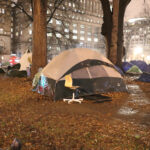
The National Park Service on Wednesday cleared a large homeless encampment at McPherson Square, despite pushback and calls for a delay from some D.C. lawmakers and numerous homeless advocacy groups.
Though the clearing was originally scheduled for April 12, D.C. Deputy Mayor for Health and Human Services Wayne Turnage requested that it happen two months sooner due to what he called “imminent public health and safety issues” at the site. Residents were informed in October that the square would be cleared, but they did not know the clearing was rescheduled until late January.
The clearing is the latest effort by D.C. and federal officials to address what had been an increase in homeless encampments in D.C. since the COVID-19 pandemic hit. Since mid-2021 the city has closed encampments in NoMa and Truxton Circle, while NPS has taken the lead to clear others outside Union Station, in downtown D.C., and on Capitol Hill.
While city officials say they have worked to engage encampment residents and connect as many as possible to temporary housing, some — including at McPherson Square — were left scrambling to find somewhere else to sleep. Umi, who declined to give her last name, became a resident of McPherson Square in 2020. She doesn’t know where she’s going to go next.
“I’m very enraged,” she said. “Wayne Turnage’s office has failed us.”
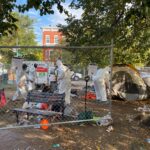
Umi had come to McPherson Square after getting evicted from another encampment at Franklin Park. “It’s very traumatic, as it always is,” she said. Behind her, trucks were parked in the square. Cleanup staff combed through the grass with rakes and pitchforks and shovels, throwing out entire tents, armchairs, clothes, and books.
Thankfully, Umi said, some local groups came to help her and residents move out, like Remora House, Stop the Sweeps D.C., and Ward 2 Mutual Aid. “That’s very helpful, having someone treating you like a human,” Umi said.
She’s planning on moving to another park, but she’s not sure which one. She and her neighbors are increasingly short on options.
“They don’t understand why they haven’t been housed, why it’s taking so long,” Umi said. “You all want to close the park because you just want to hide the homelessness. You don’t want it to be down here on K Street, which is a powerful street. You don’t want it to be by the White House.”

When NPS posted the original clearing notice in October, Umi said Turnage’s office had promised social services and engagement. But she said nobody came until just 14 days before the eviction.
NPS spokesperson Mike Litterst said in a statement that in recent months there have been “increasing levels of violence, illegal drug use, and significant criminal activity” at the encampment, impeding outreach to residents. Turnage echoed those concerns in a Feb. 2 email to a constituent, and said it was not “humane” to keep the encampment open.
“We work very hard to ensure that encampments remain safe while efforts are made to connect as many residents to housing as possible,” Turnage wrote. “But, when encampments exponentially increase in size and are partially inhabited by persons who engage in illegal activity, those sites must be closed.”
However, Umi said McPherson Square only got crowded after encampment clearings became more frequent. “When they closed those other encampments, they didn’t house people,” she said. “That’s why more and more people came here.”
As of earlier this month, there were an estimated 70 residents at the McPherson Square encampment, and fewer than half had completed an “assessment tool” by the Department of Human Services to determine whether they’re eligible for housing. By Tuesday, D.C. officials say there were 53 residents left at the site, 34 of which had been engaged by outreach workers, and 19 who refused.
But Umi challenged the claim that she and other refused help, saying that she and her neighbors have reached out to Turnage’s office via email and Twitter multiple times, with no response.
“This is just very frustrating,” she said. “They want to put out this narrative that we don’t want help, that we’re service-resistant.”

Umi says one of her fellow residents has been matched to a voucher since July, but that she continued to live in the square because Turnage’s office has failed to “activate” her voucher.
In the city’s shelter system, Turnage said there are 76 vacancies, 46 for men and 30 for women — “approximately sufficient,” he said, to house the residents at McPherson Square who “have not engaged for services.”
“Clearly, it is in everyone’s best interest to close this site before others die or are victimized by the illegal activity in the area,” Turnage wrote.
But for Umi and many of her neighbors, going to a shelter is out of the question. As cold as encampments can be, Umi said they are preferable to shelters. “It’s not clean,” Umi said of the shelters. “There’s body lice, roaches, vermin, there’s no ventilation. People steal your things. The staff doesn’t treat you well.”
Leading up to the clearing, Turnage’s office did not respond to requests for comment from DCist/WAMU. His office then issued a statement Wednesday night, reiterating concerns about health and safety at the encampment and noting that “per our standard practice, outreach efforts, engagement, and service connection will be ongoing.”
Speaking on Wednesday, Mayor Muriel Bowser said her administration decided to proceed with the clearing because the encampment was getting “increasingly dangerous.”
“We don’t believe it’s safe for people to live on the street,” Bowser said. She also said people will be more likely to get behavioral health services and be able to use their vouchers once they got to “a more stable environment.”
Over the past week, the call to cancel the Feb. 15 clearing grew louder. Members of the National Coalition for Housing Justice penned a letter to the Bowser administration and the White House urging it be delayed. D.C. Councilmembers Robert White (D-At Large), Brianne Nadeau (D-Ward 1), Matt Frumin (D-Ward 3), Janeese Lewis George (D-Ward 4), and Trayon White (D-Ward 8) wrote a letter Monday to NPS requesting the clearing be postponed.
But Bowser said waiting was not an option. “The argument was that we should wait until April, [but] in April we think that there could be untold numbers of people who were living there in unsanitary and dangerous conditions,” she said. “Is it a magic wand? No, it’s not. But what we have seen from site to site is that there are fewer people each time and more people are getting connected to services.”
Protesters showed up Monday at the square, and again Wednesday morning before and during the clearing, carrying signs reading “SHAME” and “STOP ENCAMPMENT EVICTIONS.”
The square itself was fenced off Wednesday to the public, including the press. But some people remained in the square, carting away belongings or staying in tents. A loudspeaker at one corner of the square blared a warning: “All persons remaining may be subject to arrest.” On the other end of the square, the loudspeaker was mostly inaudible.
Antonia Fasanelli, executive director of the National Homelessness Law Center, arrived at the square at 7 a.m., three hours before clearing began. Residents are anxious, she said.
“It has been a very tense situation this morning,” she said. “This eviction does not follow best practices.”
Fasanelli, who said she has attended other encampment clearings – mostly in Maryland – said “best practices” would mean housing encampment residents.
“That has not happened here. In the nation’s capital,” she said. “This is an embarrassment to the city. This is an embarrassment for the federal government that is not even following its own plan to end homelessness.”
She added that some police officers prevented service providers from going into the square and helping residents.
“Many unhoused people have experienced multiple traumas, including trauma at the hands of police,” she said. “The police presence here is unnecessary. Everyone is here in a peaceful capacity to provide services.”
Shortly after 3 p.m., two people were arrested for refusing to leave the park, as onlookers booed. NPS said Wednesday that they were cited and released soon after.
In an earlier statement, NPS said it had met with the National Coalition for Housing Justice “to discuss the compassionate-focused plan for closure.”
Ann Oliva, CEO of the National Alliance to End Homelessness, joined Fasanelli early Wednesday morning. She said she passes through the encampment almost every day. The night before the clearing, she stopped to talk with residents, some of whom were “really scared.”
“Justice was not done here today,” she said.
Jesse Rabinowitz, senior manager for advocacy and policy at local social services organization Miriam’s Kitchen, said it’s “cruel and inhumane” to clear the encampment when most residents are still unhoused. He said it’s still not clear who is eligible for what resources.
“There’s so much miscommunication and back and forth that people are very confused,” he said. “It illustrates the fact that this is being done rushed and without a plan.”
Christy Respress, executive director of social services organization Pathways to Housing D.C., told DCist/WAMU that if the closure had been delayed, staff would have had more time to work with residents and help them find housing, shelter, or other living arrangements.
Those who have housing vouchers but haven’t yet been housed are eligible to stay in “bridge housing,” or a hotel. Rabinowitz expressed concern that there would not be enough units, though Caron Kirkland, outreach program manager for the D.C. Department of Human Services, said there would be enough bridge housing for those who are eligible at McPherson Square.
Kirkland, who is also with Pathways to Housing D.C., has been trying to connect people to mental health agencies and substance abuse treatment. “I didn’t expect to come back and find so many new tents this morning,” she said Monday.
One of those new tents was Brandon Campbell’s. He didn’t know the clearing was happening until a few days ago, shortly after he and his dog Lucky moved to the encampment.
“Funny, right?” Campbell said Monday, standing in front of his tent. “We don’t even know what’s going on.”
Luckily, Campbell is one of the few residents at McPherson Square with a housing voucher. The process to get that voucher started in 2019. Campbell has been homeless since he was 21. He’s now 30.
But as of Monday, he still hadn’t seen his apartment. “It’s just taking so long,” Campbell said. For the time being, he said, he would be in transitional housing. That’s a first for Campbell — though it was not immediately clear whether he could bring Lucky with him.

“I’ve been trying to look for transitional housing for the last four years,” he said. “I keep hearing about it, hearing about it, hearing about it.” He spent some time in D.C.’s PEP-V hotel shelter system, but left. “It was horrible,” he said.
For Campbell, what’s happening on Wednesday is all too familiar. “It’s barbaric,” he said. “It’s not truly thought all the way through.”
He has lived in multiple encampments, including one that used to be beneath a K Street underpass near Capitol Hill and was cleared out in the winter of 2020.
“Just because people want to walk in the park, they don’t wanna see a tent, all of a sudden I gotta move my tent,” Campbell said. “Now I gotta find somewhere else. Two weeks after that, someone doesn’t want to see – so I gotta move my tent, move my tent, move my tent. I get it, you don’t want homeless people. But you don’t want to help the homeless. You just wanna get rid of them.”
Moving belongings and setting up a tent is not a one-man job, Campbell said. Setting up his first tent took him four hours. His tent at McPherson Square took five minutes. “I shouldn’t be that experienced,” he said.
By Wednesday night, Campbell had good news: he was finally housed — not in transitional housing, but in the apartment he got through his voucher. But he says he still needs help getting basic amenities.
What Campbell wants most is to go back to school. He said he and other unhoused folks are looking for job opportunities, adding that he has 14 years of customer service experience and 12 years of IT experience under his belt.
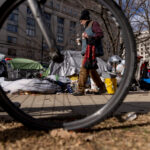
Early Monday afternoon, Robert Massey, 63, was riding his bike through McPherson Square. He used to sleep there too, about 20 years ago. Back then, he wasn’t allowed to set up a tent.
“Where are all these people going to go?” he said. “It’s inhumane.”
Massey is now housed thanks to Community of Hope, a local organization that connects people with housing and healthcare. The process to actually get housed took six months.
“It’s too long, man,” he said. He expects it would be years before some of the residents at McPherson get housing vouchers, let alone get housed.
“If the powers that be really wanted to house people, it can be done,” he said. “Sadly, it’s not.”
He came again on Wednesday morning. It’s become a routine for Massey to bike through all the places he used to sleep in. He says he doesn’t want to forget where he’s from.
He remembers dreading rainy nights. He remembers becoming dependent on cocaine during the crack epidemic — for a “false temporary sense of security.” He remembers the feeling of wanting but not being able to shower. Today, as soon as he’s in the shower, he says, “Thank you, Jesus.” When he talks about people who are homeless, he says “we.”
“We don’t want much,” he said repeatedly. “Just a safe place to go.”
This story has been updated with new information about Brandon Campbell’s housing, arrests after the encampment clearing, and a statement from the Office of the Deputy Mayor for Health and Human Services.