Dee Dwyer
 Elliot C. Williams
D.C.’s Anacostia neighborhood has long had a reputation of accomplishing a lot with a little. Too often, residents have needed to find creative ways to keep businesses and art programs alive amid underinvestment from the city and potential developers. But what could the majority-Black neighborhood in Ward 8 achieve with more funding?
Kristina Noell was appointed executive director of the Anacostia Business Improvement District (BID) in 2018, and she began asking this very question while meeting with local Advisory Neighborhood Commissioners, the BID’s arts council, and more than 110 local business owners she says she visited.
The main thing she says people wanted to amplify: Anacostia’s arts and culture scene. The neighborhood is already well-known as an official historic district, but Noell and other local leaders wanted official recognition of the area’s creativity.
“We want to be a world class area, just like the rest of the city,” Noell says. “And we want to be able to showcase what we have and what is so special about where we are.”
So, last July, the Office of the Deputy Mayor for Planning and Economic Development (DMPED) awarded $3,780,000 to the Anacostia BID to formally establish the Anacostia Arts and Culture District. Noell says she asked for “a lot more money than that” and that it’s an American Rescue Plan Act grant, meaning there are restrictions on how the funds can be spent over a five-year period.
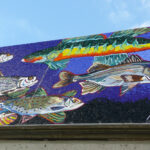
This grant is just the first step — it’s a transformative placemaking grant that can be used to add murals, signage, lighting, outdoor furniture, and greenery to welcome visitors and highlight already existing programs like Art to Go Go and the Anacostia Jazz Hop, Noell says. With an unveiling ceremony last week, Mayor Muriel Bowser solidified the designation and promised an additional $202,000 to create public art in Ward 8 through DMPED and the MuralsDC program.
To learn more about what the community wants, DCist/WAMU spoke with Ward 8 artists about what art means to them and, specifically, what they hope to see in an official Anacostia Arts and Culture District.
Their responses have been lightly edited for length and clarity.

Chris Pyrate – Artist
Art means to me, a vision that someone has in their head that they can only see. Something that doesn’t exist, yet that they can make other people see. That’s what art is, the process of making people see what’s in your mind.
We have a new arts district coming here to Ward 8. How do you feel about that?
I think it’s about time. I always tell people a big inspiration to me about what I do is, if I had seen people like me, early on, I probably would have got to my destiny or purpose way faster instead of going through a bunch of different trials and tribulations, you know, growing pains. And especially coming from around there – there’s a very limited scope, at least when when I was growing up, of people you see like you and what they’re able to do with their life.
I think art is just so unlimited in general. It makes even other things possible to you, even outside of art. When I was a kid, I wanted to make video games – that’s through art. I feel like from video games, to designing cars, to whatever you see, art means unlimited imagination.
What type of support would you say is needed for the arts district to be a thriving arts district, for it to be successful?
I think its twofold, I think you need funding, but funding isn’t always the answer because you need direction with that funding. You need different generations of artists to help lead it. We have different timelines of how you can make it, it’s not a linear career path. How people made it 40 years ago is still relevant in a gallery type of way. [But] you need young artists to represent the ever-changing ways that’s coming. I don’t think funding works without artists’ representation because you get a lot of people who represent wards and cities and can spend budgets, but they’ve never experienced art or making art. They don’t know what it takes.
How do you envision this arts district?
I think we need loud walls, colors, because everybody passes them and drives, passses [through] that [area] all the time. I think it just creates an atmosphere. You look at a place like Wynwood in Miami, there’s no place like that. We have that talent here and we have the walls for sure. There’s a lot of brick, and instead of just leaving things the natural color, why not expose people’s imagination? I think that’s a great environment for kids to grow up in specifically. Because kids gravitate towards that stuff – especially over there,(Ward 8) kids have got to grow up quick. Just having that type of art everywhere – I’m speaking of murals specifically. I see that immediately.
I think art installations too, they do that in Miami, L.A., a little bit in New York. Statues, things like that. They rotate, it’s not just a historic statue, but something creative. Something interactive too, where people can use it but it’s also art at the same time. I just see interactive from walls to installations.
I just think this is mad important. Having proper representation of people from the area, specifically Ward 8, Anacostia, around that area – get those artists involved too, so it doesn’t get out of hand. Some of this stuff loses identity in the process, and I think we can’t allow that.

Keyonna Jones – Artist, Executive Director of Congress Heights Arts & Culture Center
We are an art gallery, first and foremost. We provide programs and workshops. We also serve as a rental space for the community. But we have a mission to expose, inspire, educate and heal our community, all through art.
How do you feel about, and what do you envision a new arts district in Ward 8 to be like?
I’m very excited about the opportunity that’s coming east of the river. I think there’s a lot of development and things happening, but my lane specifically is about art and how we can use art to make our communities better. And so that much money that’s dedicated to specifically what I do and love every day is very exciting.
What will it look like? It will look busy. It will look colorful. Plenty of murals, plenty of gallery shops that can [be] just next door to each other – you can walk down a strip full of art. I think it’ll be a space where artists will want to come from all over the city, not just from east of the river. I think it will help us thrive as a community. More traffic, more business.
I think it’s important to have a space and multiple spaces that all types of artists can visit and benefit from. I think we have a lot of galleries and traditional places for visual arts, but it’d be exciting to see some more diverse places for music or dance, just touching every avenue of art. I think that’s important and it’s cool to see on our side, things that you’ve never seen before that you could go see downtown in the Smithsonian – high caliber art.
What do you feel is needed? What type of additional support does Ward 8 need to have a thriving arts district?
I think one thing that most people need to know, or most people start to learn about the businesses east of the river – in, our community, is that we need technical support. There’s a lot of us that are doing it from passion, and we’re one woman or one-man bands just trying to handle a lot of work. So, I think not only just creating spaces for us to be in, but having that back end support, whether it be accountants, CPA’s, grant writers, anything that could help the other businesses that are already here scale and expand I think would be helpful.

Dionne McDonald – Curator, Honfleur Gallery
Art is a lens in to worlds, known and unknown. It is shapeless and cannot be contained. Art challenges your beliefs and reshapes our perspectives. It is softness a cove or haven. Art is mostly visual but reaches all of our senses. Sometimes art is a life raft. As a new arts district establishes itself in Ward 8, I’d like to see the richness of the culture that already exists here be amplified.
What type of additional support do you feel Ward 8 needs to be a thriving arts district?
More visibility, accessibility and more unbiased support. The funding of projects that are impactful and meaningful to this community. Making sure the commitment to authenticity is maintained.

Dietrich Williams – Co-Founder, Capitol Hills Boys Club at “The Laundromat”
The artists’ residency is something that was created out of a need. We – Marc Garrett, my business partner – have been working in the arts as muralists and created a program of the things we need and saw that ‘oh, everybody needs this stuff’. Being muralists in Wards 7 and 8 and Ward 6 as well has shown us over the past two years – we keep meeting photographers, we keep meeting poets, we keep meeting rappers, we keep being producers. But everybody we meet is from over here (Ward 8), we keep meeting them in different spaces, but everybody’s from over here (Ward 8).
How do you feel about Ward 8 having an arts district? How do you envision it?
To be supportive of artists and art serving organizations, to be collegial in their approach in their 5,10, 15 year plan. The largest arts area in D.C. really is is in Wards 7 and 8. I envision them just being collaborative with the artists and artists’ organizations so we can help shape whatever this is going to be like for everybody. And it’s not just like something that’s [going to] come here and [be] imposed on us and saying, this is going to be like this and this is going to be this way, etc.
What type support does the arts district need to provide?
The arts district needs open space for artists to be inclusive in whatever it is that they plan on rolling out. It’s going to need a space where artists can go and create things in a drop-in capacity. We need that because artists on this side of town, we can’t afford to rent buildings and to have studio galleries. With the cost of living and the real estate, it’s just not an option to do.
And one of the things we want is to be able to leverage some equity for artists so they can just be artists – whatever that looks like for them. Give them assistance, don’t tell them how to be artists. You know, there’s a lot of spaces that can tell you how to be artists, but what they’re not doing is helping you with being artists, and with removing some of the barriers.
You may need to have an exhibit on how to go out there and begin working. Maybe you need supplies, maybe you need a place to show, maybe you need a website, maybe you need marketing and people need to know who you are. Maybe you need the business aspect of it – like being a sole proprietor and have an LLC and being registered with all the necessary agencies so you can be an artist.
Just try to be as inclusive as possible.

Marc Garrett – Artist, Co-Founder of Capitol Hills Boys Club at “The Laundromat”
[Art] is a form of expression. It’s an expressive interpretation that people can connect with. I’m a practicing artist and I’ve been a professional artist since 2012.
How do you feel about the new arts district and what do you envision for that?
I feel like D.C.’s culture oftentimes has come from its poor, more so than its affluent. If I were to do anything, I would start here, too. But on a more enlightened note, the cheapest real estate is here. So that’s the real reason why it’s going to start here if it can happen, because there’s a lot of open development that needs to take place and it can happen a lot faster with an underdeveloped area where impoverished people are given checks to give up their property, etc.
What do you envision for for the new arts district?
If I had a stronger connection to the construction and developmental process, the banks that reside in the city and the philanthropists, I would try to seek out the best ones. The ones that have a good rapport. Ones that have proven themselves to make equity wherever they’ve gone. And if they’re going to come here, I would like to see that happen versus any of the macro developers that just want to come here because they see stuff moving around over here and they want to pad their resumes with good intentions.
What type of support do you feel Ward 8 needs to thrive in the arts district? And what type of support do you need to have a thriving artists’ residency specifically?
I am a muralist and a commercial artist, so the bulk of my support has been in the form of supplies and grants. I think that D.C. Humanities is trying to work on the connectivity to its artists that want to apply. I think that there is a lot of application discrepancies that get in the way of a lot of artists’ funding that they can have access to. So, what I would hope to provide is a bridge over top of that so that people can get to the money that they deserve and have access to a lot of the things that other operating artists have.
With everything on the rise, I hope ‘rising tides raises all ships’ and I hope we can connect with some of the developers to ensure that whatever it is that they have in mind is overseen by the right people, whether it be us or other like-minded organizations.