Colleen Grablick
Over two days of emotional testimony from residents, community organizers, and gun violence prevention activists this month, one theme came up again and again: “the system is broken.”
From a dearth of city-run mental health services to unsafe police interactions to disorganized violence prevention efforts, residents from the communities most impacted by gun violence said the government is failing its people – and isn’t listening to what they need.
“I heard the mayor say…’We got a gun violence problem.’ We don’t have a gun violence problem,” said Johnny Howard, a peer support specialist who testified at Saturday’s gun violence prevention roundtable, hosted by Ward 2 Councilmember Brooke Pinto. “We have a people problem…No gun has ever gone to court and got charged. Invest in people.”
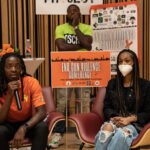
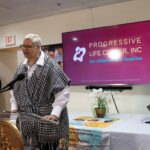
For over three hours on Saturday afternoon, residents, community leaders, and advocates offered their personal experiences with gun violence, their vision for solutions, and at times, frustration and anger at the multiple ways they say the city has failed the predominantly Black neighborhoods east of the Anacostia River. It marked the second of a three-day series of discussions hosted by Pinto, who is in her first stint as chair of the council’s Committee on the Judiciary and Public Safety.
“I heard a lot about concerns for implementation of programs that do exist, and making sure that they’re effectively interrupting cycles of violence,” Pinto said in an interview with DCist/WAMU on Monday. “There are so many fantastic community organizations or leaders doing so much of this work…but not all of those groups are getting support from the government, or funding, or even consistent training.”
Pinto says she plans to have her first meeting on Tuesday with staff to discuss what legislation, oversight procedures, or budgetary decisions can be made to account for residents’ feedback at the roundtables.
As of March 7, there have been 39 homicides in the city so far this year, a 34% increase from 2022. While the number of people killed last year decreased from 2021, the city saw an uptick in teen killings. In recent years, Mayor Muriel Bowser has created new programs, positions, and task forces to target gun violence and crime. In 2021, she poured $15 million into an initiative called Building Blocks, a network for overlapping government services tasked with addressing gun violence in targeted parts of the city, and opened an emergency operations center to respond to the crisis. (Last year, the emergency operations center wound down its services, and Building Blocks, instead of operating in a coordinated network, morphed into a more ambiguous framework spread across several agencies.)
Last month, Bowser appointed Linda Harllee Harper, the leader of the Office of Gun Violence and Prevention, to lead the Office of Neighborhood Safety and Engagement, a move meant to increase coordination between the city’s violence prevention agencies. She’s declared gun violence a public health crisis, and made a number of investments in violence interruption and diversion programs.
But community members have questioned whether those initiatives are reaching the right people, and whether the money is going to the right places. Several people who testified Saturday said the benefits of the government’s programs aren’t materializing in their communities, and don’t go far enough to address the overlapping causes of violence, like racism, poverty, and lack of access to healthcare. They spoke of a desperate need for more affordable mental health services east of the Anacostia River – specifically a network of providers that come from the communities they serve. They also called for changes to the city’s violence interruption framework, namely unifying the multiple violence interruption programs and funneling more money into smaller organizations, and for the city to decrease its reliance on police when addressing community violence.
“Somewhere along the line, the government became the creator of things and the community became a support,” said Warees Majeed, co-founder of Yaay Me!, a nonprofit serving youth, families, and formerly incarcerated residents in D.C. “Flip that around, it’s the way things are supposed to be. The community, we are the creators, we should be giving the demands and saying exactly what we want in our communities.”
“Trying to arrest your way out of violence”
Activists have long called for the city to explore alternatives to policing, and instead divert money into violence interruption, mental health, and other social services.
Nee Nee Taylor, the co-founder of the abolitionist group Harriet’s Wildest Dreams, re-upped all of those calls before Pinto on Saturday.
She shared an anecdote of a recent incident in which she and other community leaders were meeting with a group of young people to discuss violence in their communities. While they were outside, Taylor said D.C. police’s gun recovery unit showed up, disrupting the violence prevention she was trying to do. (MPD no longer maintains a gun recovery unit in name, according to D.C. police; Bowser and D.C. Police Chief Contee replaced the unit with a joint local and federal task force called the Violent Crime Impact Team in 2022, although the group’s goal is still to remove guns and arrest illegal gun holders.)
“Not only did they make us unsafe, they lost trust with the young men that we were trying to deal with,” Taylor said. “Those people still trust me, because I kept them safe as a community leader.”
Responding to crime with police – such as increasing their presence on certain targeted blocks – only perpetuates the violence cycle, Taylor said. So far this year, D.C. police have shot and seriously wounded one person, and shot at another man who later died of a reported self-inflicted gunshot wound. Last week, U.S. Marshals killed a man in the Washington Highlands neighborhood.
“There’s alternatives to policing. I don’t hate the police. I hate the system that was never built for Black people,” Taylor said. “There’s an undeniable connection between community violence and police violence.”
The role police should play in the city – and how many officers the city needs – has been a long-standing debate in D.C. Bowser has put millions into ramping up police hiring, and last month, Ward 7 Councilmember Vincent Gray introduced a bill that would increase the size of the police force as MPD sees a two-year decline in officers. Just last week, Ward 8 councilmember Trayon White introduced a bill that would put school resource officers (SROs) back in schools, after the council voted to phase out SROs in 2021. Taylor said the city dollars put towards attracting more officers, could instead be put towards building out better violence prevention efforts on a grass-roots level.
“We have to be honest about how relying on the police to address violence facilitates the ongoing criminalization, brutalization and killing of Black people,” Taylor said. “And how we rely on the police, demanding more police presence, more aggressive police, does not make us safer and does not make us feel safer…you can’t police your way out of gun violence.”
“We live in a community of people who are grieving”
Several individuals in the room spoke of their own experiences with gun violence, and watching loved ones – specifically children – in their lives carry trauma. Ward 8 ANC member Amanda Beale testified in her capacity as a licensed therapist, explaining how prolonged grief exacerbates community violence, especially when the city has too few resources for residents in the aftermath.
“When someone is killed and it hits the news, it hits pages like DMVHood or WashingtonianProblems, you got all these people – who don’t even live in D.C. – talking about what happened to your family. Or on the unsolved murders, you have no resolution to your loss, [people] have no answers to what happened to the family members,” she said. “ This all creates prolonged grief, and people have not received the proper mental health services…We live in a community of people who are grieving.”
A community member in the audience, who lost her son to gun violence, and then the mother of his daughter just months later, stood up and directly asked if she could connect with Beale for therapy, saying she’d had trouble finding a counselor and didn’t trust the city’s Department of Behavioral Health to help her. Beale said the city needs to fund counseling and social services that physically exist in the neighborhoods they serve, staffed by residents who grew up in the city and know those communities. (Last fall At-Large councilmember Robert White introduced a bill that would fund a masters in social work program at the University of the District of Columbia, free for District residents, but it failed to advance before the end of the legislative session.) Beale suggested that the city – instead of funding a ramp up in police officer hiring – create 800 mental health counselors.
“We need a safe space for people who look like them, that understand their culture, that they can come to when they need to,” Beale said.
“Too many cooks in the kitchen”
The city has several non-police violence reduction programs, or violence intervention programs. The Office of the Attorney General oversees Cure the Streets, a program that enlists outreach workers to build relationships with people at risk of being involved in gun violence and uses a data-driven approach to tracking violence in targeted neighborhoods.
The mayor’s office of Neighborhood Safety and Engagement runs its own violence interruption program, which also relies on community members with historical understanding of neighborhood conflicts to intervene before violence occurs, and the Department of Youth and Rehabilitation Services has a credible messenger initiative. There are also private groups doing similar work, like the D.C. Peace Academy, which is funded with private donations. (Many of the violence interrupters trained at D.C. Peace Academy work with the city-contracted violence interruption agencies as well.)
At baseline, the programs operate under a similar model: establishing relationships between community members and individuals at risk of being involved in violence as a way to deter or mediate conflicts before they escalate. But the city’s scattered approach, with different programs existing in different agencies, has long been critiqued. Majeed, the co-founder of Yaay Me put it plainly on Saturday: “We have too many cooks in the kitchen.”
“We need to find a way to streamline everything,” he said. “Because the smaller organizations, like Yaay Me, there are times that we don’t have the proper guidance to be able to compete and maintain and sustain what we have been doing. But we are doing the work, and we have some of the greatest impact in the community.”
The notion that the government’s disorganized response is hindering its violence reduction efforts is not new to D.C. officials. A 2022 strategic plan to reduce gun violence, commissioned by the Criminal Justice Coordinating Council, identified a lack of strategy and coordination between agencies as one of the city’s largest failures. In response, former interim Deputy Mayor for Public Safety and Justice Kevin Donahue said the city was going to hire more violence prevention workers, pay them more, and increase communication between supervising agencies and the violence interrupters working throughout the city.
Another shortcoming of the city’s approach,, according to community member Betty Murray, is a lack of mental health resources for the city’s violence interrupters. A mother of four men and founder of the nonprofit group Genuine Sisters Supporting Sisters, Murray works in the Congress Heights community to prevent violence. But she said she often feels unsafe and has been threatened doing that work – adding that the city-run violence intervention programs don’t focus enough on rehabilitating men before sending them back out into a community, where they could be triggered.
“Are we really rehabilitating them before we put them back out in the community?” she asked Saturday. “I have lost respect for so many people in my own community, because so many of these kings came and stood there and watched me be threatened.”
Murray specifically spoke of the need for services that target Black women, who are often caring for their community while in pain themselves. Her community group, Genuine Sisters Supporting Sisters, is still waiting on money from a community grant, she said.
“There’s a ton of resources for the men, but who do you think holding those men down when they gone? It’s a strong Black queen behind them, running the household, raising the kids,” Murray said. “I love doing what I do in the community, I shouldn’t have to step back because my life is threatened.”
“We need to just do a better job”
On Monday, Pinto convened the third and final roundtable for public officials, opening her remarks by describing the frustrations she’d heard over the weekend.
“The issue of gun violence itself rarely came up,” Pinto said of the public witness testimony. “Instead we were pleaded with, the council and the government, to support greater access to mental health services for those who’ve experienced gun violence…we also heard frustration from residents not only on the lack of progress in addressing these issues, but the failure in their eyes for District leaders to listen to the residents and communities most directly impacted by gun violence.”
She was joined by fellow councilmembers Robert White, Brianne Nadeau, Frumin, and a slew of Bowser administration officials, including Metropolitan Police Department Chief Robert Contee and Acting Deputy Mayor for Public Safety and Justice Lindsey Appiah. Attorney General Brian Schwalb and researchers with expertise in addressing gun violence in a public health framework also participated in the conversation. (Linda Harllee Harper, who now leads both the ONSE and OPGV offices, was not at any of the three roundtables. Neither office returned DCist/WAMU’s request for comment. Pinto told DCist/WAMU that she had invited the director and was “disappointed” to see she wasn’t there.)
While the community’s conversation on Saturday offered a number of solutions, the lawmakers largely spent their discussion breaking down details, like how agencies do – or don’t – communicate and share information with each other, and how prosecutors and police track down illegal guns.
Dr. Joseph Richardson, a professor at the University of Maryland who researches violence among Black youth and co-chair of D.C.’s Violence Fatality Review Committee, echoed similar concerns as community members about the splintered nature of the city’s violence interruption approach. Richardson described the gaps in communication and coordination between different agencies and prevention programs as the city’s “achilles heel” when it comes to improving its outreach.
“It’s also important to have policymakers, community members, MPD, universities all at the table at once and not communicating and talking over each other because we’re in separate silos,” Richardson said. He’ll be working with Dr. Daniel Webster of Johns Hopkins University, who also participated in the discussion, to study the outcomes of community violence intervention programs in the city. “I actually believe we have far more resources than many of the cities in this country, but we just need to do a better job.”