 Jenny Gathright
 Colleen Grablick
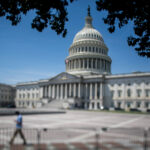
The Republican-held House of Representatives overturned a local law implementing a slew of police reform bills — voting 229 to 189 in a disapproval resolution.
Though it passed the House, it’s unclear whether the disapproval resolution will make it through the Senate and President Joe Biden’s desk; Biden has already vowed to veto the measure.
“While he does not support every provision in the D.C. policing bill, he will not support congressional Republicans’ efforts to overturn common sense police reforms,” Biden’s press secretary Karine Jean-Pierre told reporters late last month.
Many of the police reforms voted down by the House on Wednesday have already been in effect in D.C. for years via temporary legislation, which does not require congressional approval.
A version of this package of reforms was first instituted on an emergency basis in 2020, following weeks of nightly protests after the police murder of George Floyd in Minneapolis. The D.C. Council enacted a fuller version of the reforms on a permanent basis just last year, via the Comprehensive Policing And Justice Reform Amendment.
The bill limits the Metropolitan Police Department’s use of tear gas, removes discipline from the police union’s collective bargaining process, requires the release of body camera footage from police shootings within five days, and creates a public database of police misconduct, among other things.
The D.C. Police Union — which has expressed repeated opposition to the police reform bill — has rallied behind the House’s disapproval resolution. Last month, D.C. Police Union Chairman Greggory Pemberton testified to members of Congress that he believed the reform legislation and other actions by the D.C. Council had caused a “mass exodus of sworn law enforcement officers and an exponential increase in violent crime” in the District.
Because D.C. is not a state, Congress has the power to overturn its local laws, though it has only blocked a total of four D.C. bills in the last 50 years. But lately, it’s become somewhat of a trend for House Republicans to exercise their authority over the city — and use issues of crime and policing in D.C. to further their political agenda.
“By scheduling this vote, I can only conclude that the Republican leadership believes that D.C. residents, a majority of whom are Black and Brown, are unworthy of governing themselves,” Congresswoman Eleanor Holmes Norton said on the House floor ahead of the vote on Wednesday. “I say to every member of Congress: keep your hands off D.C. If you want to legislate on local D.C. matters, become a D.c. resident and get elected mayor or councilmember.”
Their most recent effort to block a D.C. bill was successful. Earlier this year, Republicans in the House introduced a resolution to block a D.C. bill that revised the city’s criminal code. It passed the House, and then a bipartisan Senate majority also voted to block the bill — a move President Joe Biden threw his support behind, too.
The criminal code revisions, well over a decade in the making, increased some maximum sentences for some crimes but reduced them for others. It got rid of most mandatory minimum sentences. It also clarified the definitions of some offenses, got rid of other outdated laws, and added new offenses, since the city’s criminal code had only been revised piecemeal since 1901. Proponents of the rewrite — a 16-year process in which prosecutors, defense attorneys, and other legal experts weighed in and copiously documented their deliberations — said it was thoughtful and overdue.
But national lawmakers, along with local D.C. officials who opposed the revisions, including Bowser, argued that reducing certain maximum sentences sent the wrong message at a time when gun-related crime was up.
House Republicans’ efforts continued last month when they called D.C. officials to testify before the House Oversight and Accountability Committee and peppered D.C. Council Chairman Phil Mendelson, Ward 6 Councilmember Charles Allen, and Chief Financial Officer Glen Lee with questions about crime and the city’s finances. The hearing included some particularly eyebrow raising moments — including when Rep. Gary Palmer (R-Alabama) referred to D.C.’s schools as “inmate factories,” and when Rep. Lauren Boebert demanded to know whether D.C.’s criminal code revisions were in effect yet — apparently not remembering (or understanding?) that Congress had blocked those exact revisions earlier that month.
Much of the Congressional meddling has focused on the issue of crime. Overall violent crime in the District is up 4% so far this year, compared with last year. Last year saw a 7% decrease in overall violent crime compared to 2021.
And while homicides in the District remain at about half the level they were in the ‘90s, years when the city was devastated by the crack epidemic, murders in the city have been steadily rising since 2019 — and are so far up 25% this year compared to last year. According to D.C. police, 65 people have been murdered in the city so far this year. Carjackings, too, have climbed in recent years.
And D.C. is not alone: homicides and carjackings have seen spikes in cities across the country since the start of the COVID-19 pandemic.
The Congressional disapproval resolution of the city’s criminal code revisions divided D.C.’s elected officials — some councilmembers, for example, criticized Mayor Muriel Bowser for not trying hard enough to stop the rebuke of the legislation (she herself opposed the code revisions and vetoed the bill, though the council was able to override her veto). But they have been united in their opposition to this latest effort to block the city’s police reforms.
“We encourage you to see this legislation for what it is: a package of reforms not unlike reforms under consideration elsewhere, including the United States Congress,” wrote Bowser and D.C. Council Chairman Phil Mendelson in a rare joint letter to Congressional leaders. “Regardless of the substance, we are united in opposition to H.J. Res 42 because it offends the basic democratic principles of self-determination and local control. Not only should our policy decisions not be overturned by officials not elected to represent our residents, but piecemeal interference hurts our ability to confront crime and improve public safety in the District of Columbia.”
D.C. Attorney General Brian Schwalb denounced the vote in a statement Thursday afternoon, accusing Congressmembers of using D.C. as a “political football.”
“Out-of-state politicians don’t know or care more about public safety in Washington, D.C. than the more than 700,000 residents who live here,” Schwalb said in a statement. “Instead of using D.C. as a political football, members of Congress should focus on addressing the needs of their own communities and allow the residents of the District of Columbia to legislate for ourselves.”
Bowser is scheduled to testify at another House oversight hearing next month on crime, homelessness, and the city’s finances. City Administrator Kevin Donahue and D.C. Police Chief Robert Contee will join her.