Jacob Fenston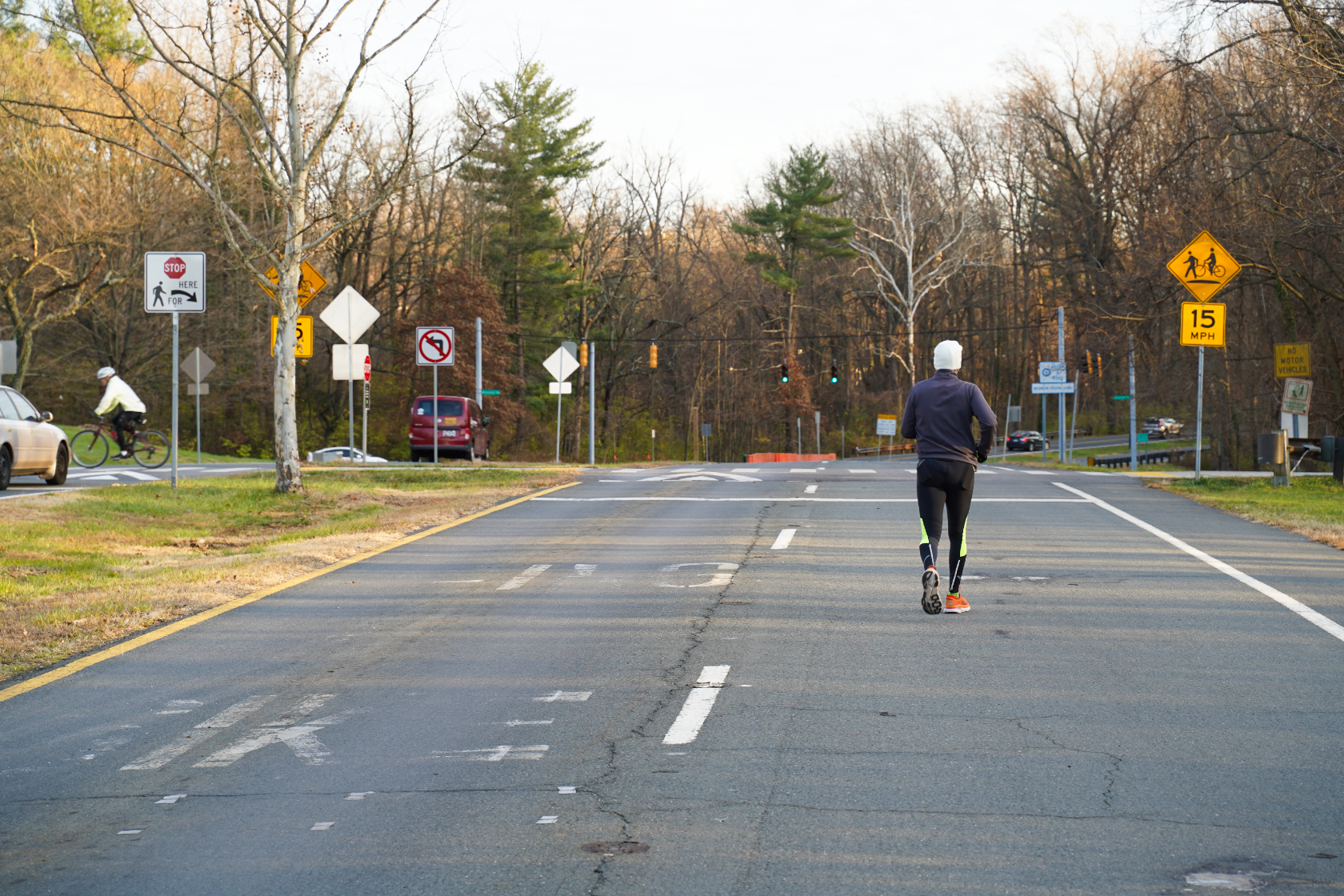
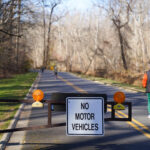
Montgomery County Executive Marc Elrich is attempting to block the creation of a new “linear park” that would permanently repurpose two lanes of Little Falls Parkway in Bethesda. Under the plan, which was approved last week, two of the parkway’s four lanes would be permanently dedicated to pedestrians and cyclists, while the other two lanes would be open to drivers.
The pedestrianized configuration has already been in place for roughly a year as pilot project. Montgomery Parks staff say the pilot proved the lanes can be repurposed for recreation and active transportation without creating large traffic backups for drivers.
“We conducted numerous traffic counts and did a lot of studying of the traffic models, both for now and even 20 years into the future, to make sure that the that the capacity of a two-lane road would be adequate,” says Andy Frank, who heads the park development division of Montgomery Parks.
Many residents support the pedestrianization of the two lanes: according to Frank, about 10% more people commented in favor than commented in opposition during a public comment period. But the opposition has been organized, vocal, and angry, gathering more than 4,000 signatures in an online petition, and deluging a public hearing late last month, where they outnumbered supporters by more than 2 to 1.
On Sunday, Elrich wrote to the county council asking lawmakers to defund the Little Falls linear park. “From the beginning, the project has been mired in controversy, with thousands of residents petitioning for relief,” Elrich wrote. “Residents, who have had to drive on the temporary two-lane reconfiguration, are rightly concerned with the safety of the new road, and with Parks’ moving forward with the project without appropriate input from affected residents.”
Elrich was not immediately available for an interview, a spokesperson said.
The changes on Little Falls Parkway are part of a national trend that picked up steam during the pandemic, when lots of cities and counties experimented with closing streets to cars to give people more room to get outside. Initially, starting in April 2020, Little Falls was closed to cars on weekends. By December 2020, officials ended the weekend closure and returned to the pre-pandemic status quo, in part due to complaints from residents that the closure was causing car traffic to overflow onto neighborhood streets.
In the following months, parks officials tweaked the configuration, finally landing on a compromise solution — rather than closing all four lanes to cars on weekends, closing two lanes 24/7. This pedestrianized section of the parkway is about a half-mile line, between Arlington Rd. and Dorset Ave. It includes the intersection of Little Falls Parkway and the Capital Crescent Trail, where in previous years numerous trail users have been struck by drivers. In 2016, Ned Gaylin was killed by a driver while riding his bike through the intersection. Gaylin’s death prompted changes to the parkway in 2017 to make the crossing safer.
The county calls its car-free parkways “open parkways,” because, while they’re closed to cars, they are open to walkers, runners, bikers, scooters, skaters and other non-motorized residents. Two other parkways in the county still have weekends-only closures.
In the coming months and years, officials plan to develop the pedestrianized lanes of Little Falls Parkway into more than just car-free asphalt. Part of one lane could be striped as a multi-use path, with the remaining area used for a variety of other activities, including live music, seating, games, and an area designated for learning to ride bikes.
“It’s very understandable that people who have seen a particular roadway as a four-lane road for 50-plus years would have a bit of consternation,” says Frank. “I do think in 3 to 5 years people will look at this, they will see the value of it and they will look back and they will wonder why this wasn’t done before.”
Opponents of the new configuration don’t buy the county’s traffic analysis and they don’t think more park land is needed.
“The parks department will tell you that traffic has not increased, but I live there and I’m going to tell you that I know firsthand that is not true,” said Debbie Heller. Heller is a member of the town council of Somerset, a small town at the southern end of the Little Falls pedestrian zone. She spoke during a public hearing before the Montgomery County Planning Board on March 30. The planning board subsequently approved the new parkway configuration at a meeting on April 27.
Heller said the new configuration with fewer lanes for cars was a “recipe for tragedy,” because more drivers were crowding other, smaller streets, like the narrow Dorset Ave. She urged the planning board to return Little Falls Parkway to four lanes of car traffic in order to “keep all of us safer, especially the children.”
David Johnson, speaking at the same March 30 meeting, argued that “there’s no need for a linear park.” In fact, he argued, Montgomery County’s inner suburbs, just north of the District, are an “over-parked area,” and any new parks should be built “elsewhere in the county” where residents “are in dire need of parks and green space.”
But people who spoke in favor of the linear park said it is indeed needed, as it’s one of the only safe places in the area for kids to ride bikes. “My five-year-old learned to ride his bike due to the open parkways program, and my two-year-old continues to use the linear park to learn to ride his bike,” said Holly Goyert at the March 30 hearing. “It’s in the best interest of pedestrians, cyclists and drivers alike to increase access by foot and bike in a safe and efficient way so as to reduce traffic volume and increase traffic flow.”
David Kathan testified that he lives “a few yards” from the parkway, with a front row seat to observe traffic changes. “The current two-lane configuration is safe for automobiles, pedestrians and bicyclists. The average speed of automobile traffic is lower. Large, late-night drag races are a thing of the past. Traffic flows smoothly — at least at the same level as it did pre-pandemic,” Kathan said.
Montgomery County Council President Evan Glass said during a media briefing Monday afternoon that he’d read Elrich’s letter, but did not yet have a position on Little Falls Parkway. Glass said he wanted to wait to weigh in until hearing from community members and parks staff at upcoming county council meetings. But, Glass said, it makes sense in some contexts to reconfigure roads to promote safety and encourage other modes of transportation besides driving.
“If we are true in our commitment to enact Vision Zero and to reduce the number of deaths and injuries on our roads, then we need to rethink the way our roads are designed,” Glass said.
The county has a Vision Zero goal to end road fatalities by 2030. In addition, the county has some of the most ambitious climate commitments in the nation: to cut carbon emissions by 80% by 2027 and to eliminate carbon emissions entirely by 2035. Transportation is the second-biggest source of greenhouse gas emissions in the county, after energy used in buildings. Achieving the county’s climate goals will require not only switching to electric vehicles, but also a large “mode shift” — in other words getting people out of cars and prioritizing other, less polluting ways of getting around.