 Jenny Gathright
In total, 76 people have died by homicide in the District of Columbia this year.
That’s up 9% from this time in 2022, when 70 people had been killed. Though the city is far below the peak levels of homicides it saw in the ’90s (when D.C. routinely saw more than 400 killings a year) it’s the most deadly first four months of any year in the last decade. The number of gunshot victims so far is also significantly up: Between January and May of last year, 260 people in the District had been shot, either fatally or non-fatally, according to police. As of May 4 of this year, 320 people had been hit by gunfire.
“It’s worse,” says Terrance Staley, the executive director of the Alliance for Concerned Men. Staley’s staff of violence interruption workers in Wards 7 and 8, he says, are working harder than they used to. “The amount of violence interruption work that they’ve had to do this year is double or maybe triple as much as last year.”
And it could soon take another bad turn: Communities, violence prevention workers, and city leaders are bracing for the start of summer, historically the most violent time of year.
The city’s approach to driving down violence over the last several years of spiking murders has been multi-pronged, including violence interruption programs whose work is similar to Staley’s (though some advocates argue the city has underinvested in or mismanaged parts of that work). Lately, though, it appears some city leaders’ focus has been shifting to the role of police and the courts.
Though Bowser’s proposed FY24 budget included significant cuts to rental assistance, crime victims’ services, and non-police forms of violence intervention, Bowser kept funding for the Metropolitan Police Department steady — and used surplus funds from this year’s budget to increase police hiring bonuses to $25,000.
On Wednesday, Bowser held a citywide “Public Safety Summit” where officials discussed the recent spike in violence. But the mayor’s office did not invite violence interrupters or other community-based organizations. Instead, Bowser focused the invites on local and federal law enforcement agencies and representatives from neighborhood Business Improvement Districts.
At that summit, Bowser hinted that she will introduce new legislation that may lead to more people getting detained in the D.C. Jail ahead of their trials. The bill, expected as early as Thursday, will likely propose adjusting rules around pre-trial release so that people with a history of arrests for violent crime will be automatically held in jail ahead of their trials.
Bowser has also pushed to bring police back into D.C. schools after the D.C. Council voted to phase them out in 2021, and she vetoed a revision of D.C.’s criminal code that would have reduced maximum prison sentences for certain violent crimes (the council overrode her veto, but Congress ended up blocking the bill anyway).
On top of these disagreements are concerns about whether certain elements of the criminal justice system are working as intended: Recent reporting showed that the U.S. Attorney for D.C. is declining to prosecute as many as 67% of arrests made by police — which they attribute to both concerns about the strength of arrests and evidence, and the fact that D.C. does not currently have a functioning crime lab.
In many cases, residents express both a desire for a more effective police department and a desire for more attention to the root causes of crime and violence.
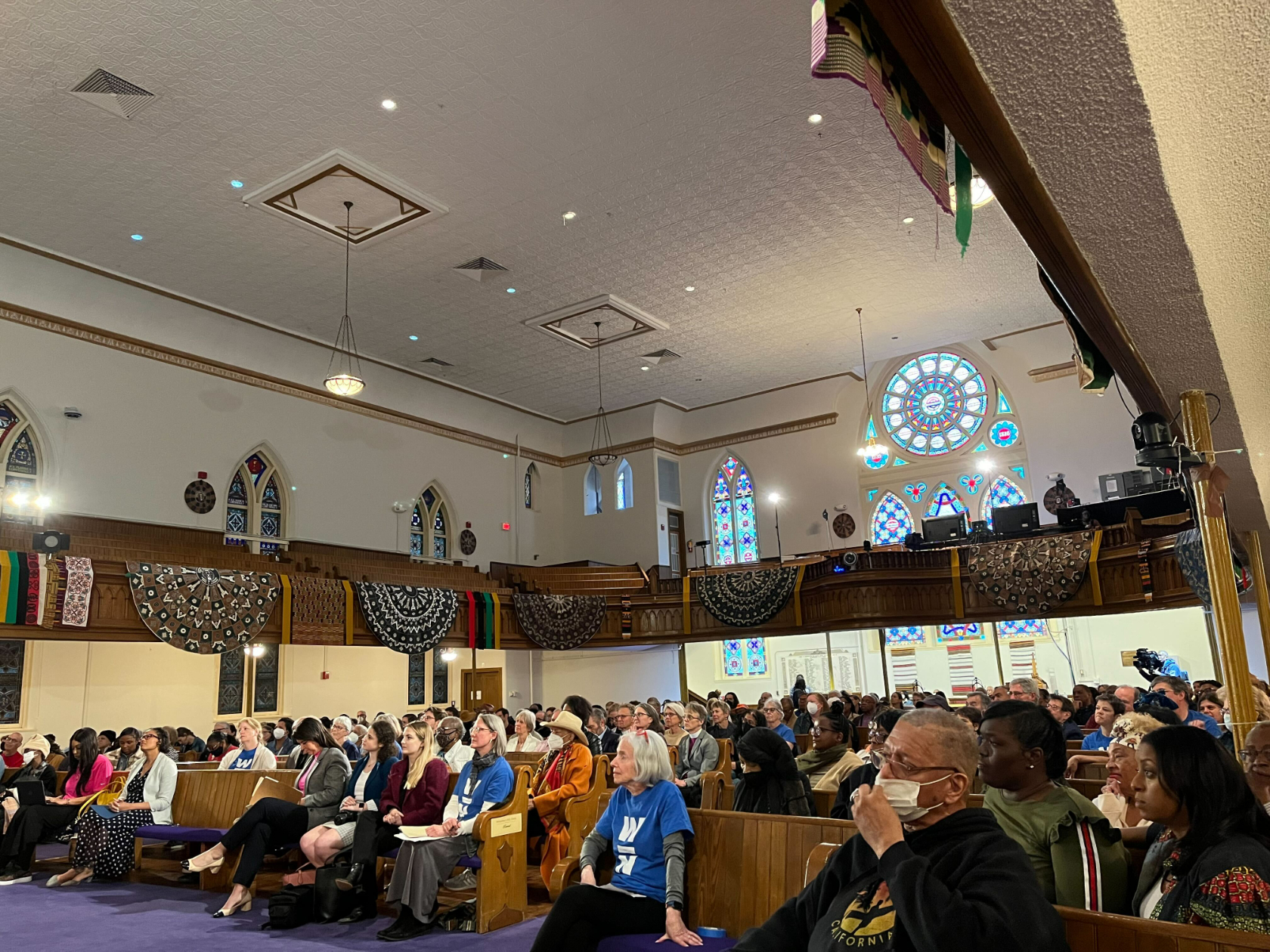
Reverend Geoffrey Tate, who attended a public safety-focused event held by the Washington Interfaith Network last week, thinks police have a significant role to play in violence prevention – but he wants them to get out of their cars and talk to people, like he remembers them doing when he was a kid in the ‘50s and ‘60s.
“They need to redevelop that relationship that has since been lost. You can’t stop crime sitting behind the wheel of a car,” he told DCist/WAMU as he sat in a pew at Metropolitan AME Church. He was one of a group of 200 people – Black and white, young and old — who had gathered for the public safety-focused event.
Some residents, however, remain skeptical that police are the true answer to the problems plaguing the city.
Ryane Nickens, who leads the TraRon Center, told the crowd at the WIN event that her community wants prevention resources, not just approaches to public safety that rely on police and the courts.
“Here’s how I know,” she told the crowd at Metropolitan AME last Tuesday. “A mother of one of the kids in my after school program called to say he had not come home for a weekend, and she called the police to report him missing, and the police officer told her: ‘Well when we find him, we can arrest him,’ because there are more resources for him with a record, in the system, than there are for a mother searching for help for her child to stop him becoming a part of the system.”
Nickens estimates she has been personally affected by gun violence at least 30 times, including when her brother, sister, and uncle were murdered.
Staley, with the Alliance of Concerned Men, says he wishes police would share more information with his teams of violence interrupters.
“Until law enforcement respects who we are and the place that we have in this work, I don’t believe that there will be a solution that’s going to be all-encompassing,” he told DCist/WAMU.
But in the meantime, he says, his teams are constantly monitoring social media and speaking with crew members at the center of violent conflicts to try to get ahead of the next shooting in the neighborhoods where they work — because social media, he says, is often where today’s violence foments.
Staley says drill music and social media have changed the dynamics behind D.C.’s gun violence in recent years and contributed to its increase, adding fuel to existing neighborhood-based conflicts. Local rappers openly publicize their violence in music, and conflicts can often emerge in plain sight, in online comments, he says.
“Music is driving a lot of the action-based conflict,” Staley says. “When neighborhood historical beefs are mixed in with music that drives [people] to act … you get real violence. And it’s tragic.”
He says his staff are trying to get ahead of these cycles of shootings and retaliations by building relationships with the people at the center of conflicts, and trying to get them to slow down before they resort to violence.
“We did it as recently as yesterday,” he told DCist/WAMU at his office in Greenway last week. When he or his staff see a potentially dangerous back-and-forth or threat on social media, he explained, they try immediately to find and speak with the people at the center of the disagreement. Sometimes, he says, redirecting them away from violence is as simple as asking them about their basic needs.
“You doing okay? How are you feeling? How’s your family feeling? You have food for the kids? Need some diapers? How you getting to school tomorrow?” Staley says. “Real life things that are needed to move the individual forward.”
The faith leaders at the Washington Interfaith Network event also framed the persistence of gun violence as a moral failure, evidence of the way historical and ongoing racism shapes people’s lives and life expectancies in the city. More than 95% of homicide victims in D.C. are Black, and the killings are concentrated in the city’s poorest neighborhoods.
“Guns … find their way cheaply and easily onto our streets,” said Pastor Delonte Gholston, who co-chairs WIN’s public safety committee with Nickens. “We treat the wounds of our people as though they were not serious.”
And nearly everyone agrees that this inequity at the root of violence will not go away any time soon.
But Staley says there are proven ways to help in the short term, and he’s got the talent on his team to do it. In one of D.C.’s most historically violent neighborhoods, Washington Highlands, he says his team negotiated a truce in 2020 that led to 124 days without a homicide. He knows they can do similar work again, and he says he’s actually looking forward to the summer.
“I’m looking forward to our community barbecues, engagement, conflict resolution, thousands of people coming in and out of the office,” Staley says. “I think that we’ll be able to show [our effectiveness] better than we can tell.”
D.C.’s police department says they’re committed to a safer summer as well. Police chief Robert Contee, who recently announced that he would be stepping down in June for a new job at the FBI, says the department will be launching a new summer crime prevention initiative they developed with criminologists at George Mason University, focusing on making police officers more visible and helpful to residents in high crime neighborhoods.
“This isn’t putting someone standing on the corner to deter crime or officers just writing tickets and making arrests,” Contee said. “This is about officers getting out of their vehicles and engaging with the community by being problem solvers, talking with community members to identify issues, checking in with businesses and apartment complexes, reporting quality of life issues to 311.”
D.C. Mayor Muriel Bowser’s Department of Parks and Recreation also recently extended hours for D.C. rec centers later into the evening, in an effort to provide young people with safe places to play.
At her public safety summit Wednesday, Bowser said she was charging all of the agencies under her purview with examining what they can do to reduce crime and violence.
The goal, Bowser said ahead of the summit, is to “look very candidly at all parts of that system and ask ourselves what could we be doing differently to make sure we’re keeping our city safe.”
Martin Austermuhle contributed reporting.