Margaret Barthel
Close Democratic primary races for the county board and commonwealth’s attorney dominated this year’s ballot in Arlington County, with the contests seen as barometers of public opinion on housing density and criminal justice reform, respectively.
Incumbent commonwealth’s attorney Parisa Dehghani-Tafti won the Arlington Democratic primary for the top prosecutor spot, beating out a primary challenge from a former deputy, Josh Katcher. Dehghani-Tafti received about 56% of the vote compared to Katcher’s 44%, according to unofficial results from the Virginia Department of Elections. More than 98% of early and day-of votes had been counted in Arlington as of Tuesday night; provisional and late-arriving ballots can be counted through Friday.
There’s no resolution yet in a tight six-way Democratic primary to nominate candidates for two open seats on the county board. The contest is also Arlington’s first attempt at using ranked choice voting, becoming the first locality in Virginia to use it in an election.
Arlington voters listed up to three candidates in order of their preference, so those preliminary results represent only people’s first-choice votes; no candidate emerged as the clear winner in the first round. Susan Cunningham, Natalie Roy, Maureen Coffey, and JD Spain all received more than 20% of the vote, shy of the 33.33% threshold for victory.
It appears that either Dromgoole or Weaver, who both finished with low single-digit percentages of the vote, will be dropped from the second round of counting. Voters who ranked the person dropped first will have their votes reallocated to their second-choice candidate. The tabulation of the next rounds of ranked choice voting won’t begin until Friday afternoon, according to Arlington elections officials.
A three-way race for the county sheriff appears to have ended with Jose Quiroz, the current acting sheriff, on top. He defeated challengers Wanda Younger, a longtime deputy, and Arlington police officer James Herring with nearly 40% percent of the vote, according to unofficial results posted by the Virginia Department of Elections.
Adele McClure, the executive director of the Virginia Legislative Black Caucus, sailed to victory in the primary in the newly-drawn House of Delegates 2nd District. Her opponent, Kevin Saucedo-Broach, who previously worked for Del. Alfonso Lopez (D-49th District; running in the new 3rd District), dropped out of the race in May.
Incumbent Sen. Barbara Favola easily won her primary in Senate District 40 (she previously represented the old SD-31).
Democratic nominees in deep-blue Arlington are all but guaranteed victory in November. Some will be unopposed, or face an independent candidate; Republicans in Arlington have struggled to field candidates.
Incumbent prosecutor wins another term
The results — and the margin of victory — in the commonwealth’s attorney race were quite clear on Tuesday evening.
Dehghani-Tafti, who is essentially assured victory in November (no Republican candidate has filed to run), was originally elected to the post in 2019, part of a wave of reform-minded prosecutors across Northern Virginia. (In Loudoun and Fairfax counties, the incumbent prosecutors also appear to have held on in the face of stiff primary challenges.)
“Four years ago, the voters of Arlington and the City of Falls Church chose to do the important work of reforming our criminal legal system,” Dehghani-Tafti said in a statement to DCist/WAMU. “Tonight’s victory showed the voters’ renewed trust in us to continue that work.”
“This election has laid bare the need to expand mental health services for our youth, the need to offer better services to victims, and the need to provide fair representation of the accused by bringing pay parity to public defenders,” she continued.
Katcher conceded in a statement on Tuesday night.
“Over the course of the last six months, we’ve had an important debate in our community over the future of criminal justice reform,” he said. “Our team left it all on the field, as we sought to have a debate about what real reform and real justice could mean for our community.”
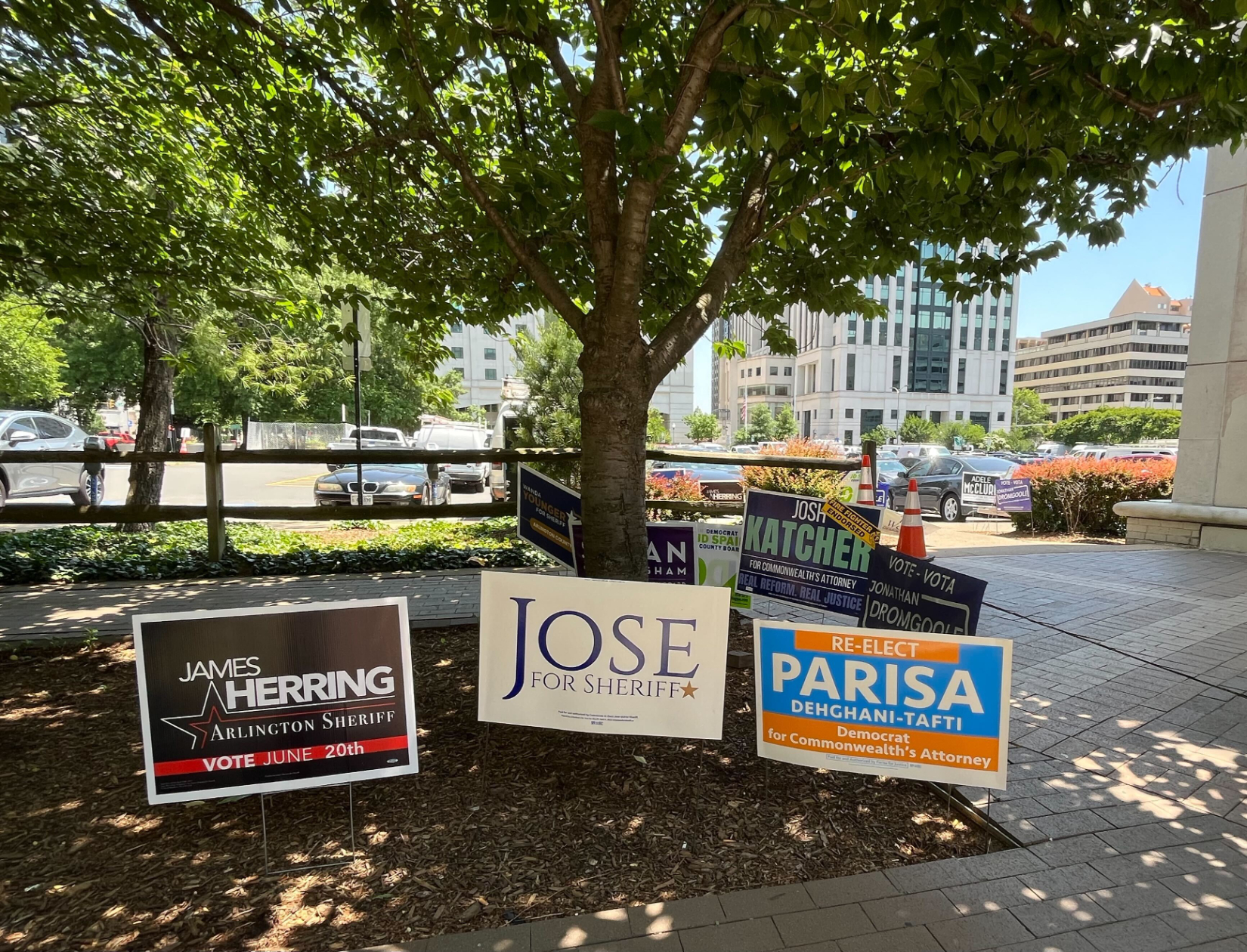
On the campaign trail, Dehghani-Tafti said she’d use another term in office to continue and expand the reforms she began in her first term. Those include pushing for diversion and treatment for people accused of crimes and ending practices like cash bail and prosecuting simple marijuana possession. (It’s now decriminalized in Virginia, but it’s still illegal to buy or sell it.) She also created a position to review old convictions that may have been faulty, launched a restorative justice program (which is already proving popular), and helped install a behavioral health docket, an alternative to incarceration for people with serious mental illness or developmental disabilities who are accused of committing crimes.
“Not every social ill has to be criminalized,” Dehghani-Tafti previously told DCist/WAMU. “Not everything that’s criminalized has to result in incarceration … not every period of incarceration has to be so long and so onerous that it doesn’t leave room for rehabilitation and redemption.”
Katcher is a career prosecutor of more than a decade who previously served in her office — and in the office of her predecessor, Theo Stamos, who took a more punitive approach to prosecution in the county and now works for Virginia Attorney General Jason Miyares, a Republican and vocal critic of reform prosecutors.
During the campaign, Katcher said he held similar reform principles to Dehghani-Tafti, but criticized her management of the Arlington office, blaming her for persistent staff turnover. He also raised questions about her office’s treatment of victims of crime, cutting a television ad that featured the mother of a teenager killed by a drunk driver, who said she did not feel Dehghani-Tafti had prosecuted the drunk driver — himself a teenager — to the fullest extent possible.
Dehghani-Tafti, the incumbent, had the support of many local Democrats, as well as an endorsement from The Washington Post. She also got a financial boost in the final two months of the campaign, raising more than $400,000 to Katcher’s nearly $160,000.
A sizable amount of Dehghani-Tafti’s support — including nearly $300,000 in the last campaign finance report before Election Day — came from Democracy PAC II, a federal political action committee with ties to George Soros, the liberal billionaire who supports criminal justice reform. Katcher has criticized Dehghani-Tafti for taking money from groups outside of Arlington.
In another race with significant implications for Arlington’s justice system, acting sheriff Jose Quiroz won the Democratic nomination for the post. Quiroz took over running the jail and court security after longtime sheriff Beth Arthur stepped down from her post earlier in the year.
Quiroz’s campaign focused on improving rehabilitation services and medical care in the jail, following a string of deaths of people held there under Arthur’s tenure. (The Arlington jail has a particularly high volume of incarcerated people in severe mental health crisis.) In particular, Quiroz emphasized his decision as acting sheriff to push for biometric tech tools that can be used to detect early signs of a medical crisis. A lawsuit from the family of a man who died in the jail details failures of medical professionals and sheriff’s deputies to notice or act on the man’s worsening medical condition. Arlington dismissed its jail healthcare contractor following the man’s death and hired a new provider.
No clarity yet in county board race
The county board race has been widely touted as a referendum on the current board’s approach to development and density. The primary comes just months after the board ended single-family zoning, in a move that sharply divided the Arlington community and became a defining issue in the campaign.
Susan Cunningham, Natalie Roy, Maureen Coffey, and JD Spain all received more than 20% of the vote in the county board race, but no candidate emerged as a clear winner.
Roy and Cunningham have been highly critical of the board’s decision to go ahead with the zoning change, even as many longtime homeowners raised concerns over changes in the character of their neighborhoods and possible strain on county infrastructure and services to accommodate added density. Both have advocated for a more cautious approach to county planning and density, and won the support of Arlingtonians For Our Sustainable Future, a group that opposed the “missing middle” decision and has raised concerns about overdevelopment and higher density across the county.
Meanwhile, some believe the “missing middle” debate animated younger residents and renters who have not historically played a significant role in county decision-making. Three candidates in the field have pitched themselves as people who can represent those interests: Maureen Coffey and Jonathan Dromgoole, both of whom are millennials and renters, and JD Spain, the former president of the local NAACP, an organization that vocally supported the zoning change.
More development-related questions are on the horizon for the next iteration of the board, including a long-range plan for Langston Boulevard and challenges with the county’s rising office vacancy rate.
Under ranked choice voting, candidates only win if they achieve a certain percentage of the ballots cast. In this case, with two open seats, the magic number is 33.33%. If no one gets at least that percentage among first-choice ballots — as is the case here — the candidate with the fewest votes will be eliminated and the voters who cast the eliminated candidate as their first choice will have their second-choice ballots counted.
The process continues with eliminations until, in this case, two candidates get 33.33% of the vote. There’s a further mathematical wrinkle, too: if a round shows a winner capturing more than 33.33% of the vote, the voters who voted for that candidate will have a proportion of their votes re-allocated to their next choice. In other words: their ballot can have some impact in the remaining rounds of voting.
Because the tabulation of the results requires knowing exactly how many ballots were cast (and therefore what number represents 33.33% of the total vote), Arlingtonians will have to wait a little longer than usual for their election results. Under Virginia law, mail-in ballots postmarked on Election Day can straggle into the local registrar up until this Friday at noon — after which election officials can conduct elimination rounds.
It’s important to note that candidates who appear to be close to the top in the first round — as Susan Cunningham and Natalie Roy are currently — are not guaranteed victory after additional rounds of ranked choice voting. If they failed to appeal to the voters of an eliminated candidate, those voters’ second choices might boost someone else out of the middle of the pack.
By this point, it probably goes without saying: multiple-winner ranked choice voting is complicated and can be hard to grasp — and some Arlington leaders, including the local NAACP, have expressed concerns about the challenge of educating voters about the method in the lead-up to the primary.
During early voting at least, the process seems to have gone relatively smoothly, Arlington elections director Gretchen Reinemeyer told WAMU. She said the rate of erroneously-marked ballots was slightly higher than normal, but still in the low single-digits. The most common mistake voters made was marking two people as their first choice candidate.
But overall, “The process is very similar for the voter,” said Reinemeyer. “Where ranked choice voting differs from other elections in terms of election administration really comes down to tabulation and how we will tabulate this race.”
Héctor Arzate contributed reporting. This story has been updated with a statement from Dehghani-Tafti.