 Jenny Gathright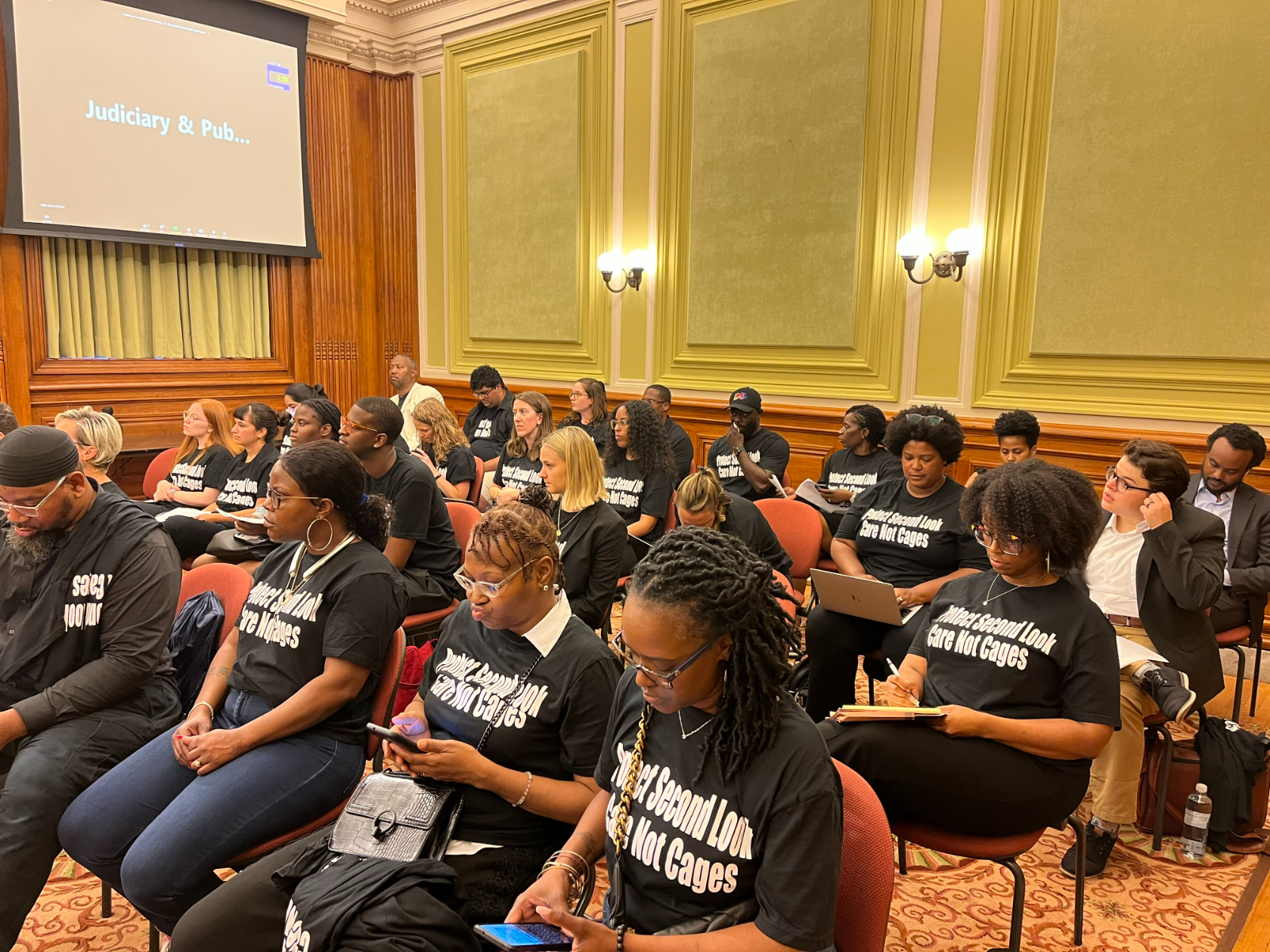
The D.C. Council held a lengthy hearing Tuesday on a package of laws meant to address the continued rise in crime across the city.
The legislation, proposed by Mayor Muriel Bowser, would increase penalties for gun-related crimes, tilt the scales toward more pretrial detention, and make it more difficult for people with longer prison sentences to gain early release. The bill has sparked intense debate and engagement among residents –more than 160 people signed up to testify before the council on Tuesday, expressing a mix of support and opposition.
The hearing highlighted tensions in the city between those who want to see longer sentences and stricter pretrial release policies in response to rising crime, and those who believe the measures are a counterproductive return to the failed “tough on crime” policies of D.C.’s past. But there was consensus about one point: violence in the city has reached unacceptable levels.
“We have a crisis of violence in the District of Columbia,” said Ward 2 Councilmember Brooke Pinto, who chaired the hearing, in her opening remarks. “The status quo is not working. And we cannot accept the state of affairs as just the ongoing costs following the pandemic, or costs of living in a major city.”
Pinto noted that D.C. is no longer following national crime trends – the spike here is sustained and out of step with other metropolitan areas. Homicides in D.C. are up 12% this year compared to last year, according to D.C. police, while killings have begun to fall this year in other major American cities.
“Cities are facing many of the same challenges that we are across the country: police staffing shortages, a loss of trust in the police following George Floyd’s murder, and the lingering effects of reduced social services in the pandemic. But many other cities are managing to see improvements,” she said. “I think all of us here owe it to District residents to take a hard look at what our policies and programs are… to understand what those cities are doing right that we aren’t.”
For the past several years, homicides have been at levels not seen in the city in two decades – though they are still well below the grim totals the city saw in the ‘90s. The city’s gun violence is concentrated in majority-Black neighborhoods east of the Anacostia River: Out of the 111 homicides in the District so far this year, 71 of them have been in the police districts covering Wards 7 and 8, according to Pinto.
Bowser and her Deputy Mayor for Public Safety and Justice Lindsey Appiah have described the bill as “common sense legislation” to address crime in the District. And they’ve also pushed back on reform advocates’ characterization of the bill as a step backwards.
“We recognize that there are those who are concerned that this set of policy proposals will not substantially reduce crime and will instead turn back the clock to the bygone era of tough on crime rhetoric and practices and mass incarceration,” Appiah said in her prepared testimony. “This is not the case. We are vehemently opposed to perpetuating those past policies which we know do not work. This is not about making a political statement but honestly evaluating the impacts of our current policies and making pragmatic, necessary adjustments where we are seeing harm and believe that change can reduce crime.”
What the bill does
Some of the bill’s provisions focus on expanding the available evidence for solving and prosecuting crimes, like:
- Increasing the reimbursement the city provides to people who buy private surveillance cameras for their homes or businesses
- Allowing law enforcement to collect DNA evidence from people accused of sexual assault earlier in the legal process
- And expanding the amount of GPS data from ankle bracelets available to police and prosecutors.
Other provisions are designed to fill what the Bowser administration sees as gaps in D.C.’s laws that allow people accused of or convicted of crimes to skirt accountability.
For example, the bill would increase the maximum penalties for certain crimes, including illegal gun possession and crimes that target certain populations like residents with physical and mental impairments, transit and for-hire vehicle workers, transit passengers, and people at rec centers.
The bill would also tilt the law toward increased pretrial detention for both adults and children, asking judges to lean in favor of detention for adults accused of violent crimes who have a past violent crime conviction. It would also allow judges to detain a child for that child’s own protection.
Yet another provision targets D.C.’s Second Look Amendment Act, which offers people convicted of crimes before their 25th birthday a chance to petition a judge for early release after they’ve served 15 years of their sentence. Under current law, judges have to consider a person’s dangerousness to others in the community, as well as whether “the interests of justice warrant a sentence modification,” along with a host of other factors, including how much they deem the person to be rehabilitated. Bowser’s proposal expands what the court may consider, adding factors like the person’s level of remorse and the nature of the crime they’re in prison for.
Mixed reactions
About 165 residents signed up to testify either via Zoom or in-person at the hearing, which was expected to run late into Tuesday evening. They represented a broad range of perspectives, including reform-focused advocacy groups, churches, business leaders, ANC commissioners, crime victims and survivors, and formerly incarcerated residents. Former D.C. Mayor Tony Williams signed up to testify. So did Hilary Cairns, the former director of D.C.’s juvenile justice agency. A collection of formerly incarcerated residents and other advocates packed the hearing room at the Wilson Building wearing matching shirts with the words “Protect Second Look. Care Not Cages” to demonstrate their opposition to the bill.
The Office of the U.S. Attorney for D.C., which prosecutes most adult crimes in the District, offered detailed testimony in support of the bill. (Though, notably, the D.C. Office of the Attorney General, which prosecutes juvenile crime, has come out against it.)
Business leaders who testified in support of the bill – including the head of the D.C. Chamber of Commerce and representatives for developers — argued that crime in the city was increasing costs for business owners, some of whom have hired private security in response to rising thefts and dwindling police staffing. They also argued that crime was preventing people from investing their money in the city. Shawn Townsend with the Restaurant Association of Metropolitan Washington testified in support of the bill because “violence is so regular in one neighborhood that one of our members paid thousands of dollars to break her restaurant lease and move to a safer area.” In some cases, Townsend said, restaurant owners are choosing to relocate to Maryland or Virginia.
Several victims or survivors of crime also spoke in support of the bill. William Fairfax Sr., whose brother was murdered in 1995, described himself as a “victim of the Second Look Act” who strongly opposed resentencing or early release for people convicted of serious violent crimes like murder. He supported the provisions that would ask judges to consider additional factors before ruling in favor of early release.
“How does a serial killer, a man that killed two people, get a second look and my brother didn’t get a second breath?” Fairfax asked in his testimony.
Some experts called out specific portions of the bill they supported: For example, Elisabeth Olds – the city’s independent expert consultant on sexual assault victims’ rights – said she supported the provision that would allow authorities to collect DNA evidence from sexual assault suspects before they are convicted. She argued that since many sexual assault cases do not lead to convictions, gathering DNA prior to conviction would better allow police to identify and apprehend serial offenders before they commit additional crimes or assaults.
Gregg Pemberton, chair of the D.C. police union, said the union “broadly supported” Bowser’s proposed changes, but wanted to see the D.C. Council go further to help with police recruitment and roll back police reforms — which he has repeatedly argued are causing officers to resign from the Metropolitan Police Department.
But the bill also faced staunch opposition from residents and advocates.
One portion that drew some of the strongest opposition was the section on changes to juvenile pretrial detention.
“The proposed changes to the juvenile pre-trial detention statute will not make us safer or stronger,” said D.C. Attorney General Brian Schwalb in a written statement ahead of his testimony on Tuesday. “Instead, they will result in locking up more kids pre-trial, even though there is no good data to suggest that kids who are released pre-trial are committing violent or serious offenses. Decades of research confirms that incarcerating kids causes very real harms, including increasing the likelihood that they will commit more serious crimes in the future.”
The Bowser administration has argued that it’s important for judges to be given more power to detain children accused of violent or dangerous crimes, but advocates have argued that the language in the bill rolls back important juvenile justice reforms and would lead to an increase in the number of children detained for crimes that are not particularly dangerous, like cell phone snatches and other forms of theft.
“The last time we got tough on crime, we sent tens of thousands of Black Washingtonians to prison, fearful that we had raised a generation of superpredators. D.C.’s youth are not superpredators. There is nothing especially bad nor scary about them,” said Rondell Jordan, a staff attorney for Open City Advocates who represents youth in D.C.’s juvenile justice system. “Make no mistake: I believe in accountability. However, before we cast stones at youth, we adults must hold ourselves accountable for the harm that the systems we perpetuate have done to our young people.”
Danielle Robinette, a policy analyst at Children’s Law Center, said the organization supported one aspect of the bill: a provision that would expand protections for children who have experienced child abuse and allow contractors and consultants who have access to schools to be prosecuted for sexual abuse. But Robinette said the organization strongly opposed the provision that would allow judges to detain children in the city’s youth detention facility for their own protection.
“It is difficult for us to imagine a set of circumstances in which incarceration is in a child’s best interest,” Robinette said. “We worry this creates a slippery slope, where judges are required to order pretrial detention, even when the child poses no risk to the community. This is particularly concerning given the criminogenic effect that pretrial detention has on children.”
Research has shown that juvenile detention increases the likelihood of felony recidivism later on.
And notably, Hilary Cairns, the former director of D.C.’s juvenile justice system who Bowser suddenly ousted in February, testified against the bill, too.
“I’m really concerned for young people,” Cairns said in an interview, adding that she wanted to “ensure that we’re not going backwards, and that we’re not over-incarcerating youth and that instead we’re caring for them and supporting them and looking for ways to help them and move them forward.”
Appiah defended the changes to pretrial juvenile detention in an interview Tuesday morning, insisting that the Bowser administration is “not looking for there to be an explosion of young people who need to be securely held.”
Instead, Appiah argued, “we need to be willing as reformers to make the type of pivots and adaptations that will help us to keep young people safe and others.” Bowser officials also say the additional options for detaining children are a potential solution to the cycles of retaliatory violence affecting teens in the District; Appiah said that “we can not give [youth] rehabilitative services if they are not alive.”
Advocates also spoke out against the changes to sentence reduction for people convicted of crimes when they were young. Numerous people who secured release through D.C.’s second chance legislation testified at the hearing, arguing that returning citizens who gained freedom through these D.C. laws were contributing to the D.C. community in countless positive ways – including as violence interrupters and mentors to youth.
Gene Downing gained early release from a more than 80-year sentence after serving 21 years in prison, and he now works in several capacities, including in a fellowship with the Council for Court Excellence where he helps lead an initiative connecting returning citizens with businesses willing to hire them. He testified because he felt that D.C.’s second look laws should be celebrated, not vilified – and he felt Bowser did not have evidence to support that reducing resentencing opportunities for people who have served more than 15 years would make the city safer.
On the contrary, he said, there was a lot of evidence that returning citizens released under the bill were productive, successful, and adding value to the city.
“We have a ton of evidence — and guys like myself are the evidence,” he said.
In defense of the changes to resentencing, Appiah said early Tuesday that D.C. “will always be a second chance city,” but “there’s no victimless crime,” and the courts need to consider the impact crimes have on victims and the community, as well as the “cold-blooded nature” of a crime, when making resentencing decisions.
Members of the D.C. Council will debate and propose amendments to the bill in the coming weeks — but on Tuesday, some of them expressed vehement opposition to its provisions and called out portions of the bill that run counter to evidence and data on effective responses to crime.
“The policy goals of this legislation are simplistic, unserious, and performative,” said Ward 1 Councilmember Brianne Nadeau. “They’ve been tried in the ‘80s, ‘90s, and 2000s, and they didn’t work then.”
Ward 4 Councilmember Janeese Lewis George argued that the bill “seemed designed to generate ‘tough on crime’ headlines rather than create good outcomes for D.C. residents who are desperately calling for our communities to be safe.” Lewis George, a former youth prosecutor, pointed to research showing that the certainty of being caught and being swiftly punished is a more effective crime deterrent than longer sentences, which don’t have a meaningful impact on crime. She said the city’s resources would be better directed at training police officers to make constitutional arrests and addressing the failures at the city’s Department of Forensic Sciences (which prosecutors argue have stymied their ability to bring cases forward).