Jacob Fenston
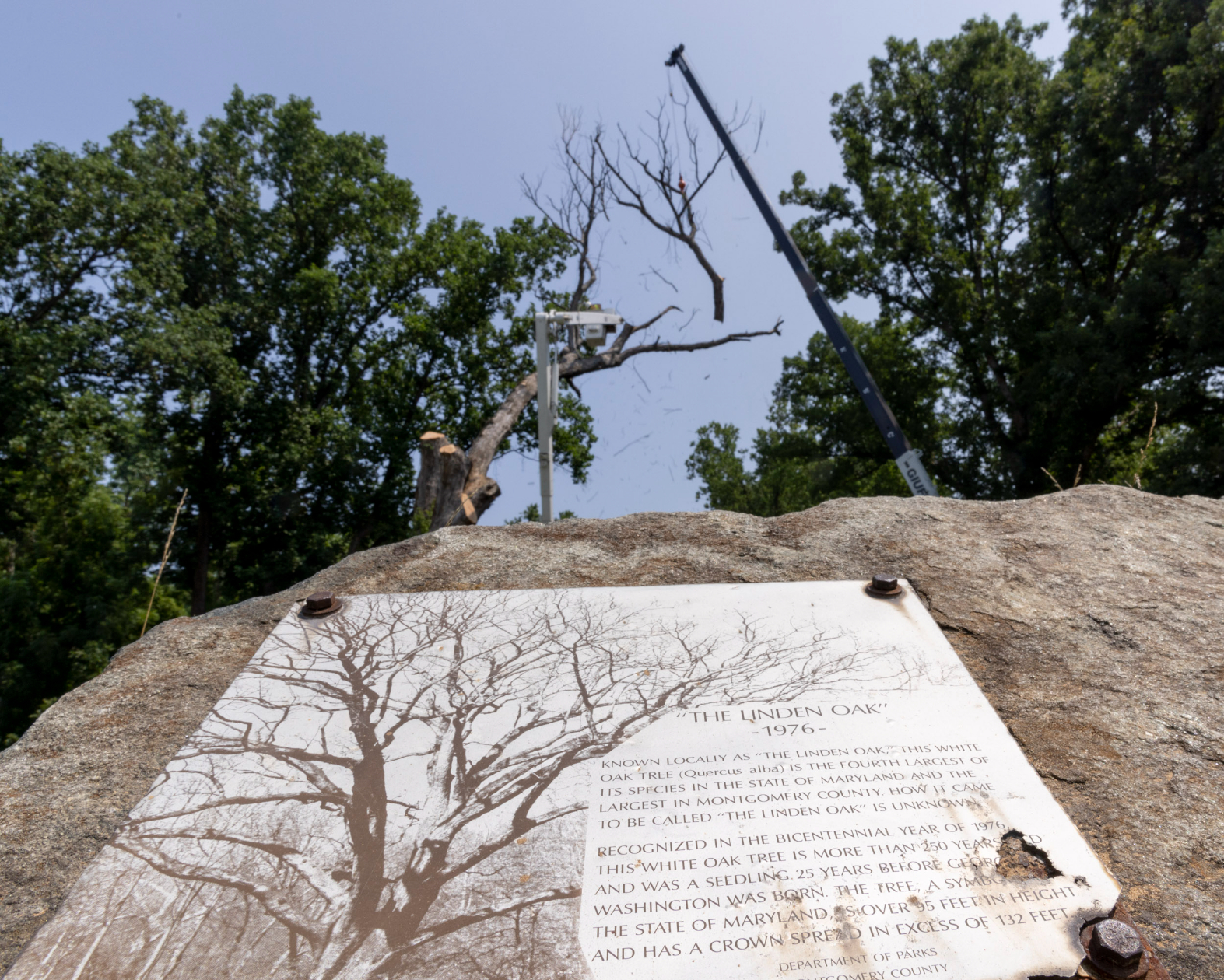
It was the largest white oak in Montgomery County. For some 300 years, it stood witness through the Revolutionary War, the Civil War, and nearly met its demise during construction of Metro in the 1970s. It was known as the “Linden Oak” and also the “Two Million Dollar Tree” — reportedly the amount it cost Metro to reroute the Red Line to avoid it.
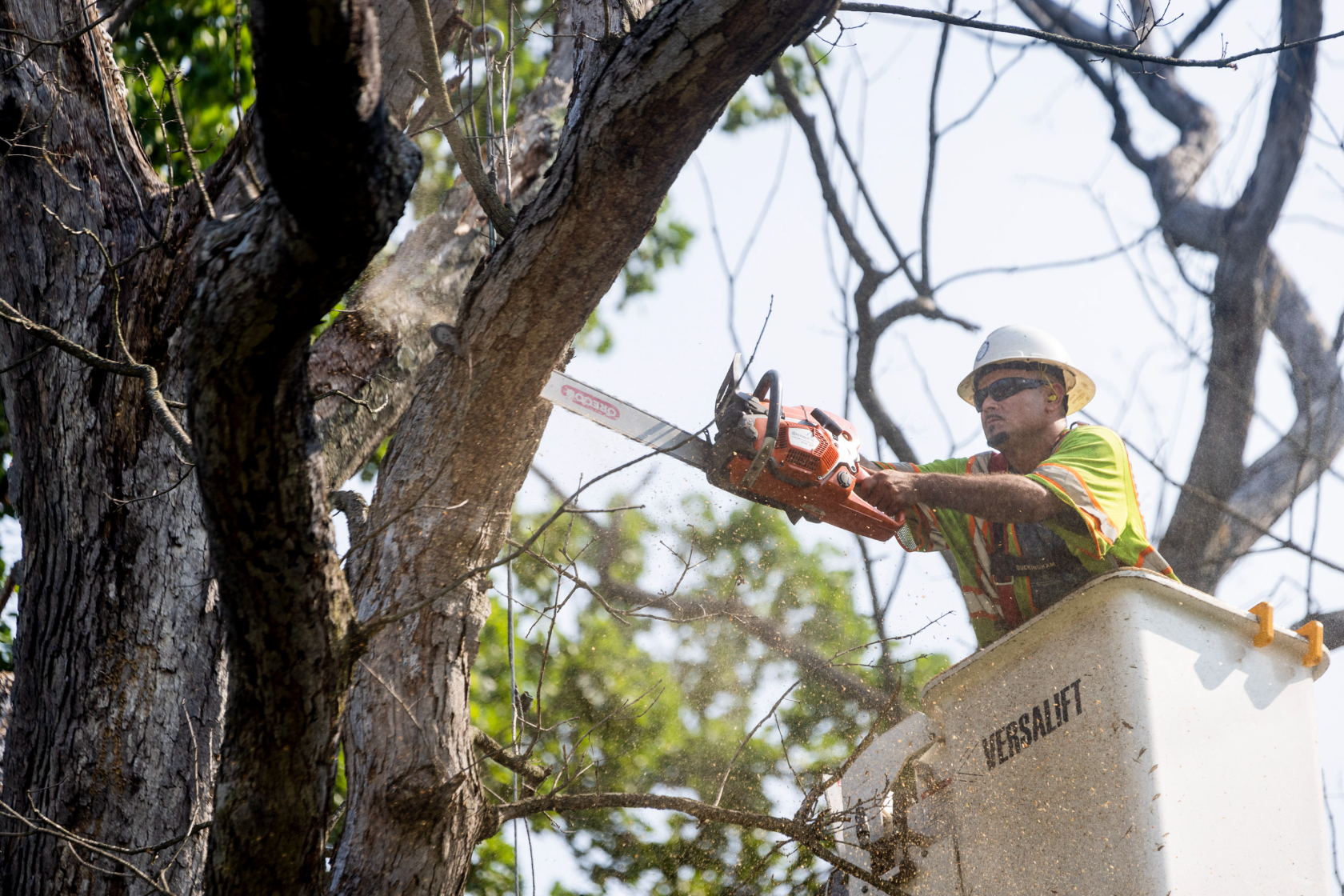
The tree, which died last year, was cut down this week. The wood will soon get a new life, as a local chainsaw artist turns it into a sculpture. Lumber from the historic tree will also be available for sale to the public later this year.
The Linden Oak was a well-known landmark in Montgomery County, visible from Rockville Pike, Beach Drive and Metro, just south of the Gosvenor Station. On Tuesday, neighbors stopped by to watch and say goodbye as chainsaws buzzed.
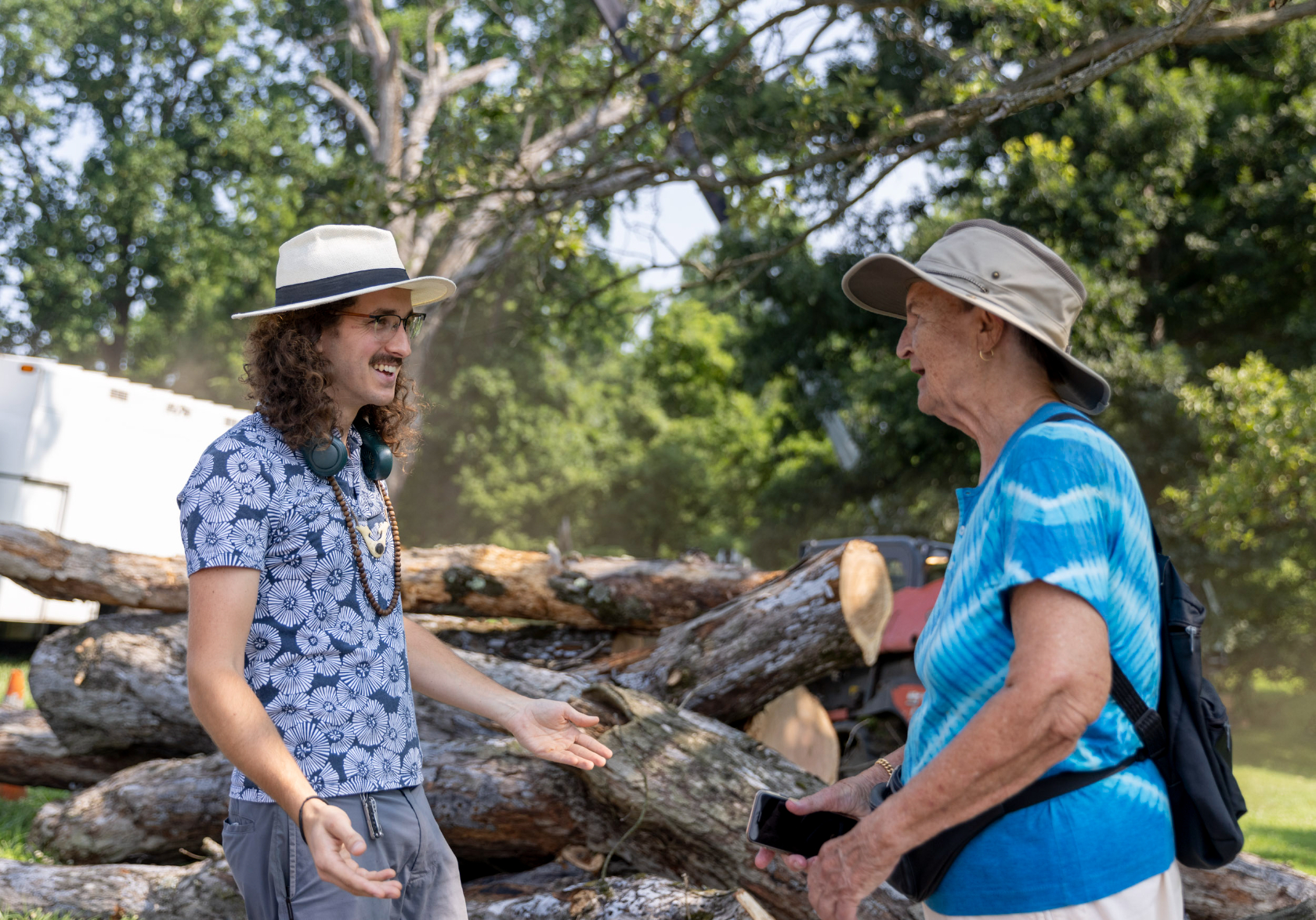
“During COVID, I came here many times with my grandson in a stroller. We’d watch the subway, we’d watch the traffic, and we’d worship this tree,” said Mark Thompson. For 35 years, he took Metro to work every day, starting when the Grosvenor Station opened in August 1984, and he always appreciated the tree.
Another woman pulled out her phone, where she had hundreds of pictures of her kids, posed by the massive trunk. The photos span the seasons and more than a decade — a mere moment in the life of the oak — as the kids grow up, from preschool-age to college-age.
Jenny Brockman stopped by the tree too — she was crying as she watched the arborists at work. She says she scattered a close friend’s ashes under the oak.
“There was a gentleman named Harry who used to panhandle on this corner, and we would come bring him food,” Brockman explains. Over the years, her family became friends with Harry. They helped him get housing and social security. When he was diagnosed with cancer, they stayed with him at the hospital.
“He wanted to be spread under the tree because he used to live back in the woods here,” she says. “So it’s emotional for me to see his tree come down, because he spent so many years out here under this tree.”
The tree stood silent as generations of human stories like this unfolded beneath its canopy. Nobody knows exactly how old it is — estimates range from 250 years to 400. Now that the tree has been cut down, officials plan to count the rings to get an exact age.
If the tree was 300 years old, it first poked its leaves above ground in the early 1700s.
“At that time, you have to remember that forests were the source for building materials, for fencing, for fuel,” says Matt Logan, executive director of Montgomery History.
Many of the region’s forests had already been clear-cut by the early 18th century, the landscape dotted with small farms.
“The fact that this survived tells me that by the time that settlement took place, it was already a large grand tree that that someone recognized as being valuable,” Logan says. “The fact that it survived is something of a miracle.”

While modern-day commuters enjoyed observing the tree from air-conditioned Metro cars, the tree stood along what has been a busy transportation corridor for hundreds of years.
Rockville Pike was likely a footpath originally blazed by Native Americans, before European colonizers arrived. Later, it was used by farmers to transport goods to port in Georgetown.
By 1800, there were 15,000 residents in Montgomery County, compared to today’s million. More than one-third were enslaved. Historic records show that in the mid-1800s, the land around the Linden Oak included an 80-acre wheat field, a 600-tree peach orchard, as well as a house, stable, and barn.
During the Civil War, thousands of wounded soldiers likely passed right next to the Linden Oak on Rockville Pike, on the way to field hospitals in D.C.
Fast-forward to the 1970s: the Linden Oak nearly met its end as Metro was planning the Red Line. Neighbors and county council members rallied to save the tree, convincing Metro to reroute the tracks a few hundred feet to the west. Rather than building the tracks on the straightest route between Grosvenor Station and the Beltway, Metro made the tracks curve slightly, shifting to the median of Rockville Pike and avoiding the tree.
“It’s somewhere between $2 million and $4 million that it took Metro to move the line to go around the tree,” says Joli McCathran, co-coordinator of the Maryland Big Tree Program. “That’s a testament to the value of large trees in our area.”
The campaign to save the tree was spearheaded by Idamae Garrott, who was a county council member at the time, and who later went on to serve in the Maryland House of Delegates and Maryland Senate.
The tree is located in a sliver of Montgomery Parks land near Rock Creek. The oak started to decline in 2020, when an enormous branch fell, bringing down about half the canopy. In 2021, the tree was still hanging on, but the leaves turned brown midway through the summer. This spring, it didn’t leaf out at all.
“We were just going to leave it here because it’s not in a place where it’s around the public or other amenities, so it wasn’t a high hazard to people,” says Colter Burkes, senior urban forester with Montgomery Parks.
But then, some nearby residents suggested a different idea — why not salvage the wood?
Burkes says now that the tree has been cut down, the logs will be evaluated, milled, and the lumber will be offered to the public for sale. Montgomery Parks already does this with other dead trees it removes on park property.
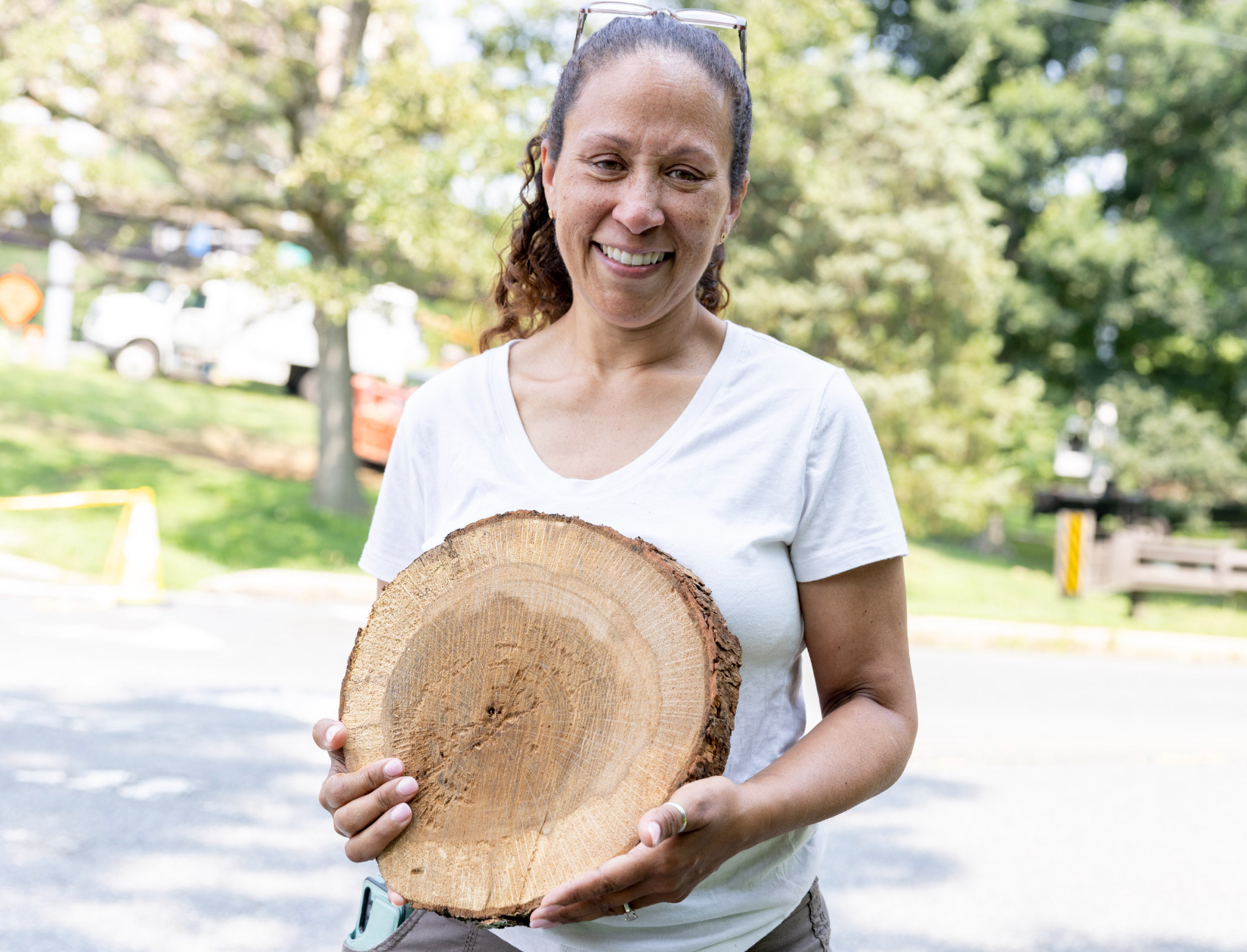
“It’ll be neat that the tree can kind of live on in people’s projects or their house,” Burkes says.
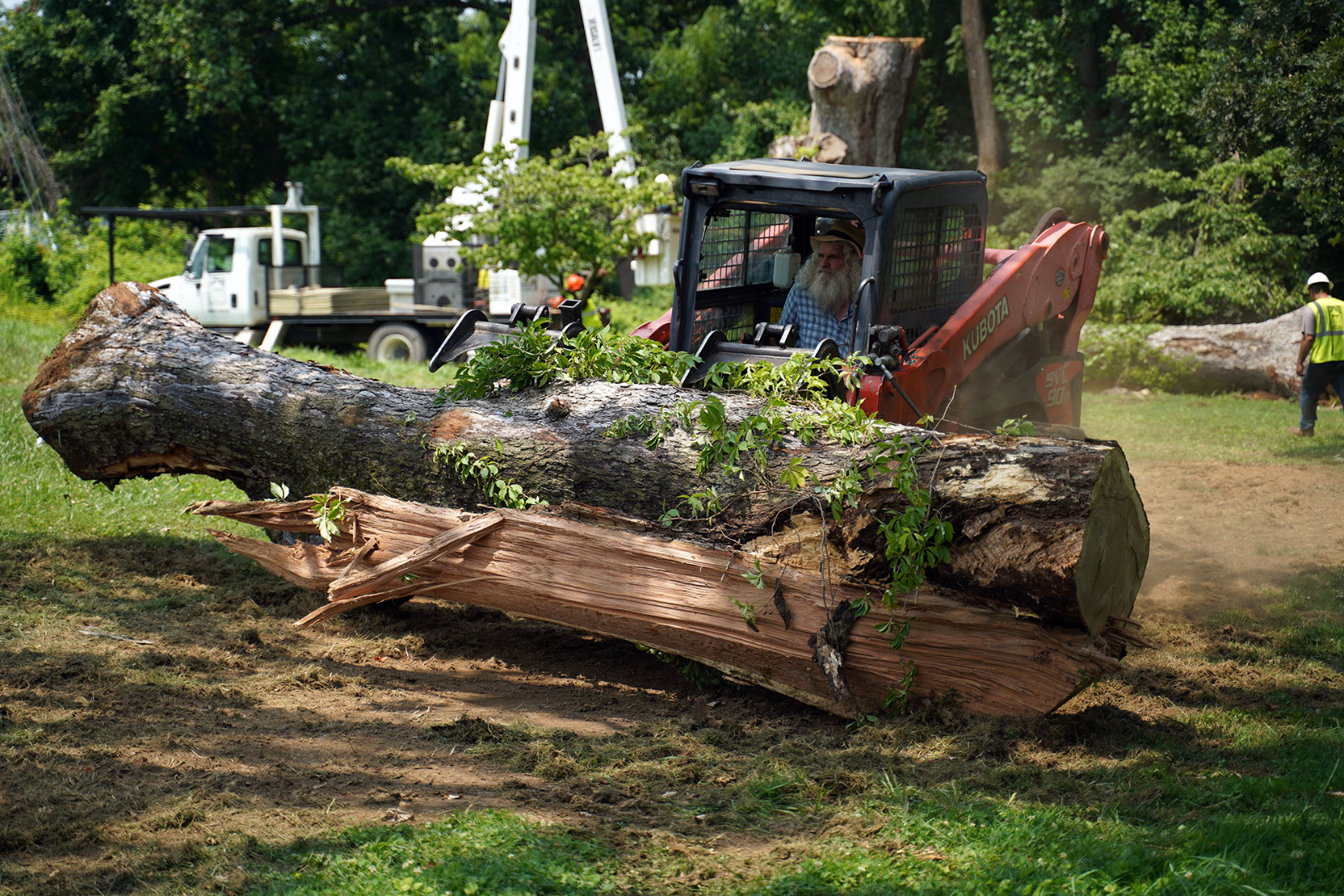
The trunk of the tree, however, won’t be up for sale: Montgomery Parks hired local chainsaw artist Colin Vale to create a sculpture from the wood.
Vale was at the Linden Oak site on Tuesday to watch the tree come down. After a large section of the trunk crashed to the ground, he went to inspect it up close.
“It looks good. There’s no hollows, so this is going to be an awesome log. I can finally start to get to meet my canvas,” Vale says.
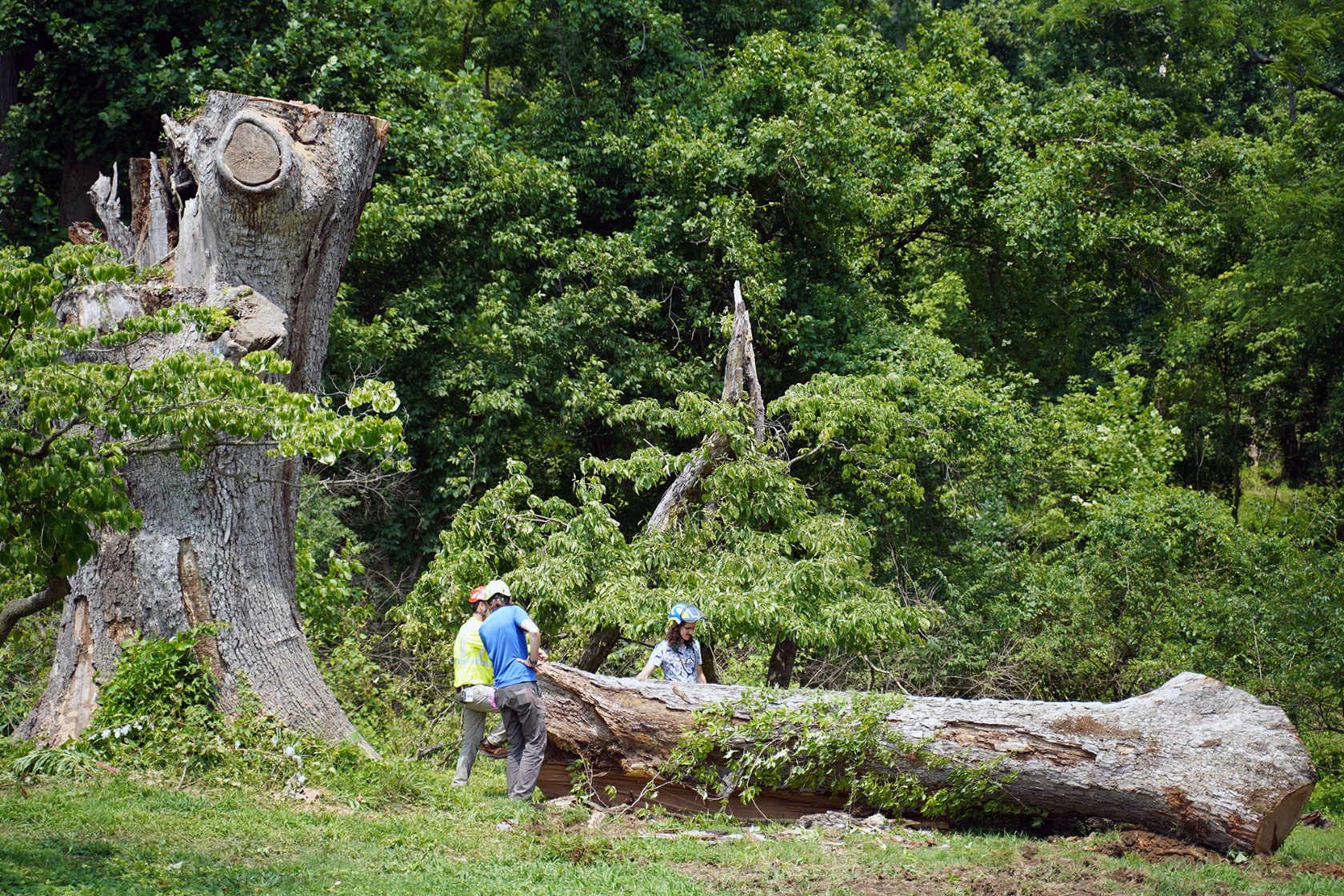
The log will be moved about a mile north to Ken-Gar park, where the carving will ultimately reside. Vale plans to work on the project throughout the month of August, and welcomes members of the public to stop by and watch him work and chat.
“It gives me a break — I need to not pass out when I’m sweating with the chainsaw, so stopping and talking to people and asking them what their experiences of the tree has been deepens it for me,” Vale says.
The Linden Oak is not the only large oak tree to die recently.
“Since probably 2018, we noticed a lot of decline in health and death of oak trees, especially large oak trees, mature oak trees,” says Burkes. “We’ve taken down a lot of trees that have seemed to be healthy, and then within a couple of years they rapidly decline and die.”
Burkes says the cause of these deaths is still somewhat mysterious, but that it’s likely due to a combination of factors, including hotter-than-normal summers, which can stress trees, allowing secondary pests to take hold.
Now that the Linden Oak is gone, the new largest white oak in the county is not too far away: it’s the Travilah Oak in Potomac.
Joli McCathran says the Travilah Oak is the last bicentennial tree left in Montgomery County, meaning it was alive in 1776 during the Revolutionary War. At the time of the U.S. bicentennial, in 1976, there were 24 known bicentennial trees in the county.
Now, McCathran is working on a statewide list of semiquincentennial trees, as the nation’s 250th birthday approaches.
McCathran says if you do pay a visit to the Travilah Oak or another large tree, it’s important to get close, and touch the tree if you can.
“You don’t get the real scope of the tree until you feel like really small, standing next to these enormous, beautiful trees,” She says.
Jenny Brockman, whose friend’s ashes were scattered under the tree, asked the arborists if she could have a small round from one of the branches.
“My husband and my son are woodworkers, so I’ll see if they can turn it into something,” Brockman says, examining the wood. “I’m happy I got a piece, that makes my day.”