 Aja Drain
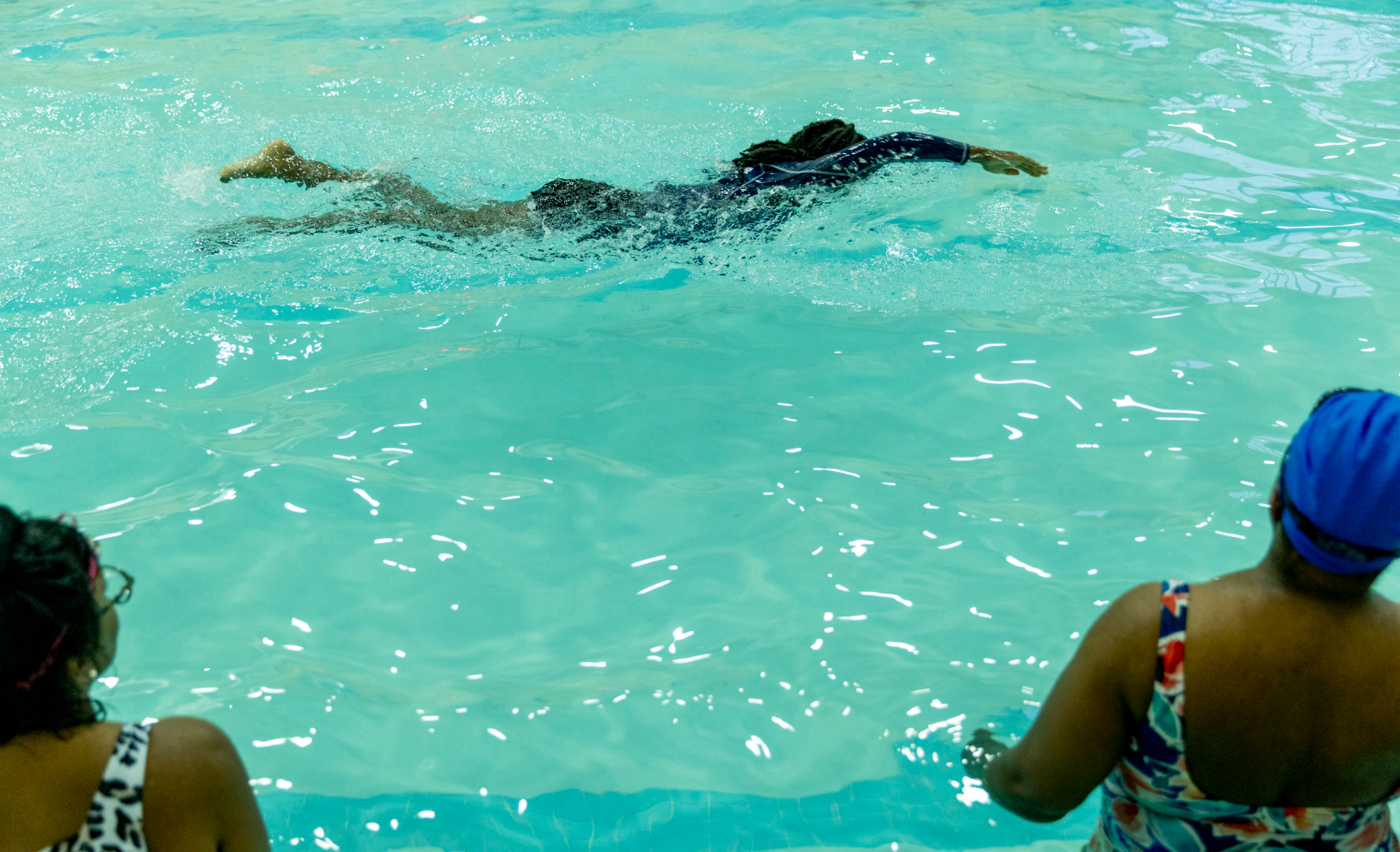
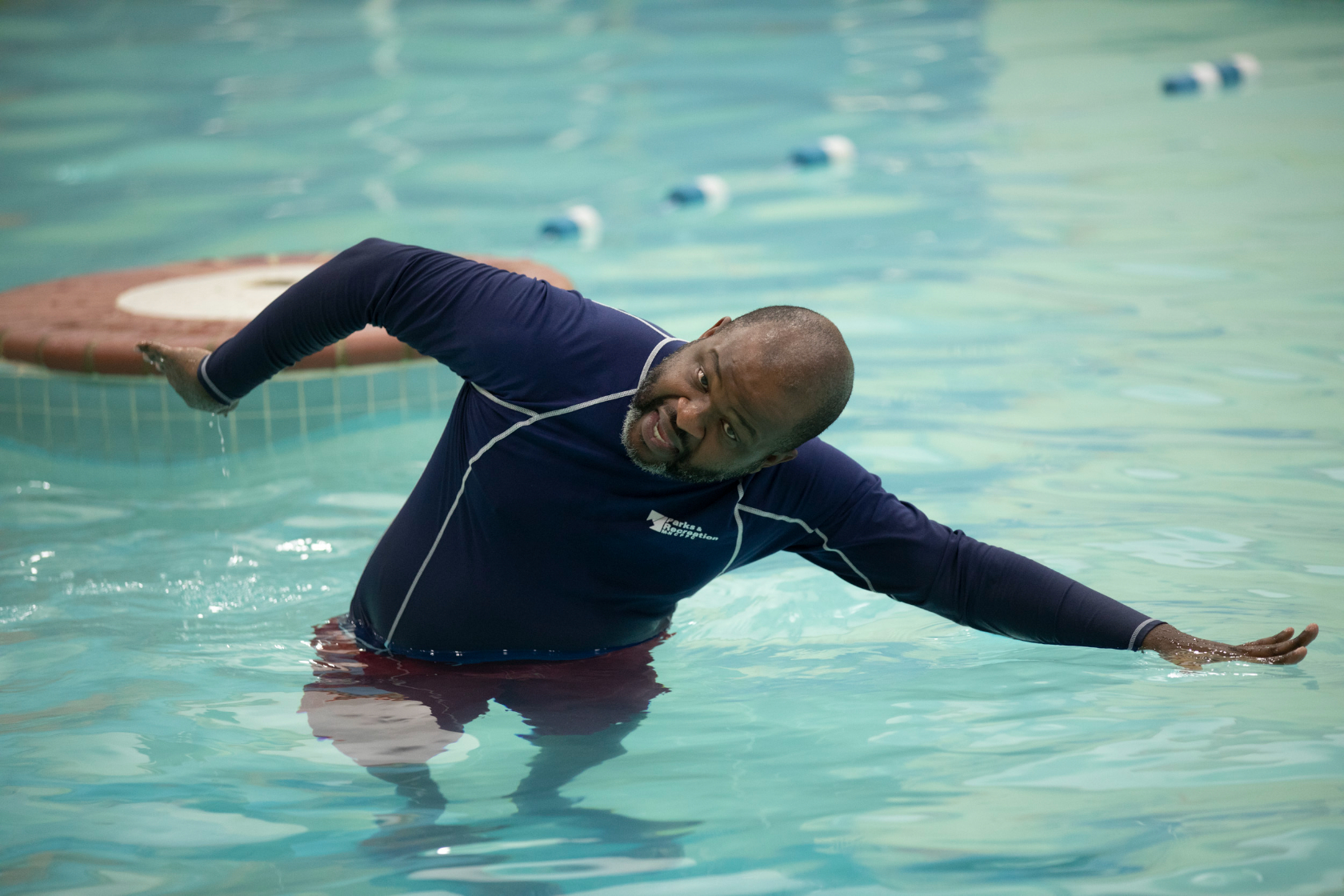
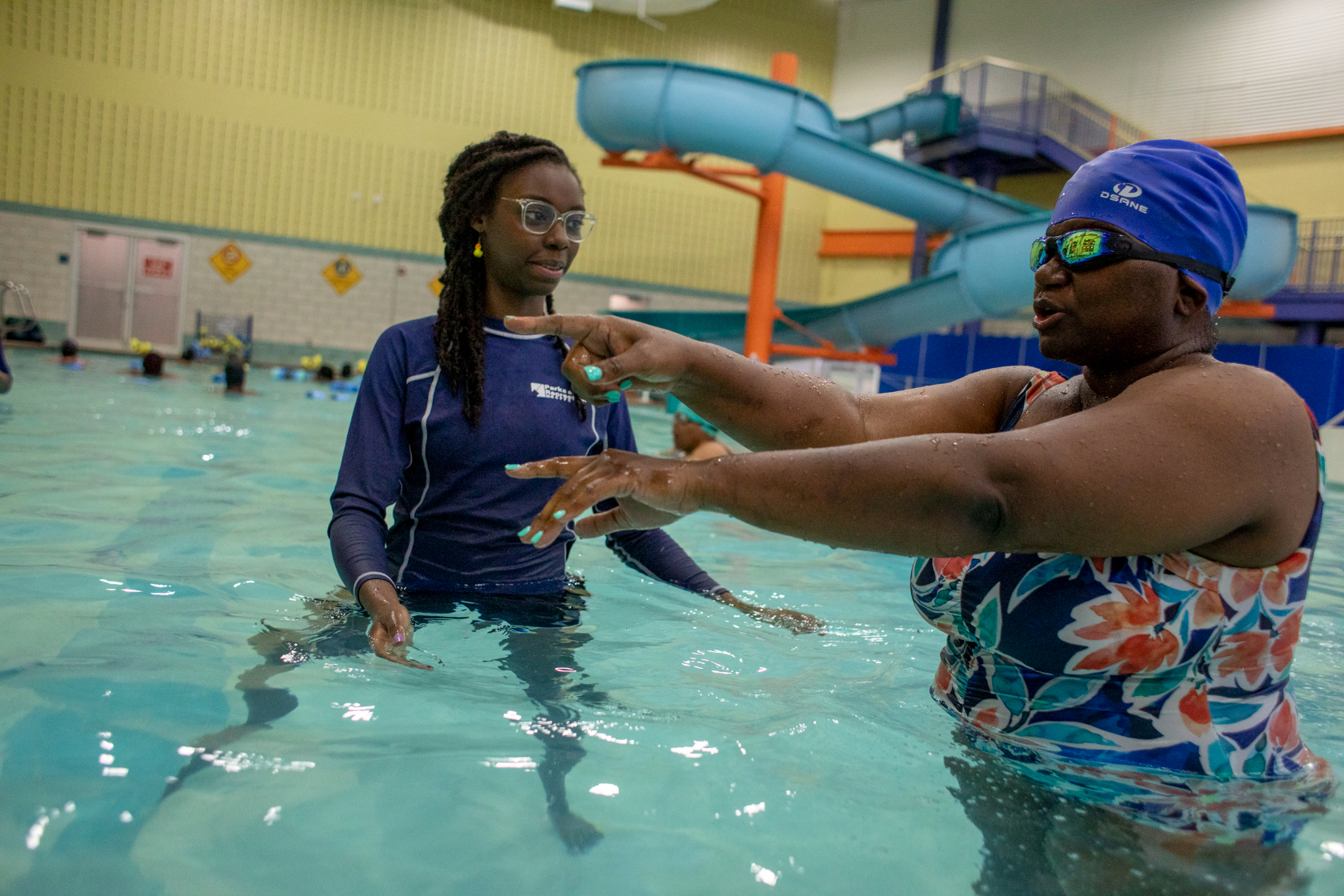
Monica Osborne floats and paddles around the blue water of a pool at the Prince George’s County Sports and Learning Complex in Largo, listening intently to swim instructor Marlon Turner. Clad in a blue leaf-patterned swimsuit and swim cap, she tentatively puts her head under water, then asks Turner for feedback on how to improve on blowing bubbles, the focus of Turner’s lesson for the day.
At 57, Osborne might not seem like the typical swimming student. But she’s one of many Black residents around the D.C. area that are reclaiming the water — even if it means facing some longstanding fears and breaking a decades-long pattern of unequal swimming access in the region.
Nationally, nearly 64% of Black children have either no or low swimming ability — compared to 40% of white children, according to a 2017 study from USA Swimming Foundation. The rate of drownings for Black people ages 29 or younger was 50% higher than white people of the same age, according to research from the Centers for Disease Control and Prevention.
Locally, despite wealth and relatively good pool access in Prince George’s County today, history shows that segregation and lack of funding barred Black residents from learning how to swim for years in the county and the larger D.C. region — contributing to disparities in swimming abilities.
Take Osborne. She grew up in D.C. with access to a pool but never learned how to swim. It wasn’t until a scary incident at a waterpark in Florida last year that she realized it was time to learn.

“A current came and hit me, and I got scared, nervous, I thought I was going to drown, and so I said, ‘No, I need to learn to swim at 57,’” Osborne says. She was with her family and wearing a life jacket, but that still didn’t quell the fear when she was smacked by a wave.
“I felt the need to learn because it’s a life skill,” Osborne says. “I was fearful because I had never learned, but that was my choice.”
Starting with the basics
For this adult class, the process of learning to swim doesn’t start with laps. Just like with the children’s lessons, they start with small steps to build, or in this case rebuild, a relationship with the water.
“I tell all the adults … that if you show up, you are 50% there,” Turner says. “You’re halfway there because you understand what water can do. The other half is for me to show you what you may not have learned, or you may have had a bad experience with … so that you can be comfortable.”
Another student, 68-year-old Monica Murray, didn’t have access to a pool as a child and wasn’t allowed to swim in a creek near where she grew up. Murray had some experience, like swimming underwater and being able to stand in shallow water, but struggled with other basic skills.
“What I really wanted to do was learn how to float,” Murray says. “So far, he’s been teaching me some lessons [on] how to breathe.”

There are five necessary skills in order to be considered water competent, according to the American Red Cross: Jumping into the water over your head and returning to the surface. Floating or treading for one minute. Turning over and around in a full circle. Swimming at least 25 yards, and being able to exit a pool without a ladder.
For Turner, swimming was his first love. He grew up in Lansing, Michigan, and was fortunate enough to have a pool in his backyard.
“I just assumed that the majority of the people in the world could swim,” Turner says. “I found out that so many people that I would run into either never learned how to swim [or] had a bad experience with water.”
And so Turner merged his love for swimming with his college degree in physical education and kinesiology. He’s helped guide kids and adults of all abilities to learn how to swim for the past 24 years.
Turner teaches in one of the wealthiest, predominantly Black counties in the nation, and despite pervasive stereotypes that “Black people can’t swim,” he sees something different.
“I know more minorities that do know how to swim than what you would think,” Turner says. “It just kind of depends on resources, maybe that they grew up around experiences.”

Although Osborne was nervous the first time she started taking classes, she says she was prepared to challenge herself emotionally and has built courage with every lesson. But building that courage is no easy feat. Learning how to swim as an adult may feel embarrassing, intimidating or scary, but Turner understands the root of those fears, and he, along with other instructors, want to help.
Learning water competency doesn’t only increase comfort levels; it can be life-saving as well. Another motivating factor for Osborne is gaining the assurance she can keep herself safe if she chooses to go in the water or in the case of an emergency.
Feeling safe at public pools connects to a deep history of barriers that have kept Black swimmers from the water, according to Miriam Lynch, executive director of Diversity in Aquatics, an organization dedicated to educating and funding efforts to reduce drowning disparities.
A relationship with water forever changed
Black communities historically had a very close relationship to water and traditions surrounding it, Lynch says. During the 16th century through the 1840s, Western travelers and slave traders coming to West Africa reported that Africans were not only sound swimmers but better than Europeans, according to research in The Journals of American History.
As Africans were enslaved and taken to the Americas, they brought those swimming and diving skills with them. But instead of being able to use them for their own enjoyment, those skills were deployed for the capital gains of white communities — like with pearl diving, Lynch says.
After the Civil War, those in power limited Black Americans’ access to water for recreation, according to Lynch. And so Black people often sought water access in places that weren’t safe.
“The places that you can access water are in dangerous places that aren’t built with the same parameters as white spaces,” Lynch says of the time.
During the Civil Rights era, water itself was often weaponized, as fire departments would turn hoses on protesters. Meanwhile, the restrictions that kept Black people out of public aquatic facilities might have technically gone away, but segregation continued, including locally.
In the 1920s, D.C. built two pools for Black residents — Francis Pool in the West End and Banneker Pool in Petworth — separate from the four white pools. Francis and Banneker pools were meccas for Black swimmers during the 1930s, and in 1949 federal law mandated that all of the pools had to be desegregated — which prompted a violent response from some white D.C. residents, many of whom chose to stop using the pools.
Alexandria’s municipal pool was for white residents only until 1952, according to an inscription outside of the Charles Houston Recreation Center Pool. Black residents sometimes sought relief in the Potomac River — which resulted in multiple accidental drownings, according to the same inscription. The city opened the Johnson Memorial Pool in 1952, making it the first pool for Black residents in Northern Virginia. It was named for Lonnie and Leroy Johnson, two brothers who drowned in the Potomac. The physical pool no longer exists, but the Houston Rec Center still retains a “Memorial Pool” in its honor.
In Montgomery County, the privately owned Glen Echo Park Amusement Park only allowed white children to access their facilities — including its Crystal Pool — through the 1950s. In 1960, a group of Howard University students and Bannockburn residents protested and picketed at the amusement park. Pushed by the civil disobedience, U.S. Attorney General Robert Kennedy threatened to revoke a trolley lease for the park if it didn’t integrate, and in 1961, the park was desegregated.
But this was the time of mass white flight, when more and more white city dwellers started moving into the suburbs. They also built private pools, creating clubs that were private and thus could still find ways to bar Black members.
“Swimming became part of the housing community, and you had to live in this house to be able to join the swim club,” Lynch says. “Well, if you weren’t allowed to buy a house in that community, you didn’t have access to that swim club.”
Many of those pools and communities popped up in Prince George’s County, which was largely populated by white residents until the 1990s. The former membership-only Prince George’s Swimming Pool discriminated against Black residents until the pool was forced to integrate in 1975. Adelphi Pool, another private, membership-only pool in Hyattsville, in 2020 investigated its own racist beginnings and made an effort to own up to that history.
Around the country, public recreation budgets were cut after white residents withdrew their support, post-desegregation, leading to neglect of the public pools that did exist. D.C.’s public pools deteriorated over the years, and affordable and accessible swimming lessons became less and less common.
The District has tried to remedy the poor pool facilities more recently, as well as to increase diversity and access, like by lowering barriers to entry for the free D.C Summer League swim teams. DCPS has implemented programs dedicated to teaching kids how to swim, and have even expanded it to Wards 7 and 8. At a competitive level, Howard University is the only historically Black college or university with a swim and dive team, and its coach has made a habit of working to increase the number of Black children who learn to swim in the region. Maryland has also recently introduced legislation to teach swimming in schools.
But if a parent doesn’t know how to swim, there’s still a 70% chance their child won’t either — so what happens when that child grows up? It can be scary to learn to swim as an adult — but many who do can see the benefits immediately.
What swimming does for students
Adults learning to swim now — like those in Turner’s class — will tell you swimming is freeing. It makes them free from the fear of drowning, free from uncertainty on how to help others in the water, and free to explore more of the world.
“If you learn how to swim, you can scuba dive, you learn how to swim, you can be a surfer,” Lynch says. Swimming can open doors for increased fitness, can be an alternative form of cardio if you have joint issues, it can help expose you to kayaking, paddleboarding, and could even help you become a mermaid – yes, that’s a real job. The possibilities are endless when you know how to stay safe in the water, and the opportunities should be for everyone.
Murray found her inspiration in annual trips to the Caribbean with her friends. While they enjoyed the water, she would always stay on the shore. So she started taking lessons along with a co-worker to prepare for the next trip.
“The water is beautiful,” Murray says. “We’re going to Aruba in October, and I said, ‘I am getting in the water, I don’t care. I’m getting in.’”