Margaret Barthel
There’s something about seeing a meteor streak across the sky: Your heart jumps, you suck in your breath, and in a split second, it’s gone.
After the wonder comes the doubt. You think: Did I really just see that? Maybe it was just a firefly, or a trick of sleepy eyes staring up at the night sky for too long. It feels too fleeting and too beautiful to be believed.
But you should believe it, especially if you’re craning your neck back to look up in the first two weeks in August, when the night skies in the Northern Hemisphere put on a light show called the Perseid meteor shower. It happens every year when the Earth passes through the cloud of debris left in the tail of a comet. When those particles hit the atmosphere at high speeds, they heat up quickly, appearing to the human eye as meteors, affectionately known as shooting stars.
The Perseids start in late July, but they peak in frequency in mid-August — this year, on a weekend, with a slim, late-rising crescent moon. Unobstructed Outlook calendar and unobstructed viewing: check and check.
There was just one obstacle remaining to a Perseids viewing attempt, at least in my case.
Normally, if you asked me, “Hey, want to go camping in Northern Virginia in August?” my cold-loving self would reply, “Umm, What about West Virginia? Or… Maine?” (I’m approaching a decade of living in Northern Virginia, but there are just some things my Massachusetts-grown body is not built for, with “mid-90s and humid” topping the list.)
But it turns out I’m willing to give a couple hot, sticky nights in a tent in the Virginia Piedmont a try if it means the chance to see some shooting stars. When friends asked if I wanted to go camping for the weekend, I said yes.
Our group posted up for two nights at Sky Meadows State Park, in Delaplane, Virginia, less than an hour from where I live in Arlington. Sky Meadows is a serious gem: It’s all about the big, rolling foothills before the peaks of Shenandoah, wooded slopes, open farm fields and, aptly, meadows and a lot of open sky. The Appalachian Trail passes through the park, making the hiking opportunities extensive, and there are plenty of other things to check out — a children’s area, a picnicking spot, and a project to grow a grove of blight-resistant American Chestnut trees.
Most importantly for this weekend’s purposes: Sky Meadows is an International Dark Sky park, a designation given to areas with clear night skies that have taken steps to protect the nighttime environment from light pollution — a particularly impressive conservation feat for a park situated so close to the lit-up sprawl of the Northern Virginia suburbs.
The park holds monthly astronomy programs in partnership with the Northern Virginia Astronomy Club and scientist ambassadors from NASA’s Jet Propulsion Laboratory; the next one is coming up at the end of the month.
(All that outreach appears to be succeeding in acquainting the public with Sky Meadows’ big nocturnal views: One ranger told us that people had been calling every few minutes for the past week for information about how to see the Perseids in the park, which normally closes at dusk.)
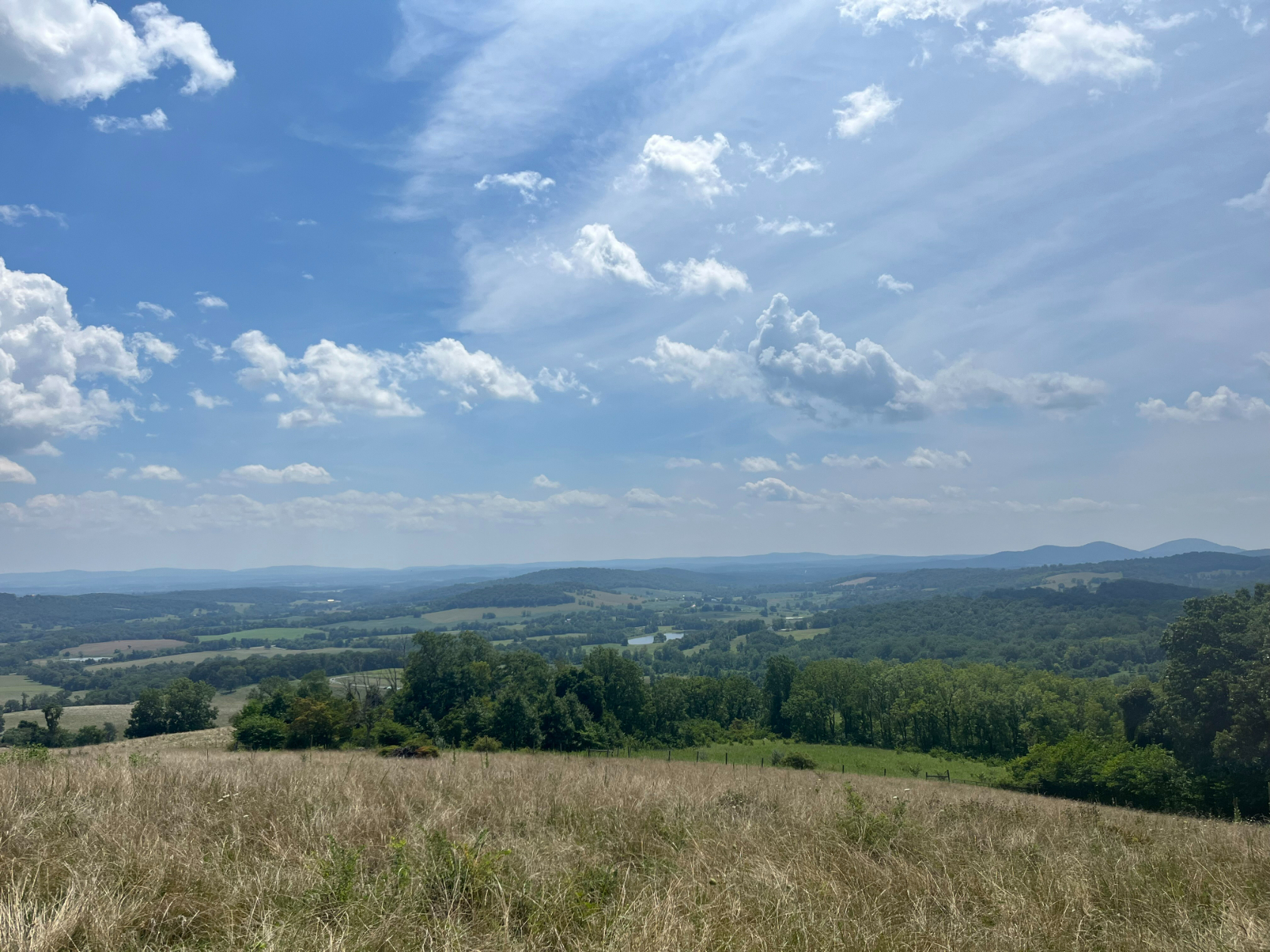
The campground at Sky Meadows is a little more adventurous than your usual front-country car-camping affair. The place is a series of tent pads, a water pump (non-potable), and some pit toilets nestled on the side of a lush forested hillside, about a mile from where you park your car at the park entrance. You lug your stuff down a mostly-flat trail to get there.
I loaded up my backpacking pack, but it’s also possible to haul a wagon back there if you want a few more of the comforts of home. Note for those who are bringing a backcountry feast with them: The campground is in black bear country, so you’ll need to stash all your smelly items — okay, minus your sweaty, post-hike-in self — in the bear locker at your campsite.
It’s all worth it once you’ve made it to camp. You can practically see the verdant creeper vines growing, and I swear the cicadas at night are louder than the planes that fly by my window to land at DCA. And, as advertised, the stars are indeed clear and beautiful there.
We hiked in and set up our tents as it was getting dark. The night started out cloudy, a relic of a passing evening rain shower, but soon I tipped my head back and saw first one, then two, then a handful, then a dozen stars winking through the parting clouds.
The campground’s rough backwoods amphitheater is a little bowl of land with a mirroring bowl of sky above. I lay back on a wooden bench and settled into staring up at the night sky.
My dad is a self-described astronomy nerd who loves nothing more than a good opportunity for citizen science, specifically if it involves his children. (No one was more delighted by an assignment in 9th grade that required me to catalog all the constellations I could see for a week.) He texted our family group chat on Friday afternoon with typically enthusiastic advice for the Perseids.
“No equipment needed, just patience. Comfortable chair, mosquito protection, and a place with good horizon and dark skies,” he wrote. And, just to underscore the point, “Patience! Give the sky time to entertain you, like an hour.”
(That last bit sounds an awful lot like advice from NPR, which I’d like to think is another of my father’s passions.)
A hard wooden bench is not a comfortable chair, and we probably could’ve found a more perfect horizon — we had a good view of a big patch of sky, but trees did block some outer parts of it. But even in imperfect conditions, Dad’s wisdom, particularly about patience, did pay off.
Five minutes in, just after 10 p.m., there was the first one, a pinprick of light slicing across the sky. A little while later, another — or maybe that was a firefly flashing in my peripheral vision. That tiny light moving methodically through the sky? Maybe an airplane or a satellite. But for a second, when your eyes first catch it, you think, Oh, maybe — could it be?
When you think about it, seeing a meteor is a tiny little miracle. First, there’s how science knows what they are and why they’re happening and when to tell all of us to troop out to a dark place and look up at the sky to catch a glimpse of the Perseids. And then there’s the seeing itself, your eyes staring up at the exact right place at the exact right time to track the split-second trail of the shooting star. Even when a group of us were all staring up at the same time, nearly every time there were a few who exclaimed in wonder and a few who were left asking, “Wait, what? Where?” too late.
Dad was right about sitting tight and letting the sky do its thing for a while. Back on the wooden bench after a break while clouds rolled through, my neck was getting sore — and then I saw it: the biggest meteor I’ve ever seen in my life, as if someone had taken a bright Sharpie and drawn it in a swoop across the whole horizon. (Maybe it was a fireball.)
It was spectacular. “Let the sky entertain you,” indeed.
All told, I saw nine shooting stars on Friday night, between 10 p.m and a little after 11 p.m. (The Perseids hit their highest frequency in the wee hours of the morning, just before dawn, but even radio reporters need their beauty sleep, and we’re not letting the perfect be the enemy of the good here.) The meteor shower is now past its peak, but will continue through August 24, so all you eager amateur astronomers might still be able to see a shooting star or two. Or you can wait until next year.
I can tell you: It’s worth it. It’s worth spending the night in the heat and humidity, trying to catch the celestial splendor that happens every year right over our heads.