Morgan Baskin
Close to one-third of people living in the greater Washington, D.C. area didn’t know where their next meal would come from over the last year, a troubling new report shows.
The study, published Tuesday by the Capital Area Food Bank, shows that profound food insecurity continues to persist across the region even as unemployment rates even out post-pandemic. Thirty-two percent of the 5,300 residents polled said they have inconsistent access to sufficient food — virtually unchanged from the 33% of people who reported the same last year. And 18% of those surveyed are “severely food insecure,” per the report.
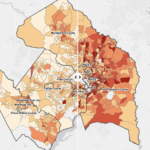
Food access is a particular challenge in Prince George’s County, Md., where 45% of respondents said they have suffered food insecurity. Prince William County, Virginia, and Washington, D.C. also face higher-than-average rates of food insecurity, at 36% and 35%, respectively. About half of the Black and Hispanic residents polled across the region also reported facing food insecurity, compared to only 14% of their white counterparts.
“By and large, the trends remain consistent: food insecurity disproportionately impacts people of color, households with children, and those with lower educational attainment and incomes,” the report authors write. Although food insecurity is more prevalent in households with kids, researchers found that adults tended to screen as food insecure more frequently than their children, in part because they sacrificed their own food to feed them. Federally-funded free school meals programs, which ended in Sept. 2022, also helped suppress rates of child hunger.
Although 82% of those who report having inconsistent access to food are considered “low income” — defined as households making less than $83,000 — affluent jurisdictions are also seeing prominent levels of food insecurity. In Arlington, Va., where the median income sits at more than $128,000, roughly one in six respondents of the survey report facing food insecurity.
The report also indicates that employment has little bearing on a household’s likeliness to face food insecurity. More than three-fourths of the people who reported having inconsistent food access were employed, the study shows, indicating that existing wages aren’t high enough to meet basic housing, food, and medical needs.
“The major drivers of food insecurity among residents of our region included the pandemic’s ongoing impacts on employment, high rates of inflation, and the rollback of pandemic government assistance programs. Any one of these forces could cause difficult financial trade-offs for low-income individuals and families without any margin in their household budget, but many people experienced two or more of them simultaneously,” the authors write.
Over one-third of all survey respondents said their household’s economic conditions have worsened over the last year, with more than half of those reporting food insecurity saying the same. Of the roughly 50% of those who said their finances were made worse by the pandemic, only 12% say they’ve recovered. And that recovery varies wildly by race, with white households being twice as likely to report financial security.