Colleen Grablick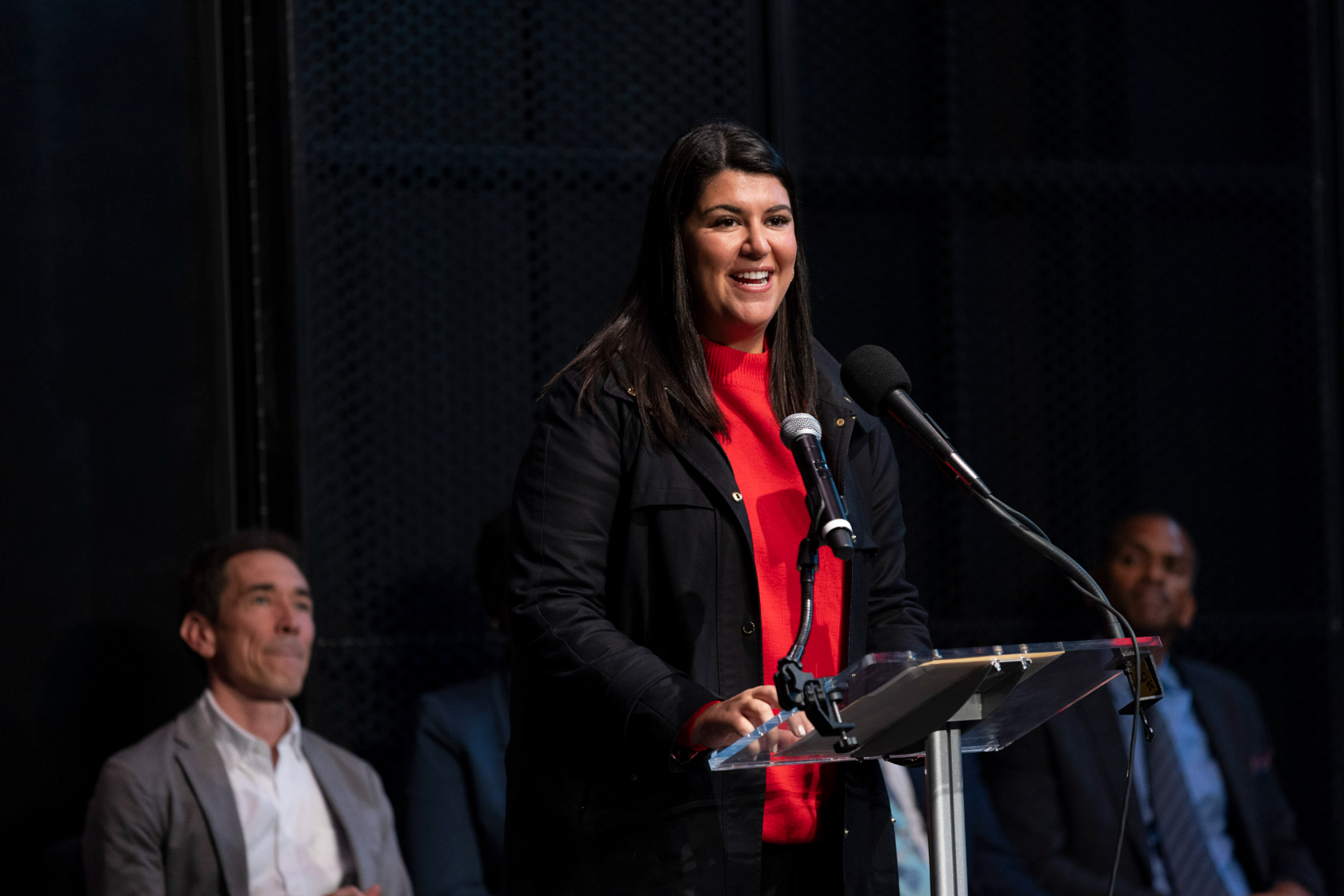
Ward 2 D.C. councilmember Brooke Pinto unveiled a comprehensive and controversial public safety legislative plan on Monday to increase carceral penalties for violent crimes and heighten law enforcement surveillance. Pinto says it is a necessary response to rising crime but it has drawn criticism, particularly for a bill that would allow D.C. police to randomly stop or seize anyone on parole, probation, or supervised release for a gun conviction which several D.C. judges say may be unconstitutional.
The plan consists of seven pieces of new legislation, as well as pushes to make temporary legislation permanent, and calls for greater oversight hearings regarding 911 operations and District violence interruption programs.
“Too many of our residents are afraid. My comprehensive package of legislative initiatives is a compilation of common-sense, targeted interventions that will urgently and practically improve safety for DC residents,” Pinto said in her plan.
The announcement comes as the council returns from its annual recess on Monday following a violent summer in the District: 191 people have died by homicide this year, a 29% increase from last year. Killings remain at their highest level in two decades, leaving residents — particularly those in neighborhoods east of the Anacostia River disproportionately impacted by gun violence — traumatized and exhausted.
In the spring, Mayor Muriel Bowser proposed a package of laws aiming to increase penalties for gun-related crimes, expand pretrial detention for adults and children, and make it more difficult for people with longer prison sentences to gain early release. Her proposal, which garnered more than 160 witnesses at a hearing, drew fierce opposition from reform advocates and community activists for its return to carceral solutions to violence, while business leaders, prosecutors, and some victims of violent crime supported the package.
Ultimately, Pinto passed a narrower version of the bill on an emergency basis following pressure from Bowser. Ward 4 councilmember Janeese Lewis George was the sole no vote, arguing that the bill’s expansion of pretrial detention would contribute to mass incarceration while doing little to improve public safety. Pinto’s vision outlined on Monday indicates a plan to make that bill permanent.
The summer’s discussions regarding violence and potential solutions brought to the fore longstanding conflicts between those who support stricter and more punitive responses to crime in the city and those who believe increased policing and incarceration will only further harm the residents most at risk of encountering violence. Returning to council on Monday, Pinto’s slate of proposals largely aligns with Bowser’s tough-on-crime posture, emphasizing harsher sentencing, surveillance, and policing.
In a press release announcing her plans for the fall, Pinto noted she worked closely with the U.S. Attorney for D.C., Matthew Graves in crafting the agenda. Asked in an interview if she met with community-based and reform organizations in shaping the policies, Pinto said she did, adding that the legislative process should involve “a lot of different players.”
“I invite the public and anybody with ideas or interest to be a part of it; it’s also another reason why we broke them up into various different parts, so it wasn’t so overwhelming, with 10,000 pages of bill text for someone to read. So that people can really participate in pieces that are of most interest to them, or that they have the expertise or lived experience in, to make sure this package is as strong, effective, fair, and responsive as we can.”
Tough-on-crime approach
The most controversial pillar of Pinto’s plan is a bill called ACTIVE (Addressing Crime Through Targeted Interventions and Violence Enforcement) Amendment Act. It would subject any person convicted of a gun offense who is on probation, supervised release, or parole to random search or seizure by a police officer any time they’re outside of their home. Judges can already mandate home searches and other surveillance as a part of parole or probation agreements. Pinto’s bill would go further, however, by emboldening officers to stop anyone they suspect is on probation or parole for a gun conviction. Critics say this is just a rebrand of the stop-and-frisk procedures the city has failed to reform despite evidence of its disproportionate impact on Black residents. (Currently, police in D.C. can lawfully frisk someone with consent, or if they have a “reasonable suspicion” that the person has a weapon.)
As reported in Washington City Paper last week, a report from the D.C. Auditor recently found that the city has not seriously implemented the NEAR (Neighborhood Engagement Achieve Results) Act, which required D.C. police to collect and release data on stop-and-frisk and to use that information to reshape policy. According to the report, the data (which was only published by MPD after a lawsuit from the DC ACLU) has not been used to reduce harm from stops. Cited in the auditor’s report, D.C. ACLU data found that in 2020, Black people were subject to 87% of stops and 91% of searches that resulted in no warning, ticket, or arrest in 2020. The ACLU analysis also found that stop-and-frisk did little to remove guns from streets: just 1.2% of MPD stops in 2020 led to the seizure of a weapon.
While the text of Pinto’s bill says: “it is not the intent of the Council to authorize law enforcement officers to conduct searches for the sole purpose of harassment,” criminal justice reform advocates and lawyers say the bill would do just that.
“The theme of the proposed Addressing Crime through Targeted Interventions and Violence Enforcement (ACTIVE) Act of 2023 is: hunt and hold people who look like they’ve been hunted and held before. In D.C., that’s exclusively Black people, poor people, and native Washingtonians,” Patrice Sulton, a lawyer and executive director of the D.C. Justice Lab, said in a statement.
In a letter to Pinto on Monday, judges from the D.C. Court of Appeals and D.C. Superior Court said the proposed legislation appears to violate the Fourth Amendment, which prohibits warrantless searches on individuals without probable cause. Sulton said even though it’s likely to face a court challenge if the Council went ahead and passed it anyway, Black and poor residents would be targeted and harassed until that challenge made its way through the courts.
“A lot of people get hurt in the meantime when unconstitutional statutes are passed,” Sulton told DCist/WAMU. “It’s not just like ‘okay, well, then the courts will take care of it.”
In an interview, Pinto said it’s intended to tamp down on illegal guns while avoiding carceral options. She added that people accessing guns while on supervised release was a challenge raised to her by Graves, the U.S. Attorney for D.C.
“We are looking continuously as a society for non-carceral options for people, particularly who commit low-level offenses, or who have demonstrated that they have rehabilitated themselves. And for those non-carceral options, there are things like supervised release, probation… so I think that ensuring that those individuals do not have access to illegal guns and are not carrying illegal guns around our streets is an appropriate condition.”
But parole and probation are likely to feed a cycle of incarceration and come with onerous agreements. Plus, in D.C., parole decisions are made by a federal agency, the U.S. Parole Commission. For multiple years, the city has failed to take it back from federal control.
Pinto said she is willing to work with colleagues and residents through hearings this fall to tailor the bill.
“Those details, about how we can enforce this fairly will continue to be centered in the conversation about this specific provision moving forward,” she said.
Expansion of pretrial detention
The emergency crime bill Pinto is moving to make permanent tilted the law in favor of pretrial detention for adults. The ACTIVE bill builds off that expansion by requiring a judge to provide written findings when they decide against detaining someone pretrial.
Prior to the emergency bill this summer, D.C. law favored the practice only when people are charged with committing a violent crime while armed, or when people commit a violent crime while awaiting trial (for any offense, violent or not). The emergency bill shifted the assumption of detainment to everyone accused of a violent crime, regardless of whether they were armed — including crimes like robbery and burglary. A judge can rule contrary to that presumption if they believe an individual won’t be dangerous to the community but the burden is on the accused to argue for release.
In Pinto’s new proposal, the judge would also be required to write a written statement explaining their reasoning to release someone pretrial. D.C. Appeals Court and D.C. Superior Court judges pushed back on this provision, arguing it would strap the resources of D.C. courts.
“An increase of this magnitude would not only have an enormous impact on associate judges currently with heavy trial calendars but would also have a substantial impact on the workload of magistrate judges handling the largest percentage of detention hearings,” wrote Chief D.C. Court of Appeals judge Anna Blackburne-Rigsby and Chief Judge of D.C. Superior Court Anita Josey-Herring.
Councilmember Lewis George has argued that detaining more people before they’re convicted of a crime only perpetuates the harm of mass incarceration in D.C.’s predominantly Black communities. Moreover, she says that evidence links pretrial detention to higher rates of recidivism, unemployment, and housing insecurity and does not link it to a decrease in crime.
“We’re not talking about extraordinarily large numbers,” he said. “This is important because these are crimes of violence and we have concerns about anyone who there is probable cause to believe committed a crime of violence and is back out in the community. But we are not talking about mass numbers.”
Recruiting more cops, corrections officers, call takers
Pinto’s legislative plan also includes a bill to bolster the recruitment and retention of police officers, corrections officers, and call-takers at the city’s beleaguered 911 agency, as well as other “difficult to fill” positions. Dubbed the Government Recruitment and Retention Act of 2023, it aims to build out the community response teams within the city’s Department of Behavioral Health (the teams meant to respond to mental health crises), social workers, and other Department of Human Services employees and care positions at the Department of Youth Rehabilitation Services. (Earlier this year, a DCist/WAMU report revealed troubling conditions at D.C.’s youth jail, in part due to understaffing at DYRS.)
To recruit more police officers and corrections officers, the bill would make both D.C. Police and the Department of Corrections engage in a campaign to attract high school-age students to enroll in training.
It would also create an entirely new role within the office of the city administrator, a Director of Recruitment and Retention, who would identify difficult-to-fill roles and agencies or positions with high attrition rates. Employees hired to these jobs would be offered a hiring incentive of up to $5,000 under the bill, and others could receive a $5,000 retention bonus.
The push to hire more officers is not a new one. Historically, localities tend to push for more police following a jump in crime, but the evidence of its impact on crime reduction is mixed. Bowser increased a hiring bonus for new MPD recruits from $20,000 to $25,000 in April. Before that, in February, Ward 7 councilmember Vince Gray proposed a bill that would’ve paid retiring cops the equivalent of one year’s pay as a bonus to stay on the force for another five years. It also would’ve repealed a number of council measures put in place to increase discipline within the force.
In an interview Monday, Pinto said MPD has about 3,380 officers at the moment — down from roughly 3,800 in 2020.
Surveillance in transit, commercial hubs
A pair of new bills would aim to increase surveillance and emergency response systems in transit corridors and commercial hubs. One would install emergency communication and video surveillance systems near bus stops, train stations, or other public spaces in the District determined by the Deputy Mayor for Public Safety and Justice, Lindsey Appiah. These locations, according to the bill, will be those with late-night or early-morning ridership or frequent incidents of harassment, theft, and violent offenses.
The other, the Safe Commercial Corridors Amendment Act of 2023, would establish a grant program that would give organizations that operate within a commercial corridor money for a broad and rather vague list of uses. According to the text of the bill, applicants must use this to provide safe passage for people to their vehicles or transit stations, install safety systems and security protocols, implement harm reduction strategies and de-escalation training, and “connect residents, workers, visitors, and businesses with resources available through District government agencies and direct service providers.”
D.C. Jail
Another bill would require the city’s Department of Corrections to provide appropriate and free education as required under the Individuals with Disabilities Education Act to people detained in its facilities and expand special education assessments for residents in DOC detention.
The bill would also establish an online portal and tracking system for grievances and other service requests filed by residents in DOC custody.
The new legislation follows an already-introduced bill that Pinto proposed earlier this year, that would set nutritional requirements for food served at DOC facilities. The bill, which is set to have a hearing this fall, would also establish a culinary arts training program within DOC that would provide employment for participants upon their release.
Oversight, hearings, roundtables
Lastly, Pinto’s Monday proposal involved new mechanisms for oversight and data tracking. One piece of legislation seeks to create a fatality review board to assess the causes associated with the death of transgender and gender-diverse individuals in the District. A bill that attempts to increase transparency at the city’s embattled 911 agency is also set to receive a hearing this fall.
She also intends to have two roundtables, one on retail theft, and a second on the mayor’s and the D.C. Attorney General’s violence prevention efforts. Both the mayor’s office and the D.C. Attorney General, who handles juvenile justice, manage their own violence interruption programs but a common critique of the city’s multi-agency approach is that the efforts are disorganized and disjointed.