Jacob Fenston
Brood x periodical cicadas emerged in the D.C. region in the summer of 2021 — then burrowed back underground, where they will stay until 2038. In the meantime, though, the impacts of their emergence have had effects that likely continue to reverberate through local ecosystems, according to newly published research.
“When the cicadas emerge, they create this absolutely massive pulse of delicious and easily accessible food for all the birds and many other species in the ecosystem,” says Zoe Getman-Pickering, lead author on the study, and a postdoctoral researcher at George Washington University while conducting the research. “We were really curious how that would affect all of the other organisms that were tied into this complex food web.”
The study was published in the journal Science.
Cicadas are unique not only because of their periodical nature — emerging aboveground only once every 17 years — but also because they are undefended. Most bugs have some way to deter predators. But not periodical cicadas, which are big, slow, and clumsy.

“They’re not poisonous and they’re not spiny. They’re just little hamburgers falling from the sky,” says Martha Weiss, another author of the study, and a biology professor at Georgetown University.
When cicadas come out they emerge by the billions. Their defense strategy is to overwhelm predators by their sheer numbers.
It’s what scientists call a “biomass pulse” — a sudden influx of food into the food web. Periodical cicada emergences in the eastern U.S. are one of the largest and most dramatic such pulses on earth.
For hundreds of years, scientists — and nonscientists — have been fascinated by cicadas, and there has been lots of research about insects themselves themselves. But there has been a lot less study of the indirect ripple effects cicadas have throughout the ecosystem, the researchers say.
“We really just are at the tip of the iceberg in terms of documenting these effects,” says John Lill, a biology professor at George Washington University, and another of the study’s authors.
To better understand these cascading effects, the team looked the impacts on birds, on the caterpillars birds usually eat, and on trees that caterpillars eat.

The researchers spent many hours in the woods with binoculars, watching birds and documenting what they ate.
“What we found was that everybody eats cicadas,” says Weiss. “From tiny gnatcatchers to giant swans.”
They documented nearly 1,000 birds of more than 80 species gorging on cicadas — in fact, one family of purple martins devoured 27 cicadas in just three hours.
They were surprised to find that birds appeared equally interested in eating cicadas, regardless of the size of the bird. They had expected larger birds would eat cicadas more often, because the bugs themselves are so big. Instead, they “observed varied prey-processing behaviors that allowed birds of all sizes to feed successfully on cicadas,” according to the study.
Next, they wanted to find out — if the birds are filling up on cicadas, are they ignoring caterpillars, one of their usual favorite foods? To answer that question, they made fake, bright green, caterpillars out of modeling clay. Each week, they glued 80 of these fake caterpillars to oak trees. At the end of the week, they counted beak strikes on the fake caterpillars, as a way to track how often birds are seeking out caterpillar meals.
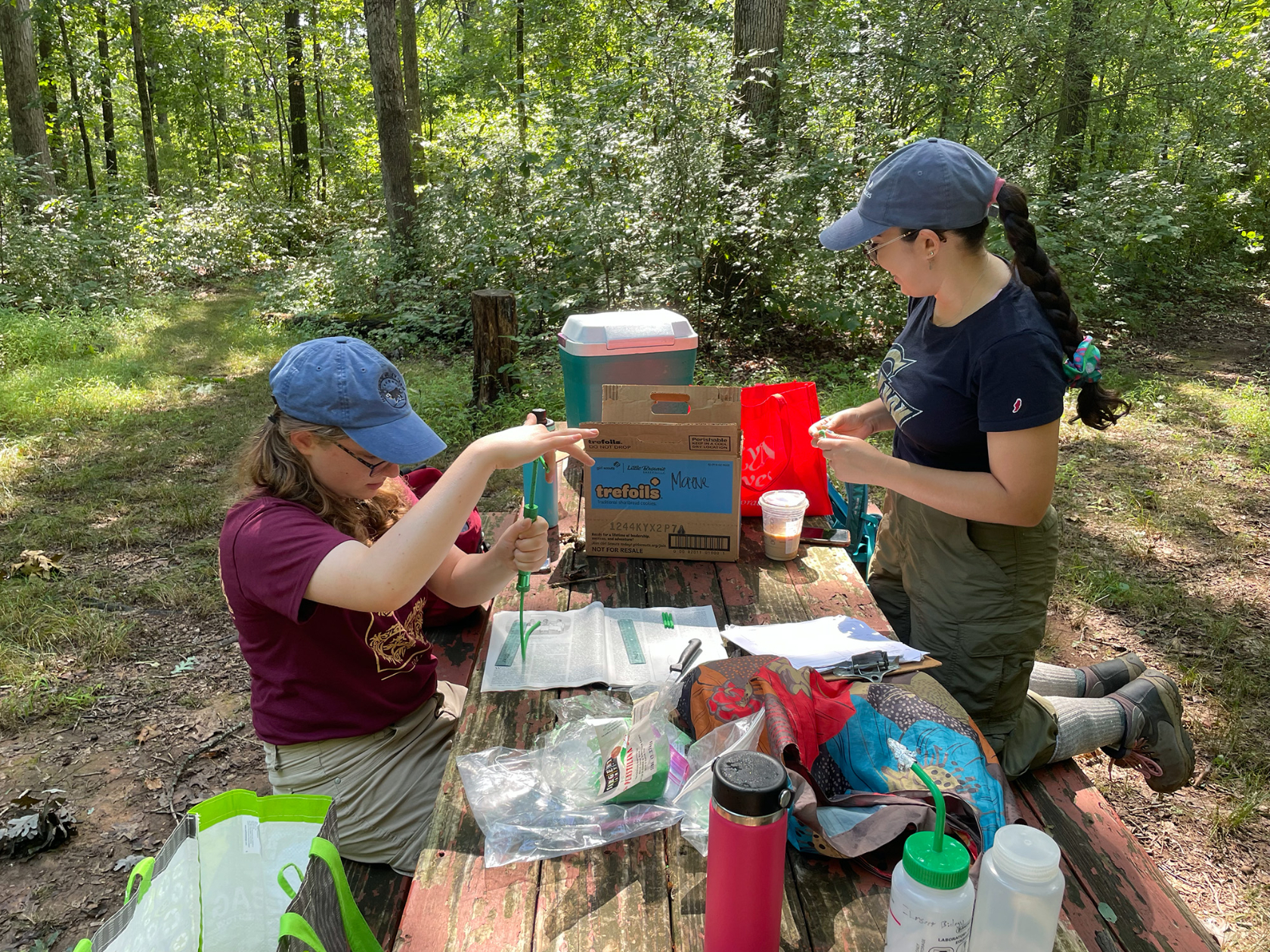
“As soon as the cicadas started to emerge, the numbers dropped from about 25% or 30% of our clay caterpillars having beak marks on them, to down below 10%,” Weiss says. As soon as the cicadas were gone, the rate shot back up to around 30%.
The next step was to look at how the caterpillars themselves were faring, with one of their main predators busy eating someone else. As expected, the caterpillars were thriving!
The researchers surveyed oak trees, inspecting more than 40,000 leaves, and found twice as many caterpillars during the cicada year, compared to the non-cicada control years before and after. And, the caterpillars were fat and happy. The research team documented a fourfold to 50-fold increase in the number of large caterpillars during the emergence year.

The final step was to look at how the booming caterpillar population impacted the trees caterpillars munch on. With twice as many caterpillars, researchers found, unsurprisingly, twice as many oak leaves getting eaten.
Researchers say the study shows how periodical cicada emergences can “rewire” food webs, dramatically altering how energy flows through the system. Just how far these impacts reverberate is unknown. Separate recent research has shown that the occurrence of mast years, when oak trees produce bumper crops of acorns, are closely tied to cicada emergences. The research found that in a cicada emergence year, and the year following, acorn production is low. But two years after a cicada emergence, oak trees consistently produce copious amounts of acorns.
Indeed, that seems to be the case this year — two years after the 2021 Brood X emergence, oaks in many places appear to be having a mast year.
The research team from GW and Georgetown intends to continue studying the downstream impacts cicadas have — next they want to study how ants are affected. But one challenge is how infrequently the creatures emerge.
“Most researchers, in a research career, you get two, maybe three emergences in your local area, if you’re lucky, to get to observe. It really does constrain your local ability to do your research,” says Lill.

Lill, who grew up in the D.C. area, was a young college student in the 1987 emergence. In the next one, in 2004, he and Weiss were early in their academic careers, both young parents with kids who were fascinated by the bugs.
“That’s when we started hatching our plans. We had no less than 17 years to plan something,” Lill says.
“There are researchers who have made their careers studying cicadas,” says Weiss. “They’re sort of like Deadheads — they follow the band — they’ll go to wherever the emergences are coming out.”
The next emergence is next year, in Illinois. It’s a big one, and that occurs only every 221 years, when a brood of 17-year cicadas overlaps with a brood of 13-year cicadas.
Weiss says the team is going to make like Deadheads:
“We’re putting on our tie dyed t-shirts and heading to Chicago,” Weiss says.