Jacob Fenston
 Tyrone Turner
In forests in the eastern U.S., it can be easy to miss the fact that things are going awry. Elsewhere, in places like the Rocky Mountains or the Sierra Nevada, the signs may be more obvious: a whole hillside dotted with dead pines or oaks, for example. But here, the lush greenery can obscure what’s going wrong.
Even though much of the D.C. region’s forests are in protected parklands, they are at risk of disappearing in the coming decades and being replaced by invasive shrublands. Forests are under attack by numerous threats, including climate change, invasive insects, and diseases. The biggest problem though, is that forests are failing to regenerate.

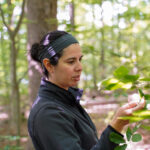
“This forest looks healthy, perhaps on a quick look, but if you look behind you, you see a tree that has fallen, cracked in half and fallen,” says Liz Matthews, a biologist with the National Park Service, walking along a popular trail in Rock Creek Park’s northern flood plain.
To see how an eastern deciduous forest is doing, don’t look up at the mature trees – look down at the ground. That’s where you’ll find the next generation of the forest. A generation that is in big trouble.

To understand why, you have to understand how East Coast forests normally regenerate. It’s through a process called gap dynamics.
The cycle starts when mature trees die – whether from disease, a storm, or old age.
“Trees die, right, they have lifespans,” Matthews says.
A dead tree creates a gap in the canopy, meaning suddenly there’s sunlight flooding onto the usually dark forest floor. In a healthy ecosystem, there’s a multitude of smaller trees growing in the understory. They’ve literally been waiting in the shadows for this very moment.

“Then they’re exposed to a bunch of light and they’re able to respond and fill that canopy gap. That cycle happens on a small scale all over the forest over time,” says Matthews.
But in nearly every local forest, that cycle is broken.
Matthews authored a study earlier this year, published in the journal Ecological Applications, looking at forest regeneration in 39 national parks up and down the East Coast. Using data from 12 years of monitoring, they put each park in one of four categories, ranging from secure – on the healthy end of the spectrum – to imminent failure.


Out of the 39 parks, 27 were classified as in imminent or probable failure in terms of regeneration. Only one was categorized as secure: Maine’s Acadia National Park.
In the D.C. area, 9 out of the 11 parks studied were categorized as in imminent or probable failure.
“While it’s concerning – the names of those categories were intended to be concerning – it is important to realize that they’re not permanent, they’re not irreversible,” Matthews says.
[Five things you can do to help save local forests.]
The study warns that without “immediate and sustained” intervention, forest loss could become a widespread pattern in the region.
The good news is, despite the huge scale and scope of the problem, the causes are pretty straightforward: an overpopulation of deer, and an invasion of fast-growing non-native plants.
Cute, Furry, And Very Hungry
White-tailed deer are a native species – they too have a place in a healthy forest. But when there are more deer than a forest can support, the impacts can be severe. Deer hungrily devour native seedlings and saplings, decimating that crucial regeneration layer.
Deer were not always a problem in this part of the country; before 1960, there were no deer at all in Rock Creek Park. The animals were hunted to near extinction in the 1800s and early 1900s. Before that, deer were kept in check by natural predators, such as wolves.
During the second half of the 20th century, in the absence of hunters and wild predators, the deer population exploded.

Parks have only started implementing deer management in the past decade or so, using sharpshooters to cull deer populations. Catoctin Mountain Park, near Frederick, Md., was one of the first in the region to do this.
“Catoctin resource managers began to notice that the park had a lack of forest regeneration back in the 1970s,” says Lindsey Donaldson, chief of resource management at the park. “They suspected that it was due to an overpopulation of deer.”
Previous research has shown that deer harm vegetation when there are 20 per sq. mile or more. In Catoctin, there were more than 120 deer per sq. mile.
Deer management started in 2010 in Catoctin. The results have been encouraging – the deer population is now about one-sixth of what it was, and there are almost 20 times as many seedlings per acre.

But repairing the damage done by deer can take decades. It took seven years to get the deer population within a sustainable range at Catoctin. While the seedling numbers have bounced back to where they should be, there are still not enough saplings – the small trees that stand ready to fill any gap that opens up in the canopy.
Killing deer to help forests isn’t without controversy: many animal rights advocates say it’s inhumane and unnecessary.
But Matthews says that without shrinking deer populations, there is no way to restore forests.
“By managing the deer, we’re able to maintain habitat and forests that would not exist with deer populations as they have been,” Matthews says.
Deer Unleash An Invasion Of Exotic Plants
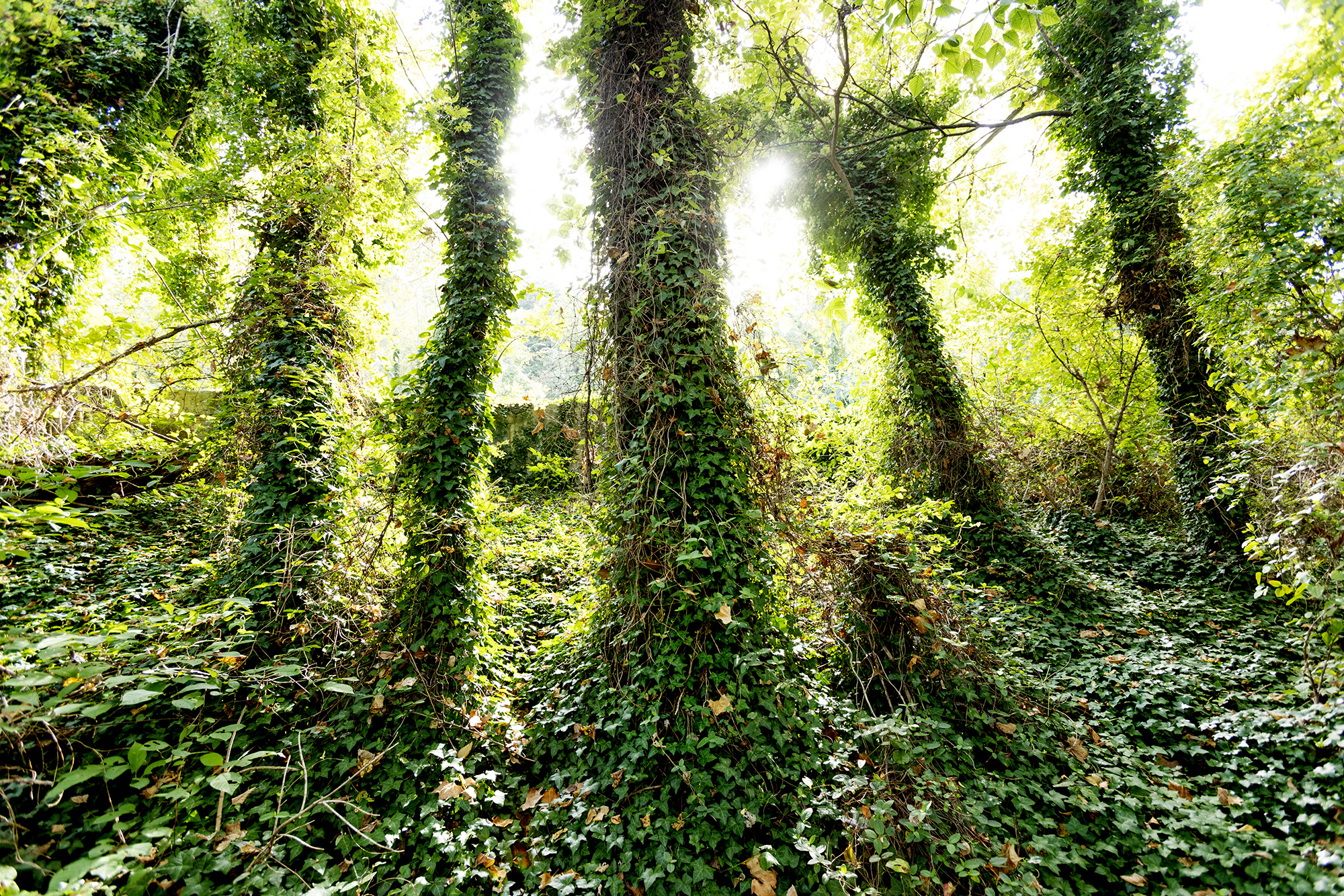
It’s almost as if deer and invasive plants are in cahoots, conspiring to undo forest ecosystems. Deer usually prefer to eat native plants – so they’ll devour baby oak trees, but leave English ivy alone. With this boost from deer, invasives can often grow in thick mats, crowding out and smothering native seedlings. When a gap appears in the canopy, there aren’t young trees waiting to spring up, but rather, invasive vines and shrubs.
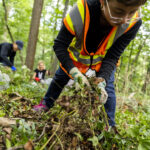
On a wooded hillside in Southeast D.C., Nathan Harrington saws away at thick vines encircling the trunk of a red oak tree in a small patch of forest. It’s part of the National Park Service’s Fort Circle Parks.
Just about every tree has invasive vines climbing the trunk – on some trees, there are so many vines you can’t see the tree bark.
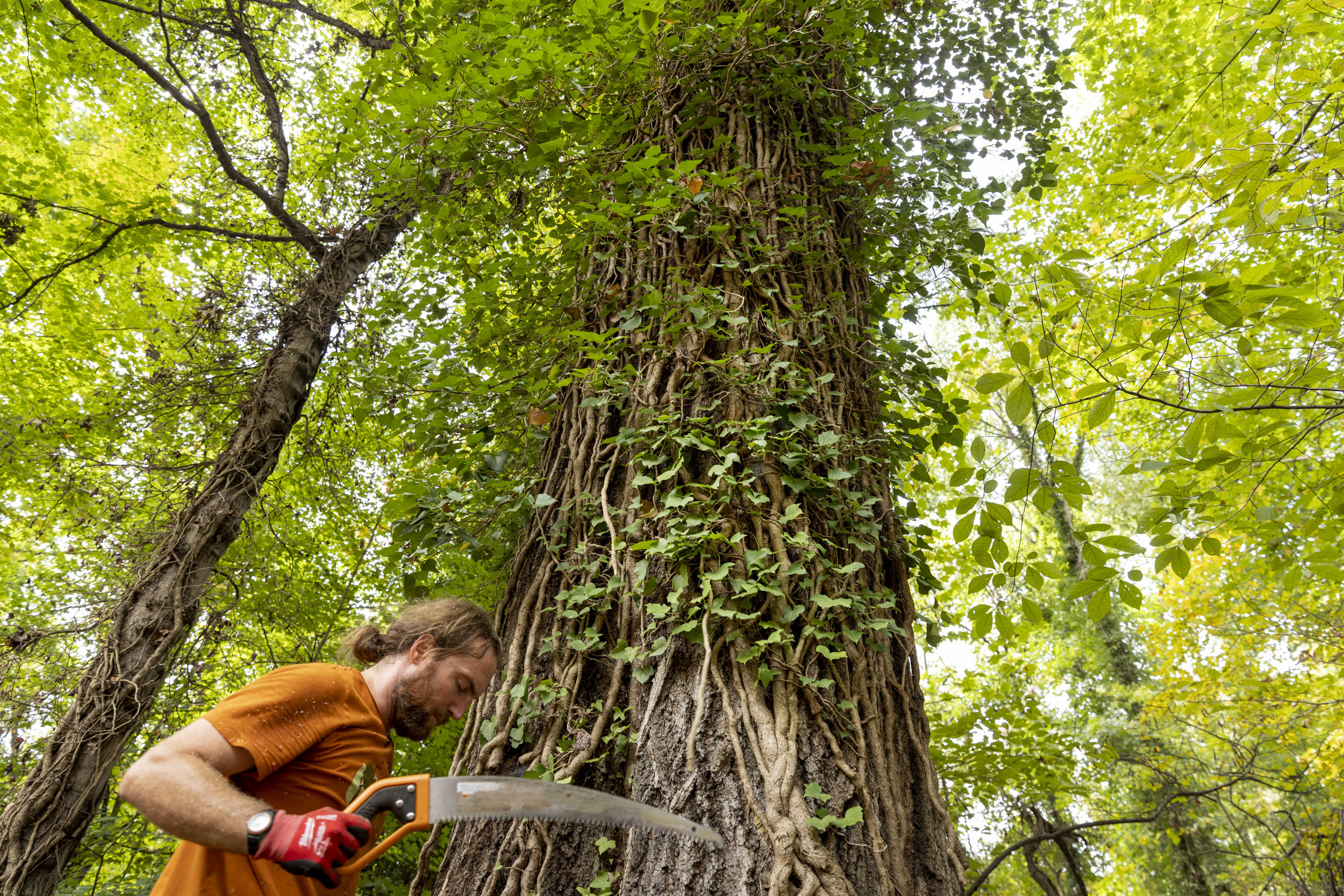

“A lot of people find this very difficult and tedious, but I’ve had ten years of practice to refine my technique, and I find it very satisfying,” Harrington says, pulling a stem of English ivy several inches thick.
Harrington is the founder and director of the nonprofit Ward 8 Woods Conservancy – the group has freed some 5,000 trees from invasive vines in parks east of the Anacostia River.
Without this sort of intensive – and sweaty – intervention, Harrington estimates this small forest fragment would disappear within a few decades.
“Just because an area has been wooded for a long time doesn’t mean that we can take it for granted and assume that it’s always going to stay that way. If we don’t go in and maintain it, it will cease to be at some point,” Harrington says.
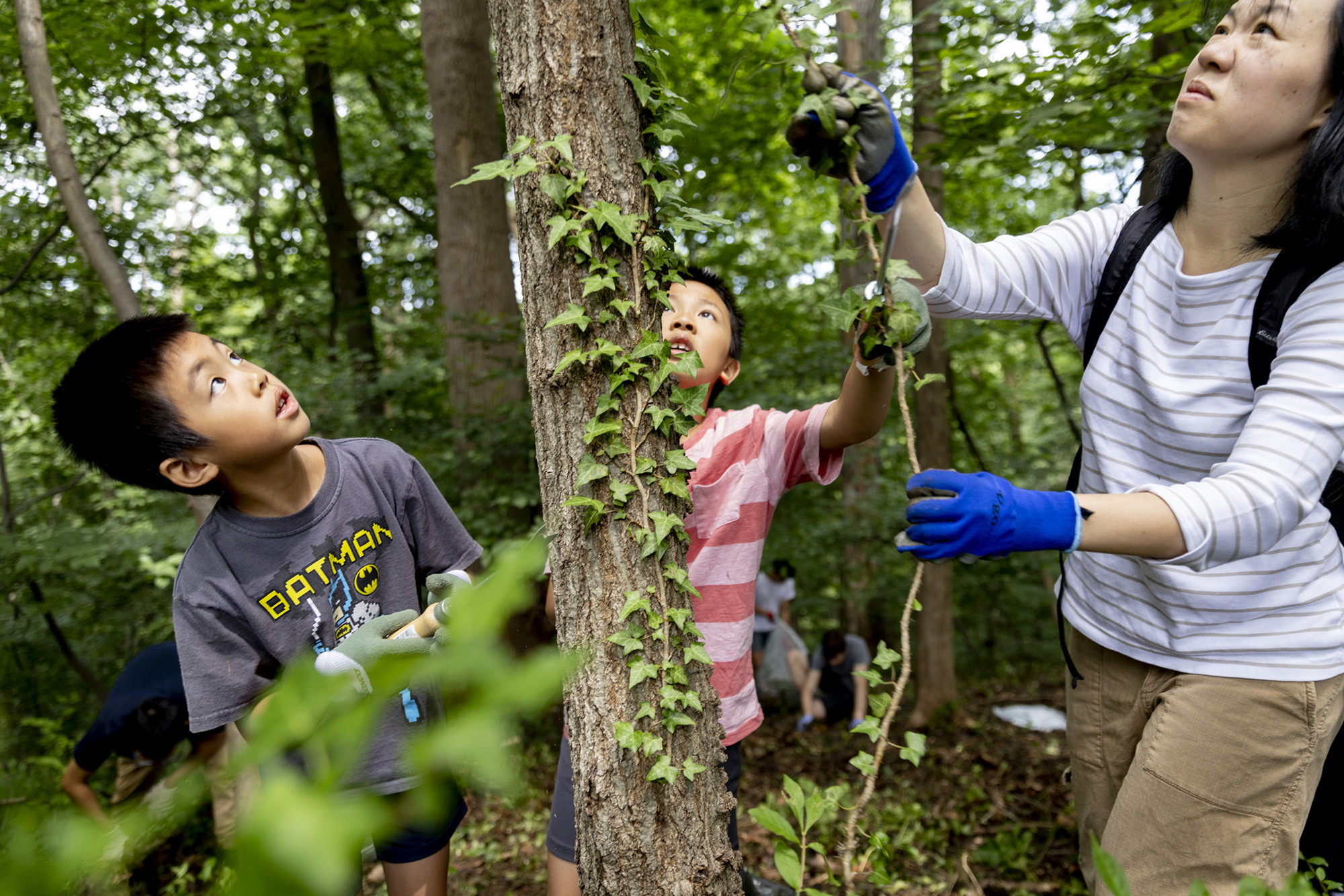
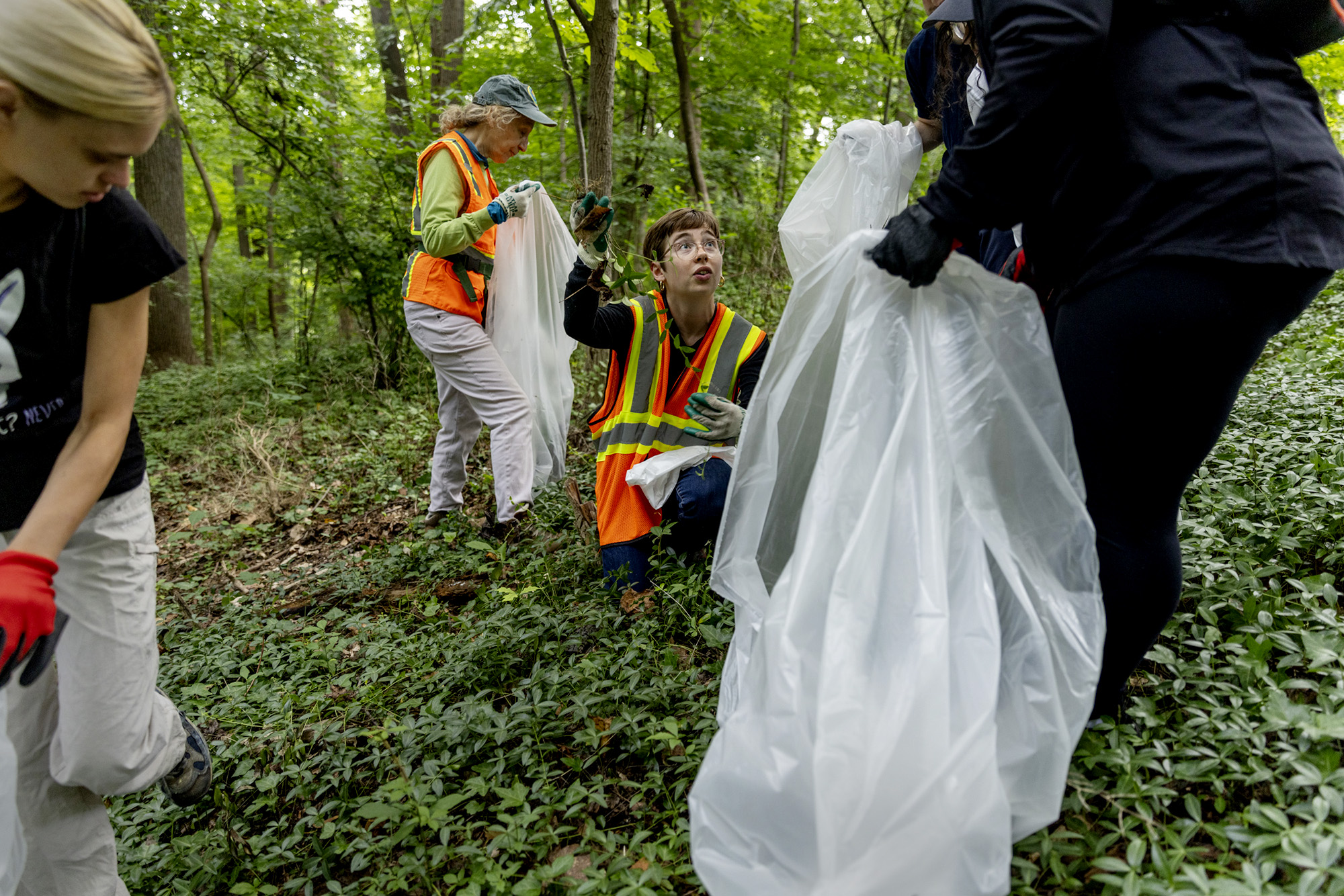
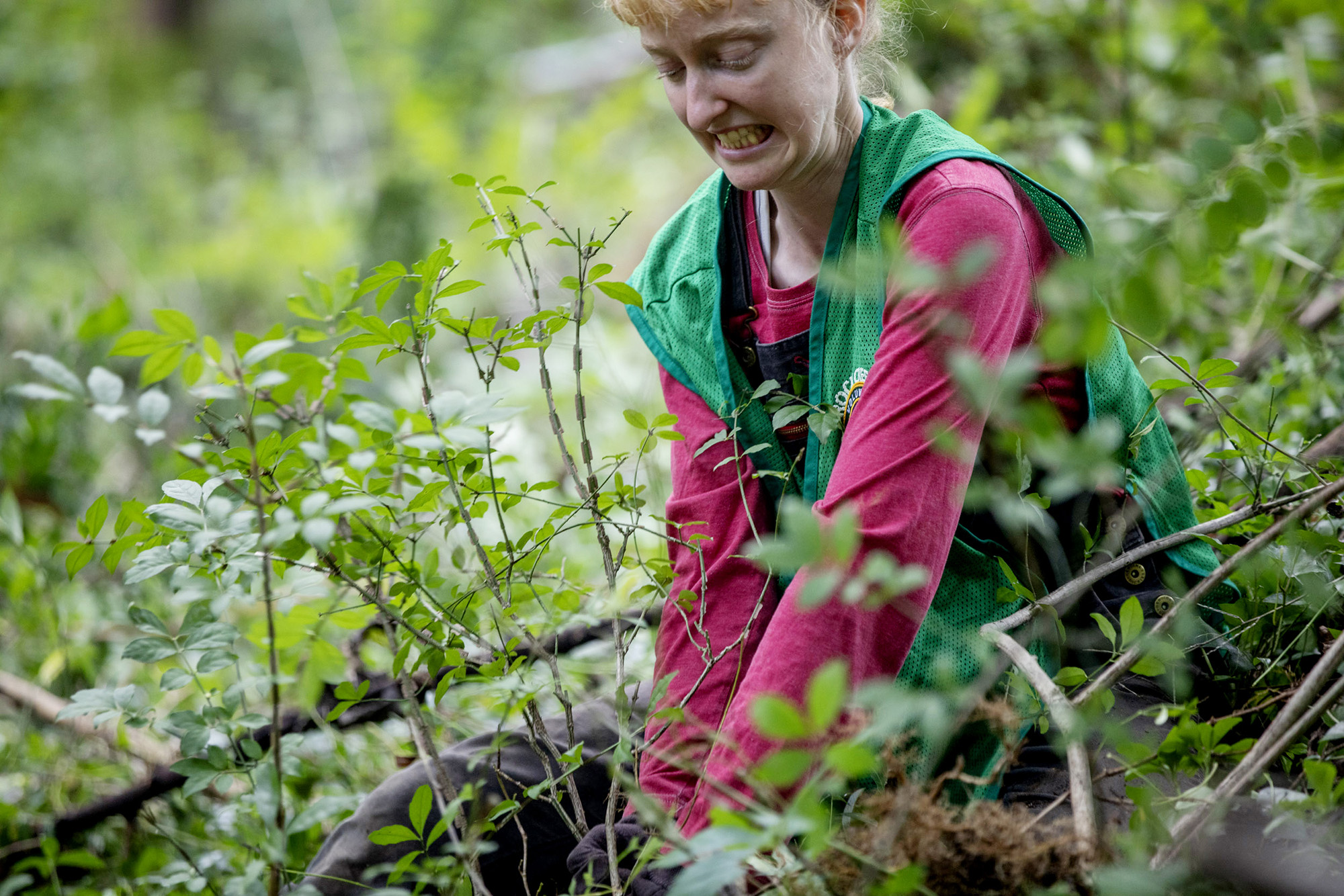
Around the region, many efforts like this are powered by volunteers, thousands of whom spend their weekends attacking invasives each year. However, Harrington says if we’re serious about saving our forests, volunteer labor isn’t enough.
“Are we going to get it done with just people going out on weekends because they feel like it? Or do we need actual professional crews that are going to be out there every single day throughout the year? I think it’s the latter,” Harrington says. After all, there are professional crews out planting trees – why isn’t there the same kind of investment in saving the trees we already have?
Restoring Forests Restores Humans Too
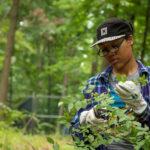
Several local organizations run programs that hire people to tackle invasives: Rock Creek Conservancy pays high school students to pull out vines in the summer; Ward 8 Woods hires park stewards from the neighborhood to remove vines and trash; Friends of Anacostia Park has its Friends Corps.
“It’s basically our green job training program, and an effort to ensure the restoration of Anacostia Park doesn’t become decoupled from the needs of the surrounding community and their skills,” says Richard Trent, executive director of Friends of Anacostia Park.

The Friends Corps hires residents who may have trouble finding work elsewhere – people like Wayne Parker, grounds lead with the group.
“I came here after doing a prison term, a long prison term, ten years,” Parker says.
He says helping restore the forest has also helped him heal.
“I was going through a lot of trauma from just being in prison, the lifestyle of D.C., the DMV. I wanted to change, but I didn’t know how. I came down and we started doing just basic cleanups. I noticed that I was getting very peaceful. I said, ‘There’s something to this.’”
Making Forests More Resilient
What does it mean to restore a forest, in a place that has been shaped and reshaped by humans for hundreds of years? Returning it to a pristine, primordial natural state is not an option.
Forests were first clearcut in the region starting in the 1600s – in many places, it was to make way for highly destructive tobacco plantations, which depleted the soil and polluted waterways. In the years since, numerous foundational tree species have been attacked by invasive pests, and are no longer a viable part of the ecosystem.
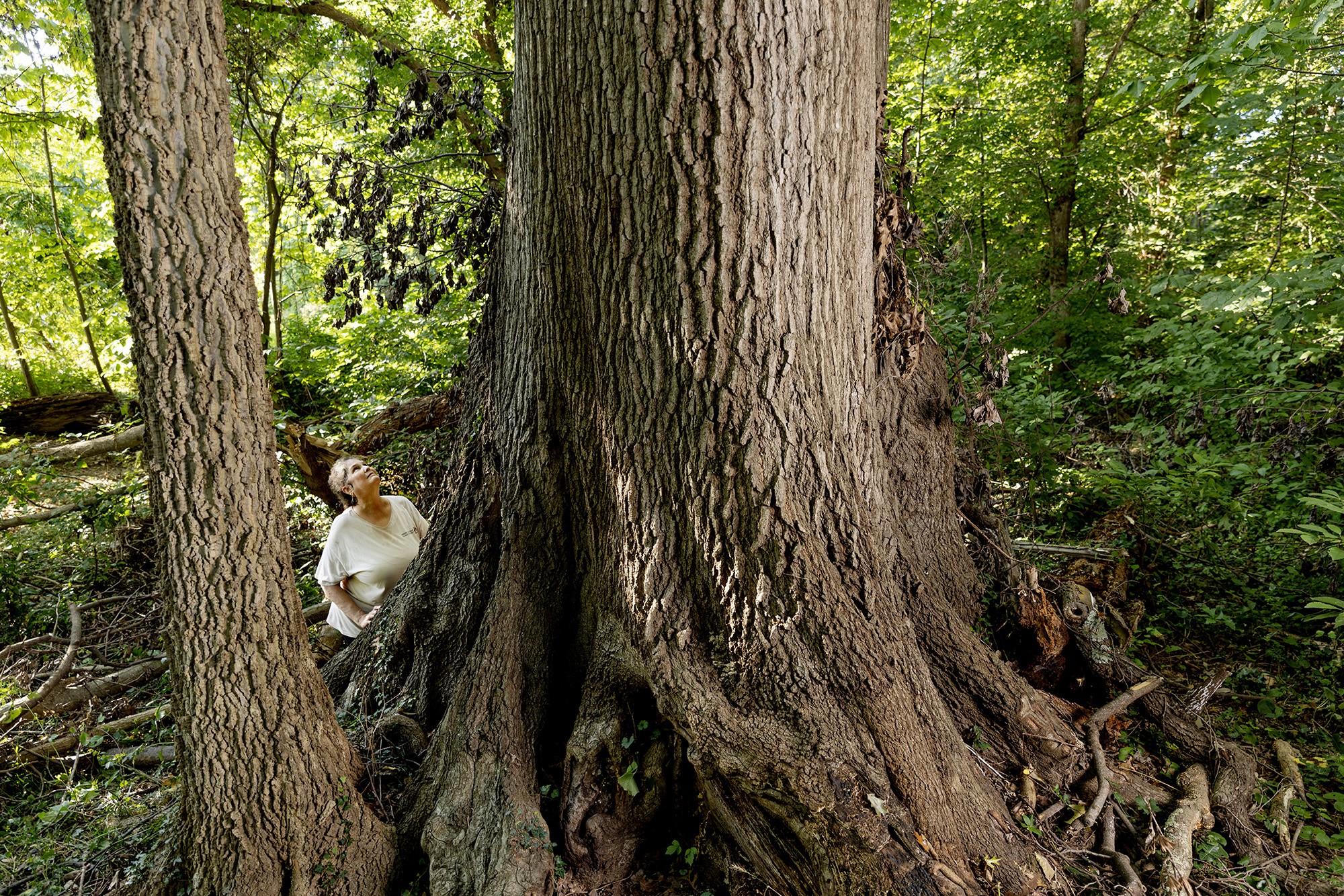
Chestnuts, once one of the most common trees in local forests, were wiped out 100 years ago by a fungus from Asia.
“A lot of our historic cabin camps are made out of chestnut because they all died back then, so we used the lumber to build the cabins,” says Lindsey Donaldson with Catoctin Mountain Park.
More recently, in the past decade, ash trees have been largely killed off by an invasive beetle. Now, beech trees – the most abundant tree in many local parks – are under attack by a mysterious new pest.
“We really don’t have that many other canopy species left,” Donaldson says. “If something comes in and wipes one of those out – I don’t even want to imagine that.”
These invasive pests and diseases exacerbate the forest regeneration problem: each species that’s lost makes forests that much less diverse, and less able to bounce back.
As forests are restored, it needs to be done in a way such that they’re more resilient, both to pests and to a changing climate.
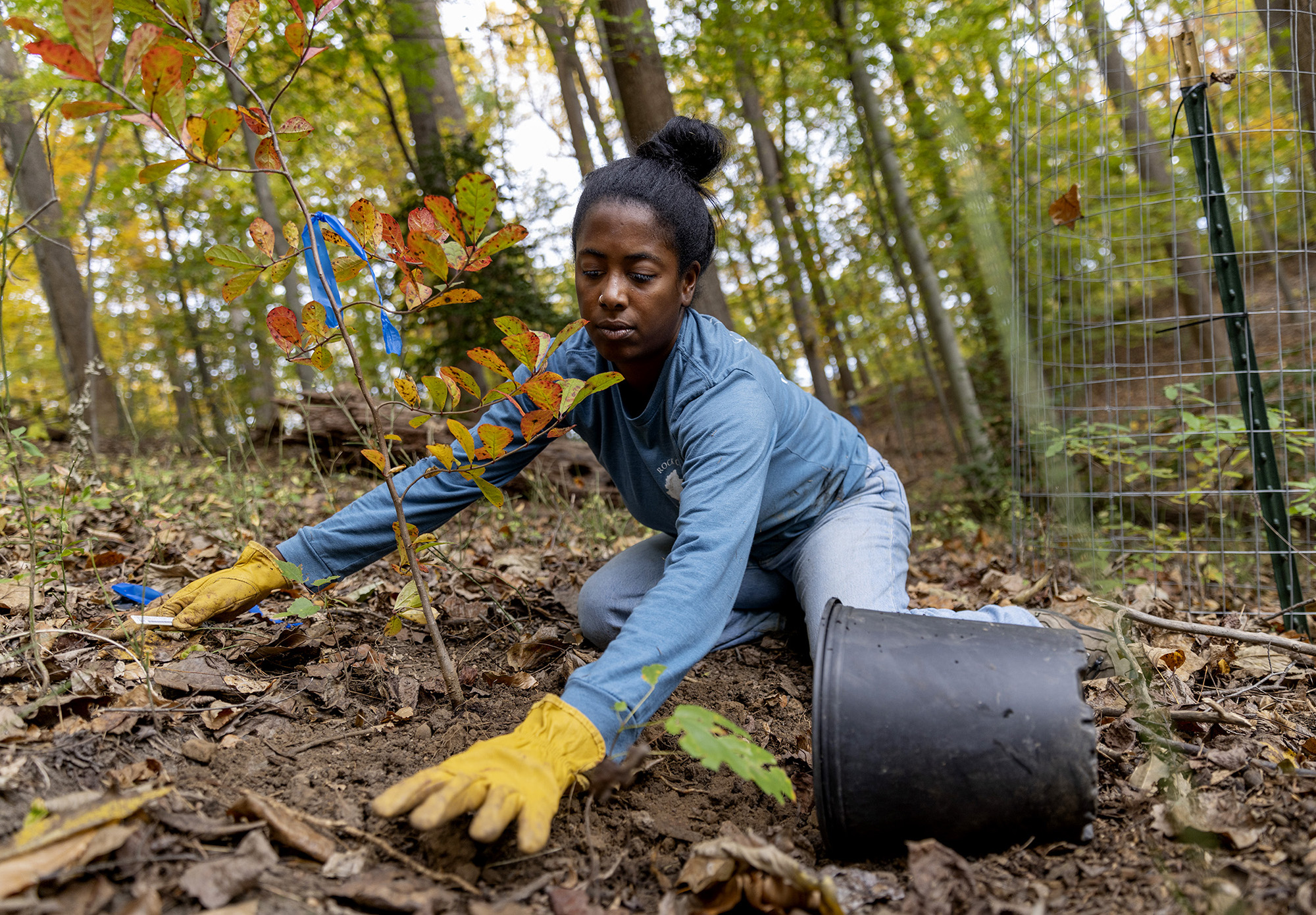


“We think of climate change as a stress multiplier,” says Liz Mattews, the NPS biologist.
If we can reduce the stress on forests from deer and invasives, the ecosystem will be in a much better position to thrive on a hotter planet.
In Rock Creek Park, NPS is working with Rock Creek Conservancy on a forest resilience plan. Jeanne Braha, the conservancy’s executive director, says the document will be “like a trail map for saving the forests.”

Currently, Rock Creek Conservancy has adopted several small sections of the park as “mini-oases” – demonstration areas, showing what a restored forest looks like. They focus volunteer efforts on these areas, clearing invasives and replanting natives. The mini-oases occupy less than 30 acres out of the park’s 1,800.
The idea behind the resilience plan is to figure out how to rapidly scale up from these mini-oases to the entire park.
At the current pace, Braha jokes, “we’ll be done in 100 years.”
By then, there might not be much forest left.
This story has been updated to reflect that Catoctin Mountain Park is one of the first in the region to implement deer management in the past decade.