 Sarah Y. Kim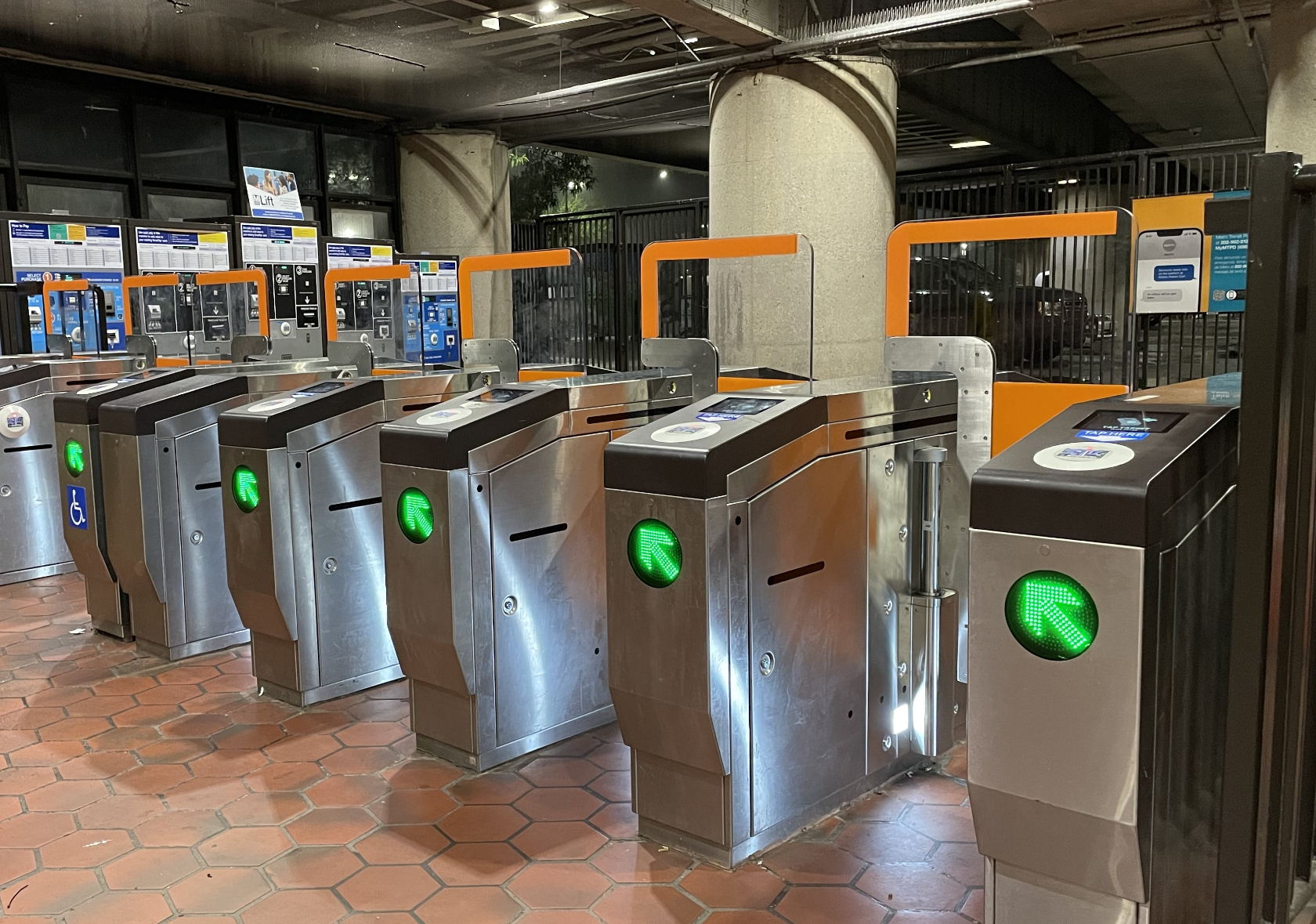
Every year, we take a look ahead at major transportation projects in the D.C. region scheduled for completion in the new year. In 2024, there will be new faregates and escalators in the Metro, newly paved streets across the District, and road updates across the region aimed at easing traffic and improving accessibility for cyclists and pedestrians.
2023 was a big year for public transportation projects, including the opening of Potomac Yard Metro Station in Alexandria as well as the reopening of the Metro’s Yellow Line and rehabilitation of its bridge and tunnel. And the year before that was an especially big year for transportation projects, including the completion of the long-awaited extension of the Silver Line.
In contrast, 2024 may be a quieter year for public transit projects, in part because money is tight across the region. Notably, Metro has a $750 million budget shortfall and is requesting significant increases in subsidies from the region’s three jurisdictions to close that gap. This month, WMATA released a budget proposing drastic cuts should that additional funding not come through. Allocating additional funding may prove difficult, however. D.C. and Virginia are warning of budget deficits and cuts ahead, and Maryland announced a $3.3 billion transportation budget shortfall .
There are also some longer-term projects still underway, including the long-delayed Purple Line – a 16-mile light rail system that will connect Prince George’s and Montgomery Counties, from New Carrollton to Bethesda. The Maryland Department of Transportation says the project is more than 63% complete and there will continue to be “significant progress” next year. But it won’t be completed until May 2027, provided there are no further delays.
The following project completion dates are subject to change.
Metro Faregate Retrofit
What: Metro began putting up taller faregates at several stations this summer, starting with Fort Totten in July. The gates, which WMATA projects will cost about $35 to $40 million in total to install, are designed to be more difficult to jump over or push through. They’re about 55 inches tall – compared to the 28-inch tall gates on the previous faregates – and are made of polycarbonate, a material about 200 times stronger than glass.
Separately, WMATA is also continuing to replace escalators across the system. That project won’t be completed until 2028, but next year we can expect about a dozen replacements, including at Deanwood, Addison Road, Ronald Reagan Washington National Airport, and Rosslyn Metro stations.
Where: Across the entire Metrorail system.
When: WMATA plans to roll out the new gates across all stations by summer 2024.
Why: The faregates are designed to reduce fare evasion, which costs Metro about $40 million annually. The gates haven’t stopped the more determined riders from climbing over; but in August, Metro released data showing that fare evasion went down by about 70-80% at stations with the new gates.
More people paying fares would help reduce the deficit, though Clarke has maintained that any reductions in fare evasion are not enough to address Metro’s ongoing structural funding shortfall.
Project Website: Fare System Modernization
DDOT Paving Plan
What: Since 2021, the District Department of Transportation has been repaving streets, sidewalks, and alleys to repair bumpy surfaces across the District.
Where: Multiple locations across D.C.
When: Fall 2024. (The project will be on pause for a few months in the winter, when paving season comes to a close, but will resume in the spring.)
Why: In 2018, about a quarter of streets in the District were considered to be in poor condition. The project is expected to improve road and pedestrian safety, and fewer potholes and cracks mean less wear and tear on tires (it should also make driving in the District a little smoother).
Project Website: DDOT Paving Plan
I-270 Innovative Congestion Management
What: The Maryland Department of Transportation State Highway Administration (SHA) has been updating Interstate 270 to alleviate congestion. They’re adding sensors on ramps to detect real-time traffic conditions and activate traffic signals to make merging onto I-270 more efficient. Once fully operational, the signals are expected to be active during peak traffic hours and will operate between 4 a.m. and 11 p.m. daily.
Where: I-270 in Montgomery County, from Frederick to I-495
When: Fall 2024
Why: The project is aimed at improving safety and reducing morning commute times by up to 30 minutes.
Project Website: I-270 Innovative Congestion Management
US 1/Baltimore Avenue Reconstruction
What: Maryland’s transportation department is repaving US 1 (Baltimore Avenue) from College Avenue to MD 193 (University Boulevard), widening the US 1 roadway and adding a five-foot-wide bicycle lane. There will also be new ADA-compliant sidewalks along both sides of US 1. Other upgrades include resurfacing, landscaping, drainage system upgrades, and new pedestrian and intersection lighting.
Where: College Park, Prince George’s County, Maryland
When: Spring 2024
Why: The upgrades are expected to improve safety for drivers, cyclists and pedestrians along US 1.
Project Website: US 1 (Baltimore Avenue) from College Avenue/Regents Drive to MD 193 (University Boulevard) Reconstruction
MD 185 at Jones Bridge Road/Kensington Parkway
What: The project will add a new left-turn lane, widening the west leg of Jones Bridge Road and allowing more drivers to travel north onto MD 185. The east leg of the road will also be widened to align through lanes. There will also be sidewalk reconstruction, a new shared-use path, upgraded traffic signals, and improvements to landscaping, drainage, and stormwater management.
Where: Chevy Chase, Montgomery County, Maryland
When: Spring 2024
Why: The project will improve capacity and operation of the MD 185 at Jones Bridge Road/Kensington Parkway intersection
Project Website: MD 185 at Jones Bridge Road/Kensington Parkway
Safety and Resurfacing Projects in Maryland
What: Maryland’s transportation department is completing several road improvements, including at MD 704 (Martin Luther King Highway) from Greenleaf Road to Ardwick-Ardmore Road in Glenarden, Prince George’s County, as well as MD 195 (Carroll Avenue) between the Washington, D.C. Line and MD 193 (University Boulevard) in Takoma Park. Improvements include revpaving, high-visibility crosswalks and ADA-compliant sidewalk ramps and driveways. The department is budgeting $5.5 million for MD 704 and $2.8 million for MD 193.
Where: Several locations in Montgomery and Prince George’s Counties, Maryland
When: Summer 2024 for MD 195, Fall 2024 for MD 704
Why: The transportation department says the projects will improve safety and mobility in Montgomery and Prince George’s Counties.
Project Websites: MD 195. See press release for MD 704.
New Traffic Control Devices in Maryland
What: There will be new traffic control devices at several locations. At Greenery Lane in Glenmont there’ll be a HAWK signal – which allow pedestrians to press a button for a red light so they can cross. At Middleton Lane in Bethesda there’ll be a new traffic signal with APS/CPS, which uses sounds and vibrating surfaces to help blind and Deaf pedestrians cross safely. There’ll also be a pedestrian-activated “flasher” signal at Wheatley Street in Kensington Montgomery County and a new traffic signal at Norair/Garret Morgan Boulevard in Prince George’s County.
Where: Multiple locations across Montgomery and Prince George’s Counties in Maryland
When: Winter 2024 for devices at Greenery Lane and Middleton Lane, late spring 2024 for Wheatley Street, summer 2024 for Norair/Garret Morgan Boulevard.
Why: The projects will make roads safer and more accessible to pedestrians and cyclists.
Boundary Channel Drive at I-395 Interchange
What: The Virginia Department of Transportation (VDOT) is making adjustments to the Boundary Channel Drive at the I-395 interchange to make it more walkable and bike-friendly. As part of the project, they will add an eight-foot-wide sidewalk eastbound and a 12-foot-wide shared-use path westbound. That shared-use path will connect Mount Vernon Trail to the Pentagon and Long Bridge Park.
Where: Arlington County, Virginia
When: Spring 2024
Why: In addition to making one of the region’s busiest corridors more accessible to cyclists and pedestrians, VDOT says the project will improve safety and traffic flow.
Project Website: Boundary Channel Drive at I-395 Interchange Improvements
Route 7 Corridor Improvements Project
What: VDOT is revamping seven miles of Route 7, widening the road from four to six lanes and adding shared-use bike and pedestrian paths, among other upgrades.
Where: Route 7 from Reston Avenue to Jarrett Valley Drive in Fairfax County.
When: Expected completion date is July 31, 2024
Why: The project will increase capacity on Route 7. It will also improve traffic flow safety and make the road more accessible to cyclists and pedestrians.
Project Website: Route 7 Corridor Improvements Project
Spring Street Widening
What: VDOT is widening about a quarter-mile of Spring Street in Fairfax County town Herndon to include additional through and turn lanes from just west of Herndon Parkway to Fairfax County Parkway in Virginia. There’ll also be new routes for people traveling by bike or on foot: a new sidewalk and an eight-foot-wide cycle track along northbound Herndon Parkway. That track will eventually connect the Herndon Metro station, which opened in late 2022, to the Washington & Old Dominion Trail.
Where: Spring Street, from just west of Herndon Parkway to Fairfax County Parkway
When: Late 2024
Why: The project aims to make Spring Street safer for drivers, bicyclists and pedestrians.
Project Website:Spring Street Widening