Amanda Michelle Gomez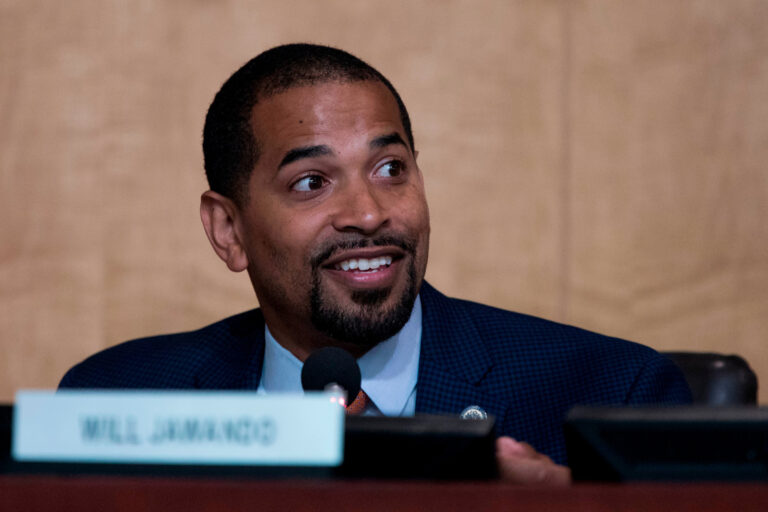
Montgomery County Councilmember Will Jawando is withdrawing a bill that would have phased out the county’s tipped minimum wage by 2028.
The at-large Democrat will withdraw his bill Tuesday to focus on a state effort to eliminate tipped wage, according to a statement from his office.
The bill, introduced in September, would have fundamentally changed the way thousands of tipped workers are paid in the county. These workers, a majority of whom are restaurant servers and bartenders, are currently paid a wage of $4 per hour by their employer, with the expectation that customer tips will boost their total earnings to at least the county’s minimum wage (which ranges from $14.50 to $16.70). If those tips fall short, employers are required by law to pay tipped workers the difference.
But Jawando sees the two-tiered wage system as contributing to income inequality, citing a Maryland Center on Economic Policy brief that says Montgomery County tipped workers are three times more likely to have family income below the federal poverty line as compared to other workers. The tip model enables customer harassment and employer wage theft, Jawando said in a September interview with DCist/WAMU
“Every worker, irrespective of their background [or] ability, deserves the dignity of making a living wage, a fair wage,” Jawando said when he introduced his bill.
Jawando’s withdrawal is unexpected. He spent the last several months lobbying for the bill, hosting numerous press conferences and visiting local restaurants alongside One Fair Wage, the national organization working to eliminate tipped minimum wages across the country.
The move comes just days after Maryland state lawmakers reintroduced a bill to phase out the tipped minimum wage at the state level. Maryland delegates Adrian Boafo and Veronica Turner, both representing Prince George’s County, and Senators Arthur Ellis of Charles County and Cory McCray of Baltimore City introduced the legislation, called “One Fair Wage Act of 2024.”
A similar state bill did not pass out of the necessary Senate or House committees last session. But local advocates, including Jawando, sound more optimistic this time around.
“The action to withdraw the bills is in coordination with other regional partners who are advancing similar measures to focus on state policy to support tipped employees,” his office’s statement reads. “Advocates are hopeful that the governor and General Assembly will take decisive action on this critical issue and champion the cause of economic fairness in our state.”
One Fair Wage supports Jawando’s position, and plans to focus resources on passing statewide legislation, given that the Maryland General Assembly only in session for a few months, the group said in a statement to DCist/WAMU.
“The strong base of support we’ve built in Montgomery and Prince George’s County will be critical to this effort,” the statement reads.
It’s unclear if Jawando’s bill had enough votes to pass. Only Councilmember Kristin Mink of District 5 had voiced public support; she co-introduced the measure.
Meanwhile, critics of Jawando’s bill celebrated the news, including the Restaurant Association of Maryland. The association, which represents hundreds of restaurants and others in the food business, argues the bill will reduce the earnings of servers and bartenders because restaurant owners would be forced to add a service charge to adjust for increased labor costs and customers would not tip on top of a fee.
“Legislation to eliminate the tip credit was pushed by a Massachusetts-based activist group as part of their nationwide agenda,” the association says in a statement. “Local tipped employees support maintaining the tip credit because the current tipping system maximizes their earnings.”
D.C. is the only jurisdiction in the region to phase out tipped minimum wage; it happened by ballot measure in 2022. That means restaurants in the city will have to pay their tipped workers the full minimum wage without relying on customer tips by 2027. It’s too soon to assess the impacts of D.C.’s change, as it’s not fully implemented. But some restaurant owners are already concerned with the incremental increase (they have to pay their tipped workers $2 per hour more), and are adding 20-22% service charges to patrons’ bills. Some servers have benefited from the wage boost, while others say they haven’t because they’ve seen a reduction in tips.
An effort to phase out tipped minimum wage in Prince George’s County also appears to have stalled. The county council tabled the bill, according to WTOP. The office of District 8 Council member Ed Burroughs, who introduced the bill, did not immediately respond to request for comment.
Jawando will also withdraw another bill creating a wage commission to evaluate the minimum wage in the region and advise the county council. The Restaurant Association of Maryland also opposed this measure, saying in a statement that wage matters should not be ceded to “an unelected and unaccountable body.”