 DCist doesn’t get over much to the eastern leg of the Red Line. Beyond Union Station, places like Brookland-CUA, Forest Glen and Glenmont, seem like far-off magical places. We’ve heard of Silver Spring (apparently there is some sort of rebirth going on there) and Wheaton has the longest set of escalators in the Western Hemisphere.
While DCist and countless other regular Red Line passengers have been complaining about delays on WMATA’s heaviest traveled subway line, we don’t know what complete hell commuters on the other end of the Red Line have had to endure since a rainstorm last week flooded a metrorail control room in Silver Spring.
Like a modern day Dante, the Post’s Lyndsey Layton shows us the agony.
The electronic blackout along a relatively short stretch of the railroad — less than a half-mile — has created several problems that have reverberated across the Red Line, which has an average daily ridership of 257,800.
Trains running through the area have been slowed to 15 miles per hour, instead of the usual 55 miles per hour. That has forced other trains to slow as they approach the affected stretch, requiring some to wait at Forest Glen and Takoma. And the Red Line’s usual pattern of turning around every other train at Silver Spring, to provide more frequent service along the line’s most heavily used downtown portion, was suspended after the flooding. Trains instead have turned back at Rhode Island Avenue, a maneuver that takes considerably longer than at Silver Spring.
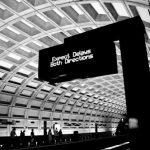
All that has meant 45-minute delays in some cases, though WMATA’s website has indicated 10-15 minute delays.
Additionally, Metro announced today that on Sunday Red Line trains between Rhode Island Avenue and Union Station will use the same track to accomodate construction at the NewYoFla Station, causing “10-15 minute” delays.
Track recently Red Line woes: an operator who mysteriously left her train, and the flooding that started this mess to begin with.