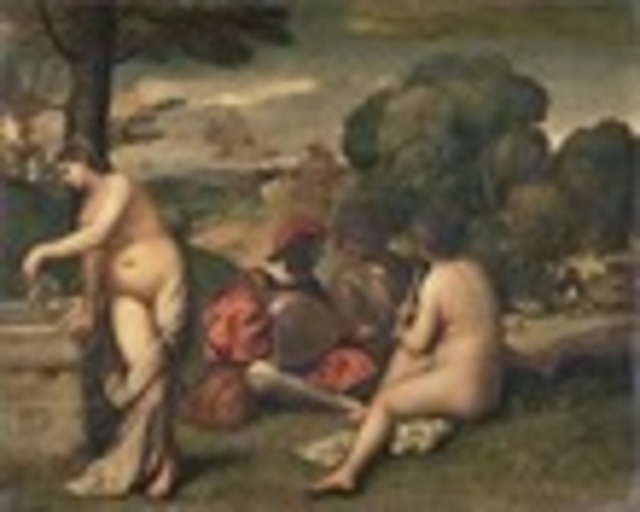
Washington may not be all that serene these days, what with the political goings-on and the influx of tourists. If you need a break, you can experience a bit of La Serenissima at the National Gallery of Art with Bellini, Giorgione, Titian, and the Renaissance of Venetian Painting, an exhibit that opened a couple weeks ago and continues through September 17. Focusing on the first part of the 16th century in Venice, the exhibit combines a few remarkable canvases by Giorgione and Giovanni Bellini, who were venerable elders at this time, with those of one of the major geniuses of Italian art, Titian. The NGA has selected a few of its own best paintings by these three (Bellini and Titian’s Feast of the Gods, Giorgione’s Adoration of the Shepherds), lined up with loans of a few extraordinary works from other institutions and collections, and then padded with minor painters to make a beautiful, medium-sized exhibit.
 The main reason to see this exhibit is the chance to stand in front of Titian’s Pastoral Concert (c. 1510), on loan from the Louvre for its first-ever visit to the United States. It is somewhat unusual for this period in Venetian painting, not particularly bright-colored and on a secular, mythological theme updated to a contemporary scene. Its arrangement of two young musicians — one a simple shepherd singer and the other a well-dressed professional player — with their nude muses in a rural setting was the inspiration for Édouard Manet’s Le Déjeuner sur l’herbe. That later painting combined Romantic artists of 19th-century France, including the painter’s brother, with their naked muse, their favorite model. As you can imagine, it caused quite a stir. Titian’s painting combines the Venetian love of landscape (more and more important in the background of most paintings of this period, an Arcadian love of the bucolic life, even behind sacred subjects) with a mythological statement about the nature of artistic inspiration.