A few years ago, Jennifer Tobias, an associate librarian at the Museum of Modern Art, came to my college campus to speak about MoMA’s book collection. She said that the museum kept all the books that artists donated to the collection, and that artists often espoused quite expansive notions of what constitutes a book. One artist, she recalled, even sent in a chair, while another submitted a wooden duck and called it a book.

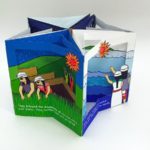
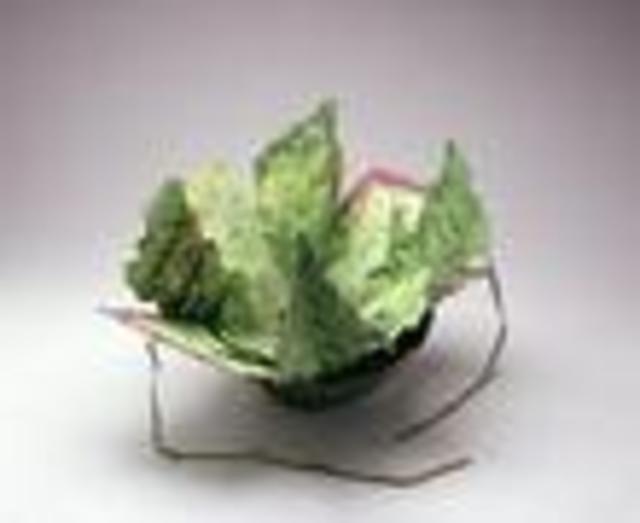
The current show at the National Museum of Women in the Arts, The Book as Art: Twenty Years of Artists’ Books, draws from the museum’s collection of more than 1,000 books by 800 artists. Many of the 108 books in the exhibit (by 86 artists from 12 countries), like Katherine A. Glover’s Green Salad, 2001 (pictured), often question the boundary between books and sculpture.
In the catalog, Glover calls her salad-as-book a love story, which recalls a day when she and her 16-year-old son ate a salad her lover had prepared the night before, but which had remained overnight uneaten. “My son found the salad particularly delicious, although the ingredients were quite ordinary, and I mused on the notion that something of my beloved had passed from his hands into the ingredients, conferring a special tastiness.”
Books-as-art used to be quite controversial. The ever-developing field — which now includes “hypertexts” and other “objects” that don’t occupy space, strictly speaking — is becoming somewhat more tame. Indeed, the New York-based Center for Book Arts, which is dedicated to “preserving the traditional crafts of book-making, as well as exploring and encouraging contemporary interpretations of the book as an art object,” offers more than 100 classes and workshops, and it has presented more than 140 exhibits in the past 30 years.