 The Shakespeare in Washington festival continues this week with the visit of the Kirov Ballet to the Kennedy Center Opera House. This year, the resident troupe of St. Petersburg’s Mariinsky Theater has brought its traveling production of Leonid Lavrovsky’s choreography of Romeo and Juliet. Sergei Prokofiev wanted to premiere the sublime music of this ballet (op. 64) at the Mariinsky in the 1930s, but the theater ultimately balked. The Bolshoi Theater in Moscow also accepted and then rejected the ballet, because of the challenging score.
The Kirov Ballet’s debut of the work was delayed until 1940, two years after Prokofiev introduced it in Brno. Even so, there is little doubt that the Kirov “owns” this ballet, in a sense, and it has been performing Lavrovsky’s Soviet-era choreography regularly ever since. The Post reports today that Mark Morris will create his own choreography of this ballet, which restores the happy ending of an early version, made by consultation with a score recently discovered in Moscow. Lavrovsky ingeniously resolved several problems in adapting the Shakespeare play to ballet, and the death scene is one of the most moving parts of this beautiful work. Romeo lifts Juliet’s apparently dead body from the funeral bier and carries her around, trying to partner with a dead weight.
If viewers are to believe the story, we must be moved by the idea of the two principal dancers falling in love at first sight. Last night’s Juliet was Olesya Novikova, and with her long body, impressive extensions, elegant port de bras, and flawless en pointe technique, she was a fragile, wispy thing as Juliet. Novikova has only recently moved from the corps de ballet into solo roles, memorably in a touring version of Don Quixote. This was her Kirov debut in the role of Juliet, and it was to my eyes an impressive success. Novikova was perhaps not well paired with Byelorussian Igor Kolb, who seemed not quite the right match by height. Kolb has been a principal dancer with the Kirov for nine years and is formerly known for the role of the Troubadour in this ballet. His strength in the lifts was remarkable, especially in the final scene, when Romeo carries the limp body of Juliet over his head back up the stairs to her bier.
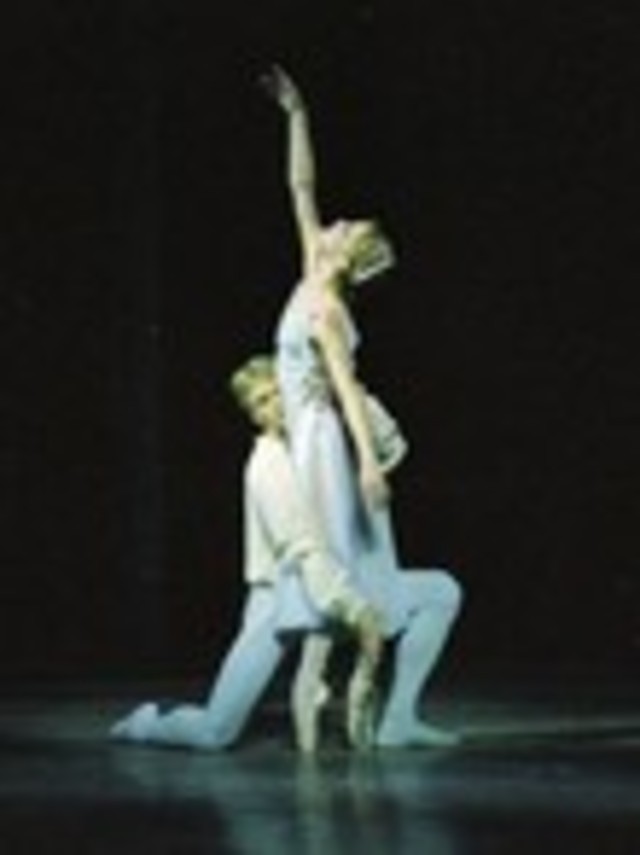
Andrian Fadeyev (Romeo) and Evgenya Obraztsova (Juliet), Kirov Ballet, photo by Natasha Razina, courtesy of the Kennedy Center