Hopes are high for the Baltimore Symphony and Marin Alsop, the first woman to be appointed Music Director of a major American orchestra. Last night at Strathmore, Washington got a taste of the adventurous programming we may expect from Alsop, who has made a name conducting contemporary music, especially by American composers. In a brief introduction to this program devoted to the music of Philip Glass, born in Baltimore 70 years ago this year, Alsop made no reference to the embarrassing neglect of Glass in Baltimore for so many years. That era, she said by gracefully not saying anything, is over. To put that neglect into context, the BSO is the only major ensemble in the Washington and Baltimore area to acknowledge Glass’s 70th birthday.
LIFE: A Journey through Time began when nature photographer Frans Lanting, whose work is probably familiar from many appearances in National Geographic and other publications, saw a way to document the history of life on Earth, by looking closely at life right now. (A coffee-table book is now available, and an exhibit will begin touring the United States this year.) Together with visual choreographer Alexander V. Nicholas, Lanting organized a selection of his photographs into a video narrative. With the guidance of Marin Alsop, the project was brought to Philip Glass to provide a musical score, first performed last summer at the Cabrillo Festival, the contemporary music festival that Alsop directs. In tandem with Michael Riesman, who often conducts and orchestrates Glass’s music, Glass adapted several earlier works, conceived originally for small ensemble or solo instruments, for orchestra.

Glass’s music works best when it accompanies visual images, which is why he is such a good film and opera composer. Some of Glass’s most memorable music accompanied the striking films by Godfrey Reggio, especially the first one, Koyaanisqatsi, from 1983. His latest film score, for Notes on a Scandal, is up for an Oscar and deserves to win, because it is such an important part of that movie. (In fact, because Glass is in Los Angeles this weekend for the Academy Award ceremony, he could not attend this series of concerts.)
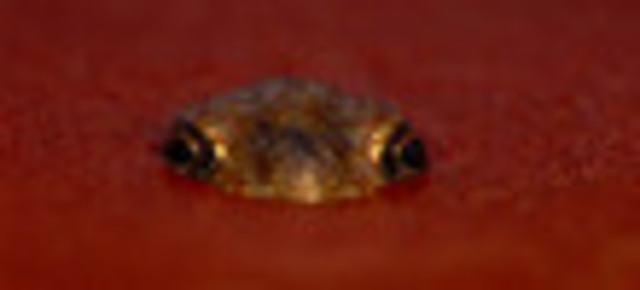
Over the course of seven movements, detailing the story of creation, not according to Genesis but following the course of evolution as narrated by science, Glass’s music accompanies the formation of the earth and its atmosphere; the beginning of life shown in fossilized remains of tiny creatures, crystals, and amber; the movement of animals in the sea; the movement of amphibians out of the water (with some of the most memorable images in the video, of frogs peering out of the slime toward land); the rise of tortoises and crocodiles, birds in the air, mammals, apes, and finally a few glimpses of our own species, but only as a fetus in utero. The video, projected on three large screens suspended above the orchestra, sets many of Lanting’s images into motion, kangaroos bouncing along, birds soaring upward diagonally, multiple flowers tesselating furiously along with the bubbling music.
Photograph by Frans Lanting, courtesy of National Geographic