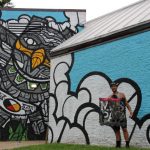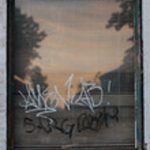
 On Friday the Washington Post ran a story about the city’s plans to step up their graffiti removal tasks after a recent rash of tagging in Wards 1, 2 and 4.
The graffiti began appearing six to eight weeks ago, stretching from the Logan and Shaw neighborhoods to communities in upper Northwest along Georgia Avenue and 13th and 14th streets. Banneker Community Center near Howard University, under renovation, was among the places hit. But the taggers aren’t choosy: They’ve struck stop signs, utility boxes, fences — anything that can make a quick canvas.
According to city records, 72 percent of the complaints of graffiti sightings in the past six months have come from Wards 1, 2 and 4 — 857 reports in those wards alone. Lately, officials said, the pace has picked up. …
The city’s six graffiti removal workers are stepping up efforts, too. Yesterday, Michael Stover, supervisor of graffiti abatement for the city’s Department of Public Works, led his crew on streets and alleys in the Brightwood neighborhood where tags such as “Inca” and “Nuk” are prevalent.
Earlier this month, our own Andrew Wiseman reported on the growing tagging resurgence, which prompted a lengthy and somewhat heated comment thread — and, for that matter, a lengthy and heated discussion on the DCist staff email list. Graffiti is one of those issues that seems to bring out as much anger as it does fascination. Certainly graffiti art is well-accepted in the contemporary art world at this point, but senseless tagging is by no means the sort of “art” aficionados take seriously. Indeed, we’ve even been wrestling with how and whether to cover the recent spate of tagging in the District at all. Recently I posted a photo submitted to our Flickr group that featured a tag and we received the following criticism from commenter snorlax:
I don’t think you should be using pictures that popularize peoples tags. This guy or girl is costing DC residents $1,000’s to clean up his uninspiring graffiti. At least with others they pick interesting locations (inside subway tunnels, underside of overpasses, etc). This amateur won’t hit anything that requires any effort or imagination.
We don’t all necessarily disagree with that sentiment, though we feel strongly that starting a discussion about tagging isn’t irresponsible — if anything, it seems likely the city’s recent efforts to take control of the problem is only being encouraged by us continuing to talk about it.
But what do you think? Is the practice of pointing out taggers and new graffiti only emboldening them, and something to be avoided? Or is publicizing the trend the best way to keep the pressure on the District, and let the taggers know we’d like our city to be beautiful?
Photo by Cary Scott Photography