Former Editor-in-Chief Ryan Avent writes a weekly column about neighborhood and development issues.
 Things used to be clearer for Fairfax County. It used to be known as the epitome of upper-middle class suburbanity, even earning name-checks in popular novels and songs as such. With acres and acres of rolling hills covered in leafy suburbs and landscaped office parks, it was a quiet complement to the quirky inner suburbs of Northern Virginia and the dense chaos of the District. But things have changed a lot for Fairfax, and fast. The outer border of the metropolitan area has long since passed through the county on its way toward Fredericksburg and West Virginia, and the outer border of the dense inner city is getting uncomfortably close. No longer a bedroom community, Fairfax was recently declared a second jobs core in the region, a title built on the strength of the defense and software firms that fill the office buildings stretching along the county’s highway corridors. But there remain more bedrooms than ever; not long ago, Fairfax County topped the million person mark, becoming the first, but almost certainly not the last, jurisdiction in the Washington area to do so.
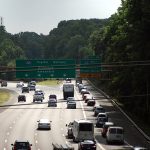
Growth in Fairfax County has recently come to a fairly abrupt halt, however. Expansion of low-density suburbs has pretty much exhausted the supply of available land, meaning that future development will need to come in the form of denser infill. Such development is frustrated, for the moment, by a lack of transportation options. Fairfax’s roads are perpetually jammed and the county, despite its size, is served by fewer stations than any other Metro jurisdiction, with the exception of tiny Alexandria. The stations Fairfax does have are limited by their placement and design. Isolated from the fabric of the county’s neighborhoods, the Fairfax stations have contributed minimally to the structure of neighborhood development. But this is the county’s own fault.
As Zach Schrag details in The Great Society Subway, Fairfax, from the beginning, pursued a different strategy regarding its Metro stations than did Arlington or Montgomery County. Where they sought to run their Metro lines through population centers and then develop more densely around the stations, Fairfax largely ignored its pockets of density—including the budding area called Tysons Corner, opting instead to place the Orange Line in the median of I-66. Where other parts of the Washington area saw transit as an opportunity to reshape areas of low density, Fairfax saw low density as a reason that transit wouldn’t work. Now, having built themselves out, Fairfax has been forced to cut back on growth while other jurisdictions continue to press on.
Now the county is trying to re-engineer its population centers and run transit where it should have gone 40 years ago, but the attempt to shift strategies has been confounded by difficulties, the most recent of which is the federal government’s assertion that the first stage of the project is budgeted to cost about $250 million more than the feds would like. Fairfax must now attempt to cut spending without reducing potential ridership, or the Federal Transit Administration may be tempted to scuttle the entire line. It’s absurd that the federal government might derail the plan, just as it was absurd that silly federal funding rules made revising the plan to include a Tysons tunnel overly difficult. Uncle Sam hands out highway money without nearly the oversight required of transit projects, and the government’s position on the tunnel was laughable—funding would have been withheld, even if the additional money for tunneling came from a non-federal source. Fairfax may yet regret its failure to hold out for a tunnel through Tysons; the decisions to take the easy route when drawing the original transit corridors is one of the reasons Tysons didn’t get Metro decades ago.
What should Fairfax County’s transportation and development strategy be? The question is complicated by Fairfax’s odd role as a suburban waystation. Roughly 250,000 people commute from Fairfax into the District and inner suburbs every day. At least another 300,000 Fairfax residents commute to a workplace within the county, and something like 200,000 people commute from outer suburbs into Fairfax County to work. No one solution will cover all three problems. Enhanced Metro service, including new extensions, will facilitate better travel into and out of the core of the region, particularly if development around the new lines is transit-oriented.
Picture taken by andertho.