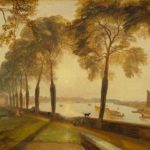
 Last week, the National Gallery of Art opened a career retrospective of British landscape artist Joseph Mallord William Turner (1775-1851) — the largest ever assembled in the United States. The curators of the show have assembled a collection that demonstrates Turner’s development as an artist, as well as his commitment to raising the status of landscape art in a time when the classical themes pervaded Europe’s artistic community. A must see for anyone with even a passing interest in the visual arts, the exhibition, entitled simply, J.M.W. Turner, features over 140 pieces and effectively communicates this seminal artist’s mastery of technique, color, depth, layering, and light.
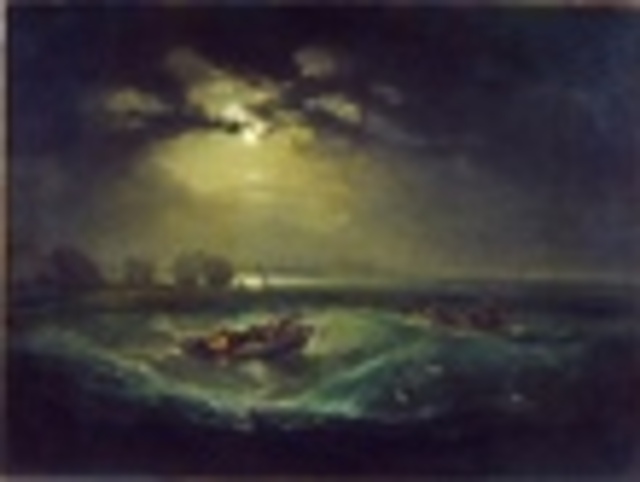
Lord Alfred Tennyson once called Turner “the Shakespeare of landscape.” One of relatively few painters who enjoyed great success and notoriety during his lifetime, at 26 he was the youngest person ever elected to England’s prestigious Royal Academy of Arts. Turner’s greatest influence was the Sublime, an aesthetic movement that celebrated the vast and infinite, particularly in a natural context. This influence is reflected in such early works as Fishermen at Sea (1796, pictured above right), which depicts human insignificance in comparison to the open sea. Despite his obvious talents, Turner found himself occasionally having to compromise some of his vision because landscape was not given respect, and so he incorporated classical elements in order to gain acceptance. An example of this is his The Temple of Jupiter Panellenius (1816), where the classical subject seems just an excuse for painting the landscape in which it is set.
Images courtesy of the National Gallery of Art.