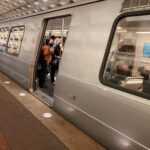
 A typical weekday morning for yours truly involves catching the next train out of Van Ness-UDC to Dupont Circle. And more often than not, there’s a train waiting for me at the station when I get there. No problems, right?
Well, we’ve noticed recently that there’s been a slight issue with the pacing of trains in the morning on the Red Line – namely, (and we never thought we’d say this) that there’s just too many trains running too close together. Obviously, the highly-trafficked corridor should be able to maintain a large capacity, but trains which are awkwardly scheduled creates tiny backups which eventually evolve into less frequent trains and, eventually, lowers capacity. The weekday morning schedules are constant, and follow a simple pattern:
Train A ARR
Train B 2
Train C 5
Train D 7
Three trains in seven minutes sounds good, right? But that’s just one way of looking at it. Two trains in two minutes might just be too many. If they run too close together, passengers on trains riding the second of the two-minute interval trains have to hold at stations or in tunnels for between 30 to 60 seconds due to a train ahead sitting at the platform, unloading and loading passengers. Factoring in any sort of divergence in operator speed only magnifies the problem.
There should be a Gladwellian tipping point at which the trains run more smoothly, but yet still maintain the efficiency commuters need. It’s a tiny issue, but one that could make things slightly better. One possible solution: rush hour Red line trains could run at a fixed three minute interval. Barring other external forces (i.e. a power outage), that Metro is still able to provide four trains every nine minutes, but every other train’s journey wouldn’t be so herky-jerky.
So, what say you? What’s the right level of train frequency during the morning rush hour – should Metro change the fixed time, or even go to a more flexible schedule so that bunching doesn’t occur?
Photo by Terecico.