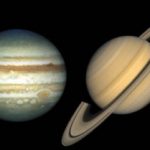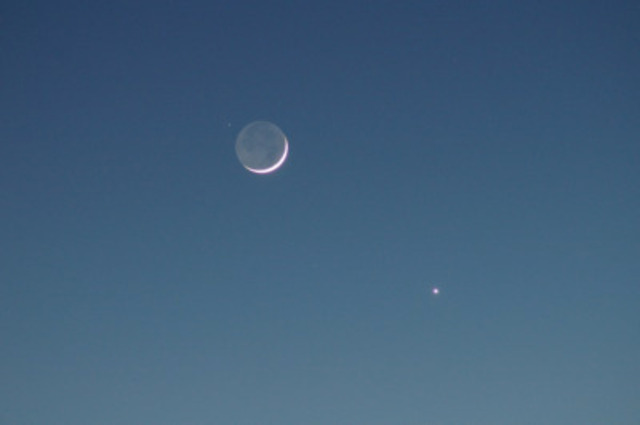
 Photo by philliefan99. Venus and the crescent Moon in January 2007. Not exactly what you’ll see before dawn this week, but similar.
As we mentioned last week, Jupiter reached opposition last Friday. At this point, the Sun and Jupiter are on opposite sides of the Earth (like when the Moon is full), making it the brightest it ever appears in the sky. Since it’s only a couple days off, it should still be a distinctly bright spot rising at sunset and lasting all night.
Did you see any of the meteor shower? D.C. had a few cloudy nights during the Perseid’s peak this year, but you still might take a look up into the night sky and try to catch one as the Earth orbits away from Comet Swift-Tuttle’s debris trail.
If you’re unfamiliar with the layout of the night sky, there’s a great teaching tool to use during the month of August. The Summer Triangle is directly overhead for the next few weeks and is a great starting point for mapping out constellations and celestial objects. Face north and look straight up — you should see the three very bright stars that make up the Triangle, which is not a constellation, but the brightest stars in three nearby constellations. The northernmost star is Deneb, the head of Cygnus, the swan — although most skywatchers prefer the asterism, the Northern Cross. Deneb is at the tip of the cross, which reaches back into the Triangle. Next, the bright star southeast of Deneb is Vega, part of Lyra, the lyre or harp. The constellation reaches southeast from Vega in a small diamond. Lastly, the southern tip of the Triangle is Altair, the head of Aquila, the eagle. Its wings and tail stretch out south of the Triangle.
Finding the Summer Triangle leaves you with a great starting point to reach farther outward and place more constellations in the sky. Once you’re comfortable with the skymap, find someone with a telescope and use these markers to find deep sky objects, like the Ring Nebula located in Lyra.
Last week commenter Tyrannous told us about Stellarium, a program for Mac, PC, and Linux systems — consider us addicted! This full screen map of the sky is totally interactive and runs in real time. You can enter any location in the world and any time (but “here” and “now” are most useful, of course) with options for constellation names and outlines, planets, deep-sky objects, and more. You can check out the Summer Triangle constellations before you head outside so you know what they really look like first. Regular star maps are notoriously hard to read and good ones are difficult to find on the Internet; Stellarium is easily the best resource for daily skygazing we’ve seen in a long time.