Martin Austermuhle
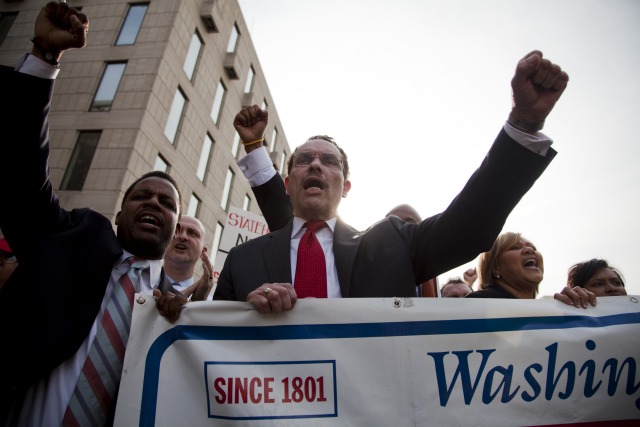 (AP Photo/Evan Vucci)
A week ago today, 41 people, including Mayor Vince Gray and six members of the D.C. Council, got themselves arrested at a protest on Capitol Hill for D.C. voting rights and autonomy. (On Friday, three more people were arrested, and another protest organized by Ward 6 ANC commissioners is set for tomorrow at noon this evening at 6 p.m.) Since then, plenty of ink has been spilled on the value — or lack thereof — of the protest, the wisdom of the tactics and what exactly comes next.
Some cheered the protest, others thought it was counterproductive. Some saw it as a cynical ploy by Gray to distract attention from his political problems, others disagreed. After six years of not-so-disinterested observation of the movement for D.C. voting rights, I’ve jotted down a few thoughts on the arrest of the “D.C. 41” and the larger fight for voting rights, self-determination and statehood.
1) The protest helped the larger movement for D.C. voting rights and self-determination: Anyone who’s been to a protest for D.C. voting rights over the last few years knows that they don’t often attract a lot of people. While last Monday’s protest wasn’t as big as the 2007 Voting Rights March, which attracted an estimated 5,000 people on a blustery spring day, it still saw a few hundred people energetically raise their voices and demand their rights. More than that, the cynicism that often afflicts the fight for D.C. voting rights was quieted by the broad excitement surrounding the fact that for once a group of elected officials was doing more than just talking about local autonomy — they were acting on it. The protest also helped bring into sharp relief a part of the debate over D.C. voting rights that doesn’t often get much attention — legislative and budgetary autonomy. Ironically enough, the District’s ability to craft its own legislation and budgets is the least sexy part of the fight, though it may be the one area where the most gains can be achieved. Congress has the constitutional right to govern over the District, though not the constitutional obligation. It can butt out if it chooses to. With enough energy and lobbying, the city may well succeed in getting Congress to for once limit its own interference in our affairs.
2) The District’s issues went national: While the majority of those arrested were ordinary residents, Gray’s participation projected the protest into the national realm. He made the media rounds throughout the week, appearing on everything from CNN to Bill O’Reilly to C-SPAN’s Washington Journal and provoking powerful editorials and coverage from outlets like the Los Angeles Times and POLITICO. While polls have found that the majority of informed Americans support D.C. voting rights, the problem is that most people simply don’t know that the District doesn’t partake in the full menu of democratic rights available to other Americans. Making them aware of that fact has been the movement’s most obvious Achilles heel, and Gray’s appearance on national TV and radio to discuss his own arrest sheds invaluable light on the city’s plight.
3) The protest was part of a multi-pronged strategy: After Gray and the six councilmembers were arrested, plenty of people called the event a stunt that would simply alienate the District from the very members of Congress it should be courting. Yes and no. Movements of this sort cannot follow one just one prong — they need to appeal both to the grassroots and to official channels. There’s no doubt that Gray needs to be more active on the Hill, and there’s certainly something to be said for a lost opportunity in his one meeting with Speaker of the House John Boehner. (D.C. voting rights was not discussed.) But simply going along to get along hasn’t worked before, and we shouldn’t assume it will work now. Gray and the District’s other elected officials need grassroots support and energy behind them to better press their claims through official channels, and they won’t get that support unless they show a little indignation over what they’re fighting for.
4) The protest was a tactic, but not a strategy or a goal: Despite everything said above, the protest is merely a tactic. It’s not a strategy for success, nor is it an end point. All 600,000 of the city’s residents could take turns getting arrested throughout 2011 and end up with nothing more than misdemeanor charges against us. The movement and the city’s elected officials have to find a way to work the success of last week’s protest into a larger end-goal, be it full legislative and budgetary autonomy or a reinvigorated push for statehood. The political context may not be great — Republicans will hold the House until at least next year, if not beyond — but the timing is. Next year is the 150th anniversary of D.C. Emancipation Day, and the year after that is the 40th anniversary of the Home Rule Act. Those two dates could bookend a large citywide push for a stated goal, say legislative and budgetary autonomy. Can more people get arrested in the process? Sure. But should them getting arrested be the only thing that gets done? Absolutely not.
5) The protest was a distraction, but not on purpose: Plenty of people pointed out that Gray’s arrest conveniently stole the limelight away from the persistent scandals involving shady hires and inflated pay for senior aides. That’s true. But did Gray plan to get arrested solely for that reason? I don’t think so. (Jonetta Rose Barras certainly disagrees, so read her take on it.) Gray’s been strong on voting rights, self-determination and statehood for a while, and he long stated that he’d be willing to get arrested if there was a good enough reason for it and a groundswell of people willing to join him. The week leading up to the almost-shutdown of the federal and local government saw that groundswell — thousands of people joined a Facebook group that threatened to take its trash down to Boehner’s Capitol Hill apartment, and the abortion deal that averted a shutdown angered many others. Gray and voting rights activists knew that they would rarely see that much energy and anger fueling their cause, and they smartly went with it. Did Gray cynically see it as a way to push Sulaimon Brown’s name out of the media for a few days? Probably. But did that dictate his decision? Likely not. If distracting the city had been his primary motivation, he could have chosen to get himself arrested the same day the D.C. Council was questioning some of his former aides on the administration’s sketchy hiring practices. As it is, the hearings will go on, whether or not Gray emerged favorably from the arrest.
6) This isn’t about abortion, but we shouldn’t pretend that abortion has nothing to do with it: Barras and the Post’s Courtland Milloy are none-too-happy that Gray had a press conference the day after his arrest in front of a Planned Parenthood office. To them, bringing an issue as controversial as abortion into the mix will only alienate potential supporters. (“Not even the most liberal black congregations will have their ministers standing in the pulpit on Sunday mornings advocating self-determination to fund abortions, needles for heroin addicts and legalized marijuana,” angrily wrote Milloy.) To be sure, the fight isn’t about abortion — but neither should we pretend the issue has nothing to do with it. The main attacks on D.C. Home Rule have come by way of budget riders affecting local initiatives that are controversial to culture warriors — medical marijuana, needle-exchange programs, abortion, same-sex marriage and gun control. While D.C. residents may have differing opinions on these issues, many of those same residents recognize that they should be left to local officials and voters to decide. To my knowledge, Dick Heller, the man that single-handedly brought down the city’s three-decade-old ban on handguns, never went to Congress to ask them to do away with it. Instead, he appealed to the courts — and won. That the concrete examples of Congress interfering in our business are controversial isn’t our fault, nor should we sidestep them. Ultimately, this isn’t about abortion — it’s about District residents and officials being able to debate and discuss controversial issues without having Congress tell us one way or another what to believe or what to do.