 Photo by jasonepowell
When Time magazine announced earlier this month that it was naming “The Protester” as its Person of the Year, was that a validation of the Occupy movement that blanketed U.S. cities the last few months of 2011?
Perhaps. But riots in Egypt brought down a dictator, rallies in Wisconsin prompted recall elections and an uprising in Libya brought one of the world’s most bizarre and repressive leaders to a violent end. The Occupy movement? Well, it’s taken up a lot of space in public parks.
Not long after Occupy Wall Street popped up in New York, a band of activists settled in McPherson Square in late September. We noticed them a few days in, but even then it wasn’t entirely clear what the then-nascent Occupy D.C. was after. There were grumblings about “money in politics”—hence the K Street NW location—and indeed, in its early days Occupy D.C. targeted Congress, the White House and groups like the Koch Industries-backed Americans for Prosperity.
But, in keeping with its Wall Street mothership, Occupy D.C. has never really expressed a fluent set of demands, other than it seeks to change the status quo. By what means (besides camping) and to what end has never been made entirely clear, and the movement’s aims have been quite diffuse. One day it was a march across the Key Bridge to rally around national infrastructure projects, the next it was a break-in at the Franklin School at 13th and K streets NW, which served as a homeless shelter until it was closed in 2008. It also doesn’t help that there’s also an encampment at Freedom Plaza that now calls itself “Occupy Washington, D.C.” but doesn’t seem to share the same spirit or confrontational strategies as its McPherson Square counterpart.
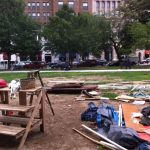
Cops, for the most part, have left Occupy D.C. alone when the group has been idling in McPherson Square. The Franklin School protest resulted in several arrests, as did various rallies that shut down city streets. Still, by November it seemed the message of Occupy D.C. had shifted more toward the sheer goal of keeping the camp alive. Three-quarters of the park has been filled by tents; there is a library, a kitchen and even a tea house.
There was the group of Occupy Wall Street protesters who walked—walked!—from Manhattan to Washington, a trip that took much of November. What the 230-mile trek accomplished other than soggy clothes and sore legs still isn’t exactly clear. The Post sent a reporter, Elizabeth Flock, to record the entire hike.
As the Occupy movement wore on, encampments across the country were gradually moved. Camps in Los Angeles and Philadelphia were shuttered more peacefully than in other cities. The Occupy flagship in New York met its end in a midnight raid on November 15; Occupy D.C. has become one of the longest holdouts.
This is not to say there haven’t been some incidents with law enforcement. Occupiers marched to Metropolitan Police Department headquarters in early November to demand an investigation into claims by four members of the group that they were purposely struck by a car outside the Walter E. Washington Convention Center the previous Friday during a protest of the Americans for Prosperity convention.
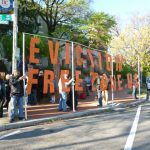
Then there was the Occu-barn. Erected overnight on December 4, the 17-foot-high structure was meant to be a cold-weather shelter as the protest extended into colder months. U.S. Park Police, who had been giving the movement lots of breathing room, saw it as a building-code violation. An all-day standoff resulted in 31 arrests, a the dismantling of the structure and a more tenuous relationship between Occupy D.C. and the Park Police.
But Occupy D.C. is now among the last camps standing, with Occupy Baltimore having been taken down December 12 — and it’s planning to continue on at least through the early months of 2012. If the National Park Service ever decides to empty McPherson Square, a federal judge has ordered that Occupy is entitled to a 24-hour eviction notice.
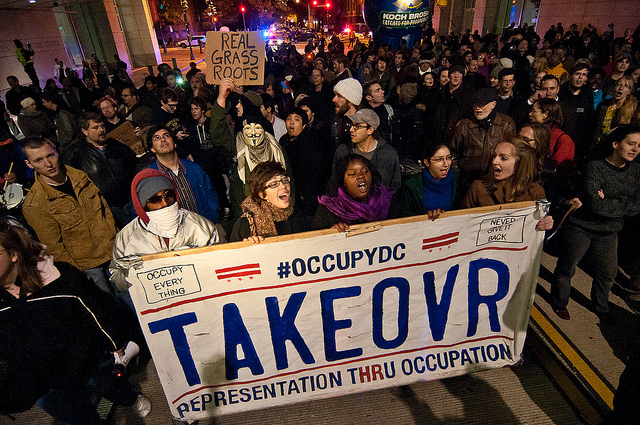
Most recently, a group of Occupiers, led by the performance artist Adrian Parsons, launched a hunger strike to protest D.C.’s lack of full Congressional representation. Parsons, now in his third week of fasting, is the only hunger striker remaining (save a few solidarity strikers), but his protest—one with a very specific demand, however seemingly unattainable—has seemed to overshadow Occupy D.C. lately. The protests are one and the same, but then again, they’re not.
Perhaps Occupy D.C. is moving beyond the original demand-free mandate of the Occupy movement, as it is planning “Occupy Congress” on the National Mall on Jan. 17. Will there finally be a legislative agenda? If so, this could be the sign that Occupy D.C. is growing up.