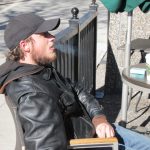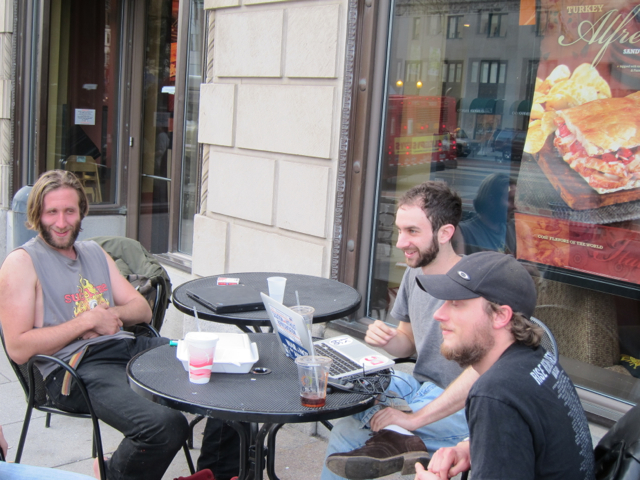
 Thomas Reges, left, and Ricky Lehner, right, haven’t slept since Monday.
Why go hungry when you can stay awake?
Yesterday, the Examiner’s Aubrey Whelan took note of two members of Occupy D.C. who, in a protest of the National Park Service’s recent decision to begin enforcing the ban on camping in McPherson Square—which includes a prohibition on slumbering in the park—decided to go on a “sleep strike.”
That’s right. Since about noon on Monday, when the enforcement regime officially went into effect, two demonstrators, Thomas Reges and Ricky Lehner decided that the best way to prove to NPS and U.S. Park Police that sleeping in public spaces is a vital and expressive part of the Occupy Wall Street movement was to forego sleep entirely.
When I spoke with them Wednesday afternoon, they had been awake for about 54 hours.
“It’s like we have energy,” Reges said. “Just kind of ache.”
The Park Service, in applying its rules against camping in the square, mentioned the health and safety of the protesters as Occupy D.C. enters its fifth month. So, in response, Reges and Lehner are doing something that is well, quite unhealthy, a fact they readily acknowledge.
“We’re going to need chaperones,” Reges said. He and Lehner have gone on a low-sugar diet during this latest round of Occupy-inspired self-deprivation. Few carbohydrates, but a lot of stimulants. Sitting outside Cosi at 15th and K streets across from McPherson Square, Lehner drained an iced coffee while Reges rolled a cigarette.
A nurse they consulted, said Lehner, who’s also a smoker, told them that if they insisted on going without sleep, they not try to quit smoking at the same time.
“Nicotine’s a stimulant, so it’s helping,” he said.
But more than two days into this venture, Reges and Lehner were already feeling the effects. They caught a break with this week’s unseasonably warm weather—it’s easier to stay awake while basking in the warm, 70-degree sunlight than while shivering in the cold. Still, both were twitchy in their seats. Reges said he could see me across the table without any difficulty, but the streets, storefronts and McPherson’s tent city were blurred together. Lehner said he occasionally lapses into a dream-like state before remembering he’s supposed to be staying awake. They try to stave off the somnambulism by keeping active, but some past-time’s are more soporific than others. Kicking a soccer ball works, but playing Scrabble nearly prompted Lehner to doze off.
Reges and Lehner were being minded by Sam Jewler, who late last year embarked on an 11-day hunger strike as a protest against the District’s lack of a vote in Congress. During his self-inflicted ordeal, Jewler was aided through his days by a cadre of fellow protesters who were themselves nourished. Over those 11 days, Jewler became frail, sickly and lethargic—but he slept a lot. Reges and Lehner are eating plenty, but on no sleep, they need some help. Assisting the them, Jewler said, is his way of paying it forward.
The Guinness Book of World Records lists the longest period without sleep at 264 hours, set in 1964 by a California teenager named Randy Gardner. The doctors who monitored Gardner’s feat reported him experiencing paranoia, memory loss, lack of concentration and even delusions of winning the Rose Bowl.
Should Reges and Lehner keep their protest up, they should expect to endure something similar, said a local sleep specialist.
“It is distinctly unhealthy,” said Dr. Helene Emsellem, who runs the Center for Sleep & Wake Disorders in Chevy Chase, Md. “It’s a huge, overwhelming stress to the entire system.”
Emsellem, who is also an associate professor of neurology at George Washington University Medical Center and is also on the staff of Suburban Hospital in Bethesda, said that Reges and Lehner, despite being otherwise healthy young men, should expect some difficulty with their mental acuity, judgment and motor skills. Going without sleep for this long could also expose more severe effects, especially if they have any underlying risks for heart disease, bipolar disorder or manic-depressiveness.
“The ability to maintain a nice easy balance diminishes,” Emsellem said.
Not that Reges and Lehner are stopping any time soon. This morning they completed the third day, which Emsellem said is a kind of breaking point for the human body.
We’ve now passed the 72hr mark. This is when things are supposed to get interesting…. #sleepstrike #occupydc
— ODC Sleeps (@ODCSleeps) February 2, 2012
And just like the hunger strikers before them, Reges and Lehner are attempting to recruit “solidarity strikers” to join them in their continuously wakened states. When I remarked to them that it’s a lot more fun to stay up all night than to not eat all day, they turned back to the standard Occupy line that camping is part of the message. There’s even a “no-slumber party” planned for this Friday.
Self-deprivation of any kind comes with risks, but what Reges and Lehner are doing seems even more dangerous than the December hunger strike. Jewler regained his energy a few days after breaking his fast and has since regained most of the weight he lost during it. Emsellem said that the effects of what Reges and Lehner are putting themselves through could take days, even weeks to shake off.
“I suggest they get some sleep,” she said.