 Photographs by Benjamin R. Freed
Is it over?
Not entirely, but it looks pretty darn close.
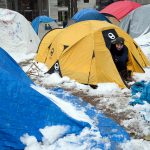
After arriving at McPherson Square early this morning, a large squadron of U.S. Park Police officers spent the day inspecting the hundreds of tents used by Occupy D.C. to fill the downtown park. In most cases, police confiscated the tents for not being compliant with the National Park Service’s ban on camping in the park.
The clearing out of McPherson Square, which is still in progress at this time, resulted in what has been by far the most tumultuous day in the four-month-old protest. Beginning shortly after 6 a.m., Park Police officers moved in and began determining if the tents were empty of camping equipment and other personal artifacts. Camping in McPherson Square and other downtown parks overseen by the National Park Service has long been against the rules, but until this week, enforcement against Occupy D.C. had been relatively light.
By this evening, eight people were arrested. More strikingly, though, is that more than half of the tents that had lined the one-block square since October are gone.
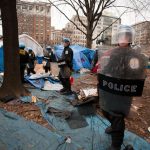
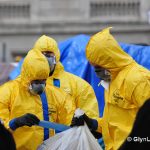
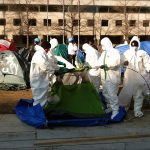
Today was one of “further enforcement,” according to an NPS flier distributed in the early hours. (Police officers also called it “nuisance abatement.”) Dozens of Park Police officers in riot gear entered McPherson, some on horseback, as well as members of a SWAT team. Two hazardous materials crews, wearing either yellow or white jumpsuits, arrived as well to catalog or discard objects found in tents. And by noon, it was clear this would be.
McPherson Square was never entirely closed off, however. Sgt. David Schlosser, a Park Police spokesman, said while officers and hazmat teams worked in one area of the park, other zones would remain open to allow members of Occupy D.C. to keep an active protest.
“The reason we’re doing it in sections is so people can exercise their First Amendment rights,” he said.
Schlosser said around 1 p.m. that while many tents were being taken down, he had seen a fair deal of compliance from the demonstrators. He also said several times he did not believe Saturday’s actions mean the end of Occupy D.C.
“We’re very interested in transparency,” he said. “We want everyone who’s watching to understand it’s not an eviction.”
But the mood of the occupiers did not seem to jibe with that assessment. Many scrambled to empty their tents before their areas of McPherson Square were barricaded off and scoured by the police. Some, like Michael Basillius, did so through tears.
“I’m fucking pissed off,” he said through sobs as he pulled personal belongings out of a tent in the northeast corner of the park.
Still, others were quick to note that while perhaps an unpleasant reality, the Park Police’s action Saturday was far less combative than measures taken by police departments in other cities where encampments associated with the Occupy Wall Street movement are active.
“This is not how they did it in Oakland,” said Wes Conners, who came to Occupy D.C. from California. “They’re allowing people in the park.”
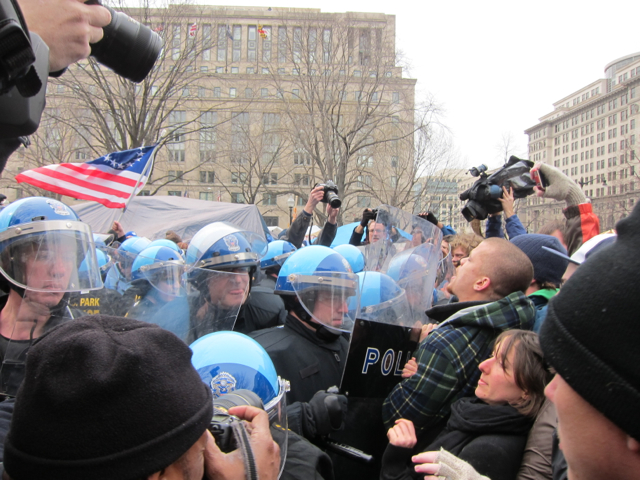
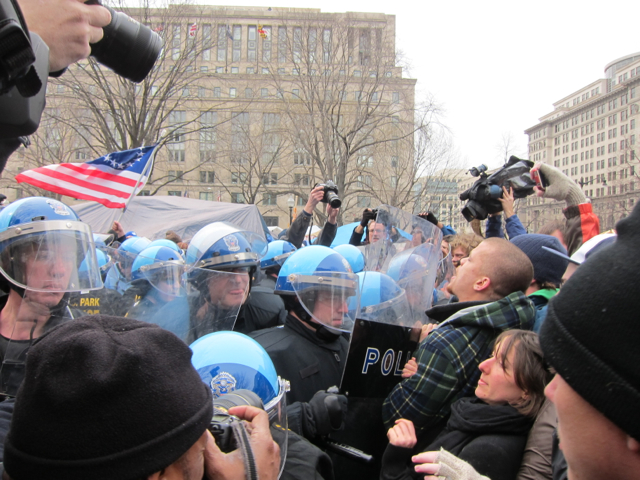
 Tensions rose steadily throughout the day, with the standard Occupy chants occasionally interrupted by obscenities flung at police officers, who wore light blue helmets with hard plastic face masks. Many also toted riot shields, which in early afternoon were deployed to clear protesters, reporters and other onlookers from the northeast corner. Some protesters attempted to push back, but soon enough officers had cleared the sidewalk and began locking the area down with metal barriers.
As each section of McPherson Square was inspected, officers would peer into each tent to determine if it was in compliance with the no-camping ban. Some were left alone, but most were taken down.
The hazmat teams tasked with clearing out the protesters’ belongings found mostly bedding and clothing, but a few nastier items turned up. Schlosser told reporters some tents contained bottles of urine or urine-soaked mattresses, while others were found to contain dead rats.
While NPS regulations allow tents as symbolic tools of a protest, they do not permit demonstrators to use them as living quarters. Since its emergence last September, the Occupy Wall Street movement has said camping in urban public spaces is part of its message and should thus be considered protected speech, though the U.S. Supreme Court ruled in 1984 that camping is not covered by the First Amendment.
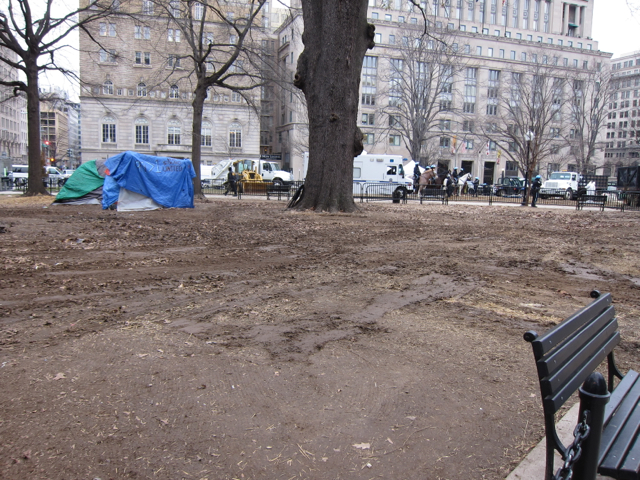
As the afternoon wore on and more tents were removed, large swaths of McPherson Square’s turf were uncovered for the first time in months. The park, which had undergone a $400,000 restoration as part of the 2009 federal stimulus act, now resembles a patchwork of muddy pits. Some onlookers cited the square’s downtrodden condition when applauding the day’s events.
“Their arguments have merit,” Hayter Whitman, a George Washington University law student, said. “But it’s completely tangential to squat all day and ruin the park.”
By late afternoon, the focus had turned to McPherson Square’s northwestern side, specifically the area around Occupy D.C.’s library. A line of protesters locked arms and sat in front of the open-fronted tent housing the group’s book collection. Schlosser said that as a structure with at least one side open and not being used as living quarters, the library would not be taken down.
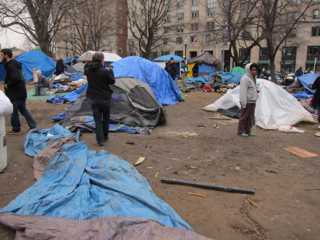
After seeing so many of their tents removed earlier in the day, however, the demonstrators were not buying it, even when a Park Police captain repeated Schlosser’s assurance. Scores more protesters surrounded their comrades protecting the library, eventually a pair of occupiers recording the day’s events for the customary Internet video stream were told they would be allowed to observe the police’s inspection of the tent.
Before this could happen, however, the Park Police needed to block off that corner of the square. Groups of riot gear-clad officers approached either side of the cluster of demonstrators and began pushing back. The ensuing scrum was much more aggressive than any earlier instances, with numerous protesters being prodded by police batons and sandwiched against shields as they were pushed onto K Street NW.
As the rush began, one protester appeared to be knocked unconscious and then handcuffed before being carried away. Another later said he was knocked over while climbing over the chain that surrounds the park. On the street, emotions continued to rise as Occupy D.C. tried to regain its composure. Cold rain pelted the demonstrators, some of whom were passing out slices of pizza to their hungry brethren who had been up since 6 a.m. or earlier.
There was another eruption in the crowd when a police officer was struck in the face with a brick. The protester who flung the brick was promptly tackled to the ground and arrested, the officer was taken to a nearby hospital and treated for injuries.
About 6 p.m., with police officers and hazmat crews still rummaging through the last batch of tents, Occupy D.C. convened its general assembly in the middle of K Street. (Roads in a two-block radius of McPherson Square were closed all day.) “We’re not scared,” the protesters chanted.
Still, many were now reconciling themselves to the fact after residing in the park for 128 days, they might have to stay elsewhere. Sara Shaw, who said the tent she shares with Sam Jewler was removed despite being completely empty, wrote on Twitter that she’d be “[drowning] my sorrows and trauma with some beer and whiskey.”
While a few Occupy D.C. tents still dot McPherson Square—including the library—it’s clear the movement was pushed into a new phase today. The occupiers continue to insist they’re here to stay, even if most of their tents are gone.