Martin Austermuhle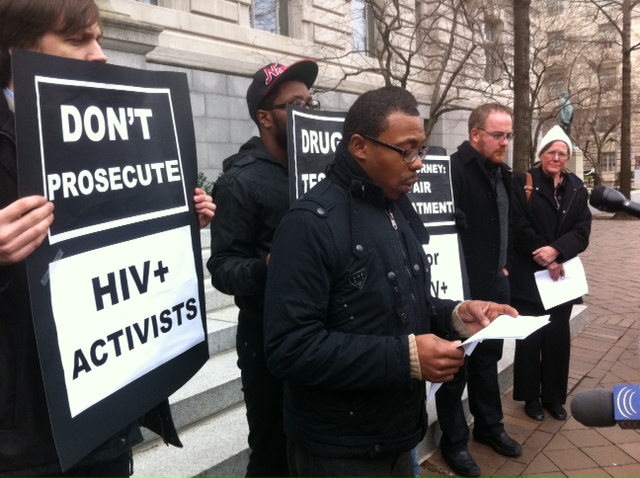
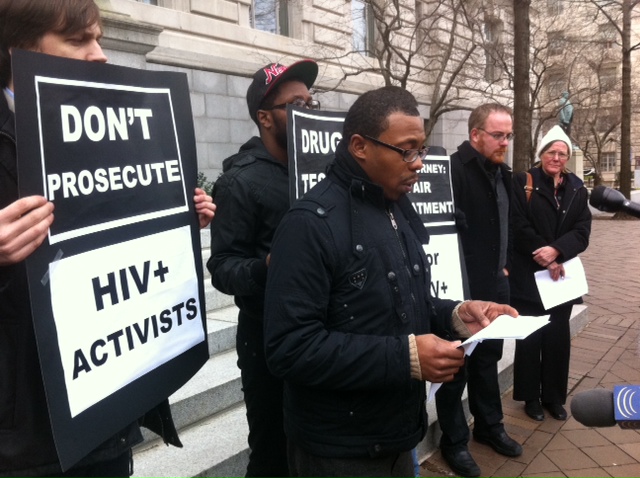 AIDS activist and patient Antonio Davis speaks in front of the Wilson Building yesterday on his case, which goes to trial in May.
On the same day in 2011 that Mayor Vince Gray, members of the D.C. Council and more than 30 residents were arrested during a protest on Capitol Hill for D.C. voting rights, Antonio Davis and 11 other activists were arrested outside the ceremonial office of House Majority Leader Eric Cantor as they angrily decried cuts to HIV/AIDS funding and needle-exchange programs in the District.
But while Gray and the majority of those he was arrested with were allowed to pay a $50 fine and go on their merry way, Davis, who lives in Philadelphia, faces trial in May and could well spend six months in jail if convicted of a single misdemeanor count of unlawful entry. Why? Because he failed a drug test, having tested positive for marijuana that his doctor has recommended he use to treat the AIDS he suffers from.
After the April 11 arrest, Davis and the 11 other activists were offered a standard “Deferred Prosecution Agreement” under which they had to stay away from the Cannon House Office Building for six months, perform 32 hours of community service and test negative in three drug tests. If they did so within four months, the charges against them would be dropped.
By June, they had all completed the community service, and 10 of the 12 successfully came in negative in their drug tests. But for Davis and fellow protester David Goode, the medical marijuana that their doctors have recommended they use to ease the pain and side-effects of their other AIDS medications registered in the tests. Having been assured by a judge that marijuana isn’t screened for and having turned in letters from their doctors attesting to their need for the marijuana, both expected that the U.S. Attorney for the District would honor the Deferred Prosecution Agreement.
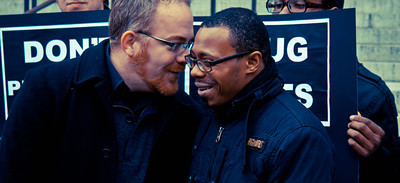 Matt Kavanagh and Davis. Photo by Larry Bryant.
That never happened.
Instead, their case was transferred to a new prosecutor, and then a third. All 12 activists were told that their first 32 hours of community service didn’t count, and were told to complete 32 more. By January 2012, Davis and Goode tested positive for marijuana again, foregoing any alternative to a trial altogether. The nine others were told that they would have to do a third 32-hour stint of community service or similarly go to trial.
“Requiring repeated drug tests, repeated unpaid community services, and a half dozen court appearances is completely unreasonable on a charge for which city council members pay a fine and walk away from,” said Matt Kavanagh, who is the Director of Advocacy at the Health GAP in the District and was arrested alongside Davis.
But according to William Miller, a spokesman for the U.S. Attorney for the District, the prosecutors have followed standard procedure in Davis’ case. Additionally, he noted, Gray and the D.C. voting rights protesters were prosecuted by the D.C. Attorney General, which would explain the different approaches.
“These cases were handled consistently with the diversion policies of the U.S. Attorney’s Office. The case involving Mayor Gray and others had a different set of circumstances and was not handled by the U.S. Attorney’s Office. The District of Columbia Office of Attorney General handled that matter. The conduct in this particular case led to a charge of unlawful conduct on Capitol grounds, a misdemeanor that is prosecuted by the U.S. Attorney’s Office. The U.S. Attorney’s Office requires defendants to pass drug tests to qualify for diversion,” he said.
That’s of little solace to Davis, who says that he used marijuana one a week to counteract the side effects of the nine other medications he takes and to stimulate his appetite. “I’ve been prescribed medical marijuana because it’s the only the thing that helps me in my condition. I do not use marijuana as a substance to get high,” he said.
The ongoing legal drama has taken its toll on him, he says. He’s given up using marijuana for the time being, and has lost 20 pounds over the last two months. He’s had to travel back and forth between Philadelphia and the District five times for hearings, and he worries that a conviction would put his career as a paralegal in jeopardy. He also sees little humor in the fact that as of January, D.C. Pre-Trial Services stopped testing for marijuana, since his case predates the change in policy.
He just wants this to be over.
“I ask that [U.S. Attorney for the District Ron Machen] look in his heart to make a reasonable decision and let those enter into the Pre-Trial Services Diversion Program or drop the case and dismiss all charges against all protesters,” he said.