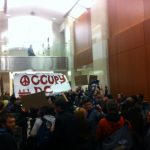
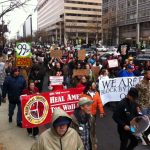
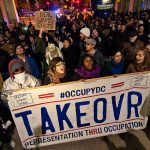
Forgive us, but it seemed not that long ago that getting the boot from McPherson Square was the best thing that ever happened to Occupy D.C. After regrouping following the National Park Service’s sweeping enforcement of the ban on camping in the downtown park, it looked as though the protest was finally getting back its groove.
Protests outside home-mortgage lender Freddie Mac helped a Bowie, Md. grandmother stay in her home after numerous bank missteps nearly led to her eviction. At the Conservative Political Action Conference last month, an appearance by Occupy led to an epic, hilarious freakout by the now-deceased right-wing provocateur Andrew Breitbart. And a rally outside the White House last week brought attention to an otherwise unnoticed law that strengthened the U.S. Secret Service’s authority to tamp down political protests.
And yet last night, in the span of about two hours, Occupy D.C. managed to get on the nerves of two groups that tend to be progressive: LGBT activists who organized a 700-person march in support of hate-crime victims, and City Paper readers in attendance at a debate of at-large D.C. Council candidates sponsored by the alt-weekly.
The march last night was meant to be a mostly quiet affair, with some participants taping over their mouths as a way of expressing the silence they feel when a member of their community is attacked. The marchers who didn’t seal their mouths spoke quietly, save a few quick speeches by the organizers and some District officials.
But the 50 or so members of Occupy D.C. who joined up couldn’t stick to the script. They mic-checked, chanted and lingered in busy intersections as police officers escorting the march reopened the streets after rolling closures. Some said they were part of a “radical queer bloc” that was enjoined by members of Occupy D.C., but with the “mic checks” and chants that wouldn’t be out of place at an Occupy rally, the distinction was unclear.
A few Occupy-affiliated marchers weaving in front of the police car at the front of the march caused more of a headache than did the rare onlooker who slung an anti-gay slur at the procession, one Metropolitan Police Department officer said after the march.
And Kyan Brady, one of the march’s organizers, said that “if they’re”—referring to Occupy D.C.—”marching in solidarity,” he had hoped they would respect the desire to keep the event a quiet vigil rather than a boisterous street protest.
With most marchers headed into the nightclub Cobalt for a fundraiser to help a hate-crime victim pay his medical bills, members of Occupy D.C. clustered in the middle of R Street NW for an impromptu general assembly as police were hoping to reopen the roadway to oncoming traffic. They resolved to relocate to the Black Cat, where the City Paper debate was about to begin.
On the venerable music club’s main stage—dressed for a showdown between Councilmember Vincent Orange (D-At Large) and his three challengers—Mike Madden, the City Paper’s managing editor, was attempting to begin the debate by taking drink orders for the candidates and the moderators.
“Mic check!” a loud voice in the back of the room exclaimed. A rabble of occupiers—not more than 20—started to issue their demands that the debate cover issues such as Walmart and corporate campaign contributions, and their apparent frustration that all three moderators—the City Paper’s Alan Suderman, WPFW’s Chuck Thies and NBC4’s Tom Sherwood—were white men.
“I didn’t expect to be interrupted by the People’s Mic while introducing our debate last night, but I suppose surprise is one of Occupy D.C.’s chief weapons,” Madden told DCist today in an email. (Madden added that while he was not actually comparing the income-inequality movement to the Spanish Inquisition, “I just had to jump at the chance to use the phrasing.”)
While last night’s lineup of moderators might have seemed monochromatic, they assured the audience the would ask questions that impact the entire city, just not in the lengthy call-and-response format that the occupiers prefer. Sherwood also said he would be keeping tabs on the behavior of not just the candidates, but of the audience members, too.
Previous City Paper-sponsored debates this cycle have featured journalists of color as moderators, including WPFW’s Gloria Minott and WJLA’s Sam Ford. Madden said the City Paper is making an effort to assemble diverse panels “because—as [the occupiers] said—D.C. is not a white, male city.”
And indeed the questions about Walmart and corporate campaign contributions came, but by then it appeared Occupy D.C. had filtered out. “It seemed like most Occupiers had wandered away, so they never heard the answer they wanted,” Madden said.
But he invited Occupy D.C. to the City Paper’s debate for the Ward 7 seat next Monday at Ray’s the Steaks at East River. “Naturally, Occupy D.C., along with all other concerned citizens in the District, are more than welcome to join us,” Madden said.
If they show up, hopefully they’ll be patient. Those Walmart and campaign ethics questions have been a staple of every previous City Paper debate.