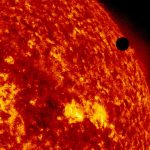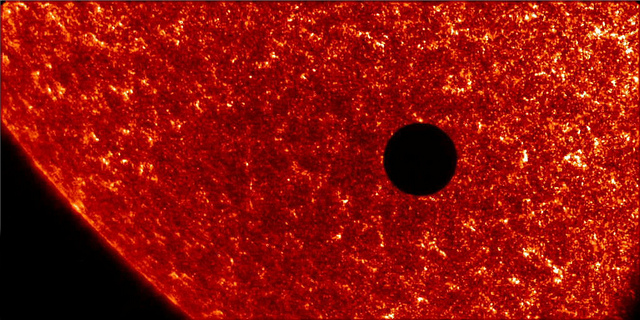
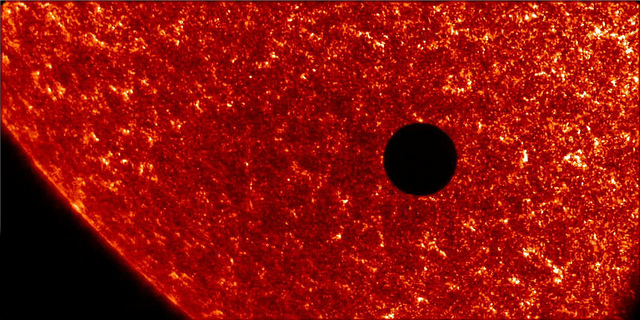
 The most recent Transit of Venus, in 2004, as viewed through NASA’s TRACE satellite. (Photo via NASA)
Today at 6 p.m., stargazers will be able to watch a rare celestial event. And we strongly recommend you join in the fun, because it won’t happen again for more than a century.
This evening brings the Transit of Venus, a phenomenon in which the second planet in our solar system passes directly between Earth and the Sun. For about six hours, Venus will take on a different form to astronomical observers. Instead of appearing as a yellowish speck in the night sky, it will look like a large black dot crawling across the fiery surface of the sun.
The Transit of Venus happens twice in an eight year span (it last happened in 2004), but then doesn’t occur again for more than a century because of the relative shapes of Earth and Venus’ orbits. As such, it’s one of those things you don’t want to miss. It won’t come again until 2117, so barring any Lazarus-like lifestyles, tonight is the last chance you’ll have to see this cosmic ballet.
But because it involves looking at the surface of the Sun, the Transit of Venus also requires a great deal of precaution for anyone hoping to glimpse it. For starters, NASA strongly— however obviously—advises against staring directly at the Sun. But a good telescope filter will make the event viewable; NASA recommends #14 welder’s glass.
For those of us without a decent telescope, there are plenty of public viewings, too. The best option in D.C. is probably at the National Air and Space Museum, which is setting up several telescopes outfitted with the proper equipment to view the Transit of Venus in the skies above the National Mall.
WTOP has a list of more gatherings to witness this twice-in-a-lifetime event.
Remember, if you miss it tonight, the make-up date won’t be for quite a while.