Martin Austermuhle
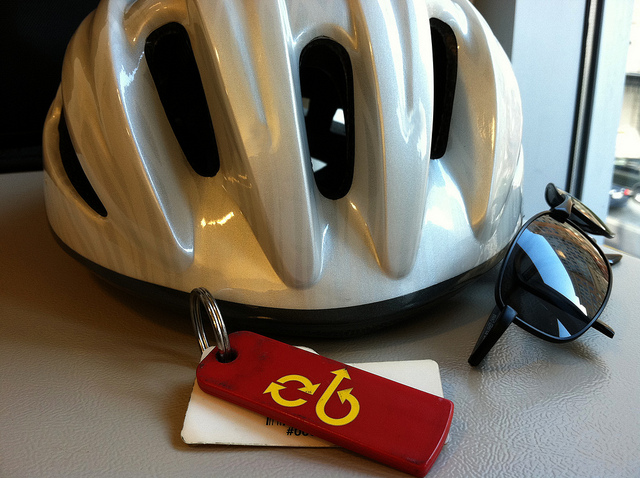 Photo by Mr. T in DC
It’s long been known that while plenty of people use Capital Bikeshare, not many of them use helmets. But now a Georgetown University study has quantified how few people actually use helmets when they jump on the system’s iconic red bikes.
Science Daily reports that research conducted by the university’s School of Nursing & Health Studies has found that seven of 10 commuters that use Capital Bikeshare go without a helmet, and only three of 10 commuters using their own bikes similarly go without protection for their heads:
The researchers concluded that out of the total 2,297 cyclists observed in the 30-day period (1,140 commuters and 887 casual riders), 10.1 percent of commuters and 12.4 percent of casual riders were Bikeshare users. Of those using Bikeshare, helmet use was significantly less compared to private cyclists. For example, 70.8 percent of commuters on private bicycles wore helmets, compared to only 33.1 percent of Bikeshare commuters.
This certainly isn’t the first study to verify what anyone can observe on a daily basis; in early May, another study pegged the number of Bikeshare users going without helmets at 80 percent.
The reasons for the low use of helmets on Bikeshare are pretty simple: opting for bike-sharing to get somewhere can be a spur-of-the-moment decision, and not everyone always carries a helmet with them. (Even though I always wear a helmet on my own bike, I’ve often gone without one on Bikeshare.) Additionally, Bikeshare users don’t often go long distances—average trips for annual members last 1.1 miles over 12 minutes, while casual users go 1.24 miles in 45 minutes. In over two million rides on Capital Bikeshare, there have only been a handful of accidents. Wearing a helmet in D.C. is only required for those under 16.
Still, bicycle accidents can happen at any time, and the D.C. Department of Transportation has started a number of initiatives to try and make helmets more available to Bikeshare users. In May, Capital Bikeshare started offering $16 helmets to renewing or new members in May; the Department of Transportation has also partnered with Kimpton Hotels to offer helmets to tourists who use the bike-sharing system.
Helmets aren’t a cure-all, of course—better bike infrastructure tends to make cycling significantly safer, after all. But the author of the study argues that given how unpredictable riding a bike can sometimes be, a helmet is the simplest way to stay safe. “Bikers can’t always control the environment around them, but they can control whether they wear a helmet. Helmets greatly reduce the risk of injury to both the brain and the face—even if a cyclist is hit by a car,” Georgetown professor John Kraemer told Science Daily.