Martin Austermuhle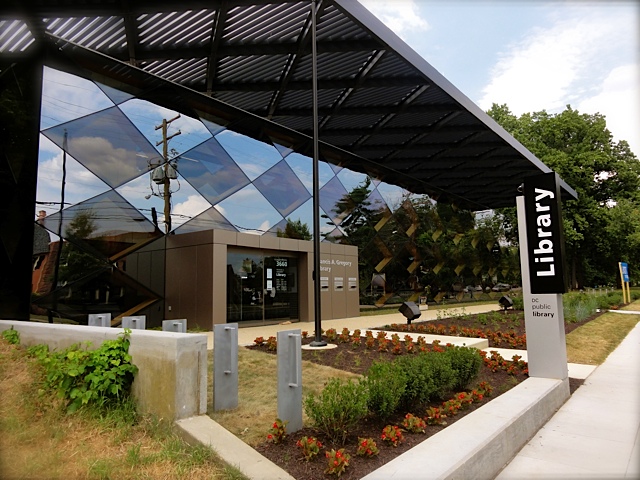
Situated along Alabama Avenue SE in the Hillcrest neighborhood, the black and silver building emerges suddenly from a wooded area. Though it’s blocky, it isn’t imposing; the patchwork of diamond-shaped windows covering the outer facade seem to draw in light.
It’s almost hard to believe that this is a D.C. government building—the Francis A. Gregory Neighborhood Library, to be exact. Opened to the public only two weeks ago, the Gregory Library is but another example in the daring attempt by D.C. Librarian Ginnie Cooper and teams of both world-renown and local architects to re-imagine what a public library can be—and then build to those specifications.
The Gregory Library was designed by Tanzanian-born London architect David Adjaye, who is also working on the National Museum of African American History and Culture, and cost $13 million to construct. He also worked on the William O. Lockridge/Bellevue Library, which opened on Atlantic Street SW in Ward 8’s Bellevue neighborhood a week earlier, a project no less impressive than its counterpart up the road.
While more simple from the outside—the $13.5 million library features wooden fins running vertically along the gray exterior—the inside is, as the City Paper’s Lydia DePillis accurately wrote, an “intricately composed Rubik’s Cube of glass and concrete.” You walk into a small lobby but are instantly drawn upwards; once upstairs, the building’s floors don’t feel like they’re traditionally stacked on top of each other, thanks to glassy openings that give the space an airy flow.
For Cooper, it didn’t take much to sell Adjaye—or other architects who are renovating or rebuilding the city’s neighborhood libraries—on the idea of working with her on the project. “Libraries are often a favorite assignment for architects, because they’re such wonderful public spaces used by so many people,” she said. “One architect I know calls them today’s cathedral—that secular, sacred space.”
Since 2007, Cooper has overseen $178 million worth of construction, both rebuilding libraries from scratch and renovating their interior spaces. The Watha T. Daniel Library in Shaw was the first to open in August 2010, and has been followed by new structures in Tenleytown, Anacostia and Benning. Libraries in Georgetown, Petworth, and Takoma Park, among others, saw substantial interior renovations. The work is ongoing—Mt. Pleasant’s long-running renovation is set to be done by September, while a team of architects was recently chosen for a new Woodridge Neighborhood Library.
The Woodridge project—the last that’s currently fully funded—shows how Cooper and library officials decide whether a building is worth saving or not. “We did a condition assessment of [the building], and out of a total of 100, the building scored 21,” she said of the old library, which dates back to 1958. “That tells us that it will be cheaper to get rid of that building than it is to try and change it.”
Despite being able to throw open the doors to a number of new and architecturally significant libraries, Cooper is all too aware that she still has to fight to make sure they are stocked with new books, adequately staffed and fully maintained. (The libraries are part of the capital budget, while books and staff are covered under the operating budget.) She has long complained that her materials budget has been slashed and that staff positions are constantly being cut, even as use has increased three-fold over six years. It was just last year that a last-minute budget maneuver saved Sunday hours at the Martin Luther King, Jr. Memorial Library—the only library in the system that keeps Sunday hours.
But it might just be those new buildings that save the libraries within them altogether. “I’m not sure we would have seen that increase”—the library budget as a whole will be 20 percent higher in the 2013 fiscal year than it is now—”had our buildings not attracted attention and greater use. People in the community are saying to their elected officials, ‘Libraries really matter. We go to the library often,'” she said.
Cooper is pushing for more funding for remaining libraries, including neighborhood branches in the Palisades, Cleveland Park, Lamond Riggs, and Southwest. She’ll also eventually have a much more contentious project on her hands—whether to scaled down the MLK Memorial Library and allow a second tenant to use part of the Ludwig Mies van der Rohe-designed building.
At the end of the day, though, Cooper isn’t only happy with how her new libraries are looking, but also how they’re functioning. “What happens inside the buildings is way more important than the buildings,” she said, citing the library staff, the new technology that’s available and the collections available to patrons. “That’s really what I am most proud of.”
The Francis A. Gregory Library is located at 3660 Alabama Avenue SE. The Bellevue Library is located at 115 Atlantic Street SW. All other locations and hours are here.